Long after he was murdered by the Nazis, Marc Bloch enters the Panthéon
Bloch, author of ‘Strange Defeat,’ is the first historian to receive this extraordinary honor
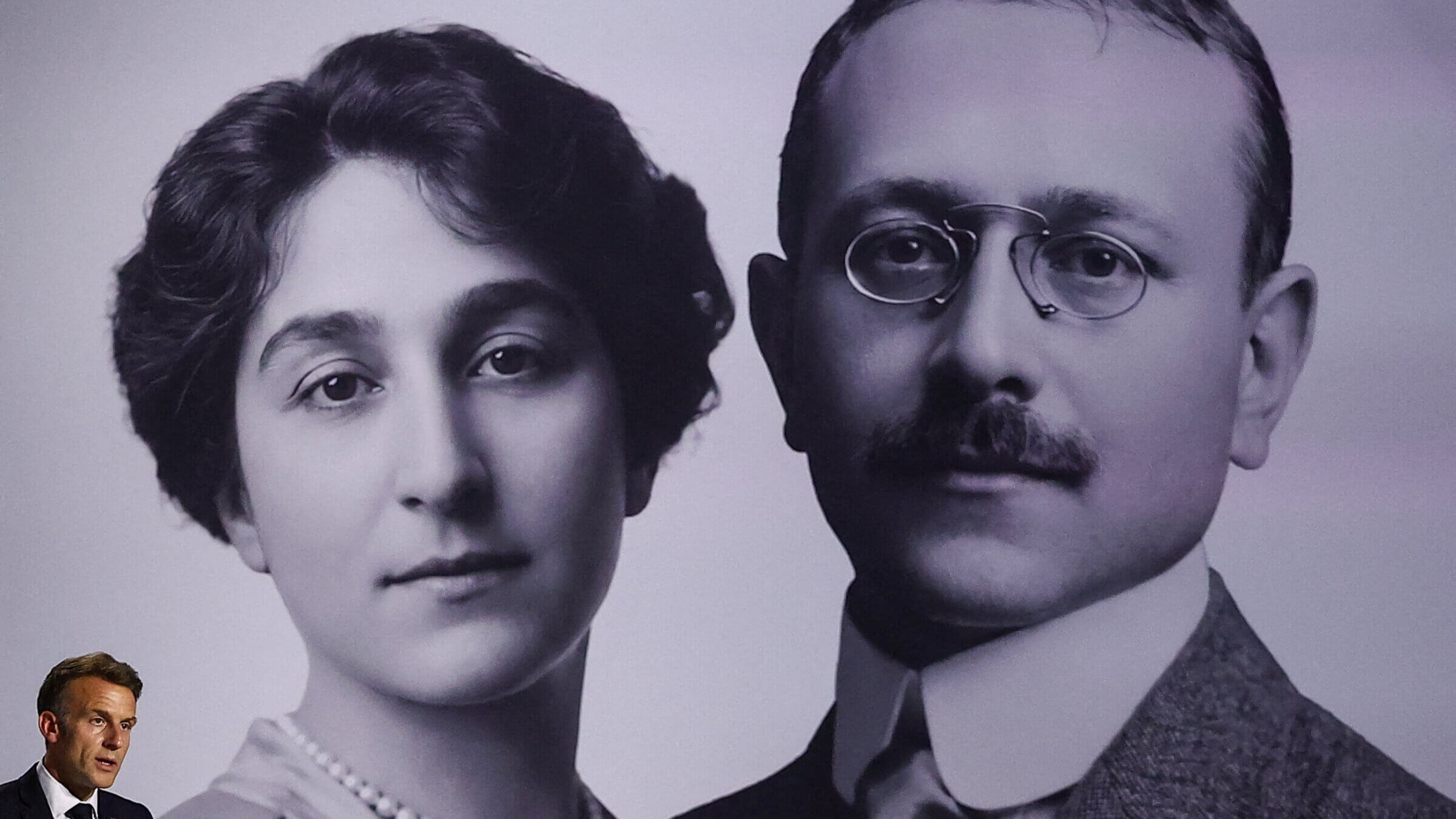
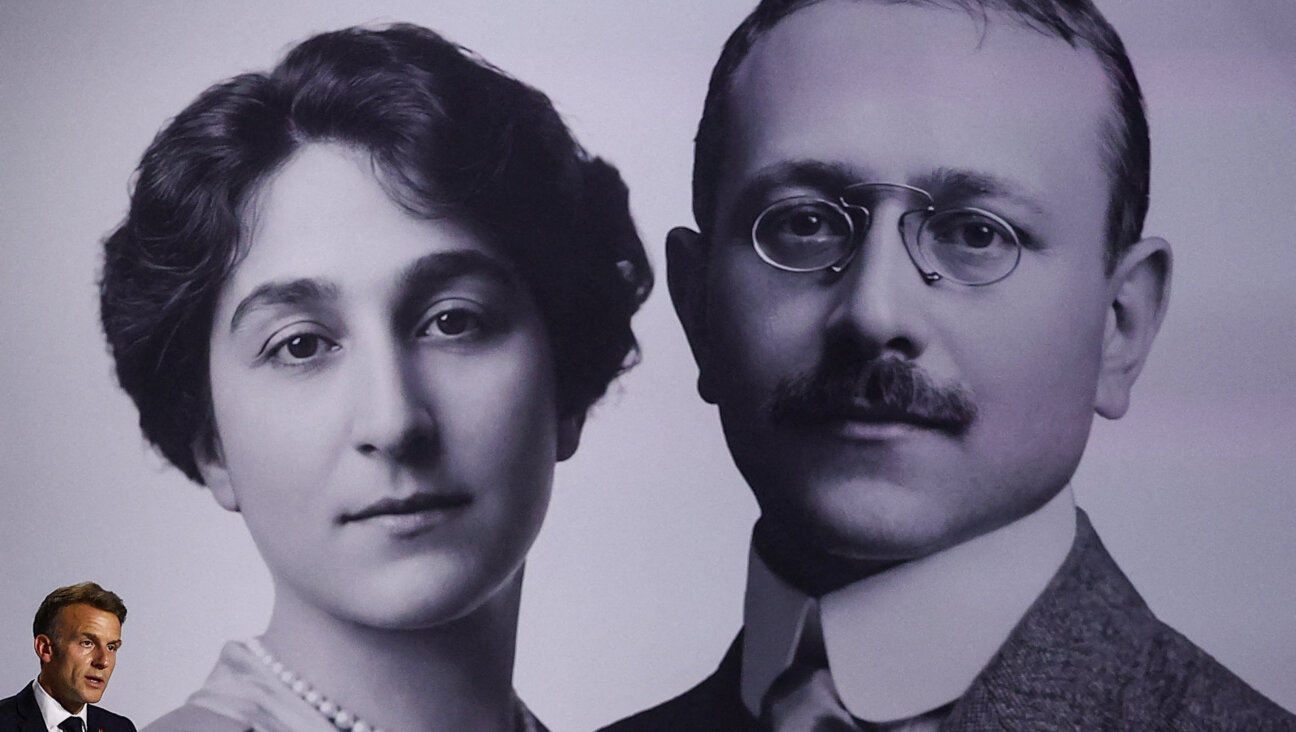
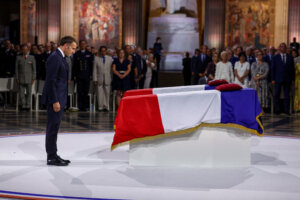
France’s President Emmanuel Macron delivers a speech during the Pantheon induction ceremony for the late historian and resistance fighter Marc Bloch and his wife Simonne Bloch in Paris on June 23, 2026. Photo by Alice Sacco / POOL / AFP v\ia Getty Images
Robert Zaretsky June 24, 2026
Yesterday, Paris experienced two record-breaking events. The first was that the city’s temperature hit 104 degrees Fahrenheit, forcing tourist sites like the Eiffel Tower and Louvre to close early. The second occurred at the Panthéon, which remained open to welcome the coffin of Marc Bloch, the first historian to enter this hallowed site.
The event was literally momentous. The massive 18th century structure, dedicated as the Church of Saint Geneviève, was rebranded by French revolutionaries in 1791 as the Panthéon, the monument for those “grands hommes” who devoted their lives to the French Republic. But in a time of relentless racist and antisemitic rhetoric, it was symbolically momentous, as well.
Bloch was born into a French Jewish family that chose to leave Strasbourg for Paris when Germany annexed their native Alsace in 1871. An adolescent during the Dreyfus Affair, Bloch interrupted a promising academic career in 1914, volunteering to serve in World War I. He spent four years in the infantry, then served as an intelligence officer; by war’s end, he had earned two wounds as well as four citations for bravery along with France’s most prestigious medal, the Croix de guerre.
Between the two world wars, Bloch and his friend Lucien Febvre founded Annales d’histoire et économique, a history journal that revolutionized the practice of history, turning away from the focus on great figures and events and towards the mundane and material lives of peoples. Bloch developed the influential, though elusive notion of mentalités: the term he gave to the intellectual and emotional structures that, no less certainly than was the case with material factors, shaped how past generations experienced their world. This theme informed his early book, Les Rois thaumaturges, or The Royal Touch, which examined the relationship between the myth of the king’s healing touch and the powers he was thought to embody.
The persistence of this myth was revealed in the wake of Nazi Germany’s defeat of France in 1940 and the nearly divine prestige bestowed on the nation’s new leader Philippe Pétain. The elderly hero of Verdun led a collaborationist regime whose first order of business was to pass a salvo of antisemitic legislation in late 1940 that stripped French Jews of their legal and civil rights. These laws forced Bloch out of his teaching position at the Sorbonne, despite the fact that, though 54 years old, hobbled by arthritis and father of six children, he insisted on rejoining the army in 1938.
Forced to abandon the family apartment in Paris, along with his library of 5,000 books, Bloch and his wife Simonne settled in the southern “Free Zone.” Stripped of his post, he nevertheless continued to practice the metier of historian. But he turned his critical gaze to the present rather than the past, holding fast to his claim—one as relevant now as then — that “when a widely held opinion is glaringly at odds with the truth, we are bound in honesty, I think, to attack it.”
The result was L’Étrange Défaite, or Strange Defeat, a searing account of how France’s military and political leaders managed to lose this war in a matter of weeks. Written in what Bloch described as a “white heat of rage,” he applied the same approach to these events as he did to those in medieval France, one “concerned with the task of seeking the solid and concrete behind the empty and abstract.” The principal reason for the debacle, he wrote, was that while the German strategists were fighting the present war, their French counterparts were fighting the last one. With poetic insight, Bloch observed that “thoughts of the last war clung to them because they were the thoughts of their youth. Those days long past had all the brilliance of things seen.”
By 1942, Bloch had come to see that, as a French patriot, he was duty-bound, despite his age, to join the Resistance where he assumed code names ranging from the majestic Narbonne to the mundane Monsieur Blanchard. His good fortune lasted nearly two years when, in the late spring of 1944, he was captured in Lyon, then imprisoned and tortured in its notorious prison Mount Luc. On June 16, he was taken in a truck with two dozen other résistants to an empty field outside the city and summarily shot to death. His buried remains were discovered shortly after the war, as was the manuscript for Strange Defeat.
Inevitably and rightfully, Strange Defeat provided much of the script for the evening ceremony at the Panthéon, which somehow managed to be both severe and stylish. Actors read passages from the book while military guards carried Marc and his wife Simonne’s empty caskets . (Bloch’s family did not want his remains to be removed from the cemetery where he is buried, while Simonne’s remains were never found.) Tellingly, when the caskets were set down inside the vast hall of the monument, an army officer recited, according to Bloch’s wishes, the several military citations for bravery he had received.
In his address, given while standing in front of a column which carried Bloch’s epitaph— dilexit veritatem (“He loved the truth”) — President Emmanuel Macron underscored the tragic relevance of the historian’s life to our own era. Referring to recent efforts made by figures on the extreme rightwing to reclaim Bloch as one of their own, Macron warned against “those who declare themselves more French than you…and yet are always the first to sell out France to hostile powers.” (Among the conditions Bloch’s descendants insisted upon was that representatives from the extreme-rightwing National Rally party could not attend the ceremony.)
But the words written by Bloch, in the introduction to Strange Defeat, are the most powerful evocation of who he was and what he represents. “By birth I am a Jew, though not by religion, for I have never professed any creed, whether Hebrew or Christian. I feel neither pride nor shame in my origins. I am, I hope, a sufficiently good historian to know that racial qualities are a myth, and that the whole notion of Race is an absurdity.” “I try never to stress my heredity save when I find myself in the presence of an antisemite.” Bloch concludes, simply and beautifully, “I was born in France. I have drunk of the waters of her culture. I have made her past my own. I breathe freely only in her climate, and I have done my best, with others, to defend her interests.”
In the other book he wrote during this period, The Historian’s Craft, Bloch quotes one of his sons who, when still a child, asked him what historians do. (The good historian, Bloch writes, “is like the giant of the fairy tale. He knows that wherever he catches the scent of human flesh, there his quarry lies.”)
As Bloch would have wished, he will always stand as an exemplar of what, in fact, historians do. And in the life he lived and values he died for, Marc Bloch will always stand as a reminder of what true patriots do.

Did you know that only 2% of Forward readers donate to support our nonprofit newsroom? That 2% make it possible for millions to read the Forward without a paywall or subscription — removing any barriers to the full and fair Jewish story.
But while the Forward is free to read, it isn’t free to produce. Big stories — like deep dives into the antisemitism data, political scoops or reporting trips to college campuses — take months of research and fact-checking. All while we keep you informed of what you need to know each day.
— Rachel Fishman Feddersen, Forward Publisher & CEO
Support our mission to tell the Jewish story fully and fairly.