I helped sell Obama’s Iran deal. Its critics owe us all an explanation.
Diplomacy succeeded where war failed, writes a longtime Democratic strategist.
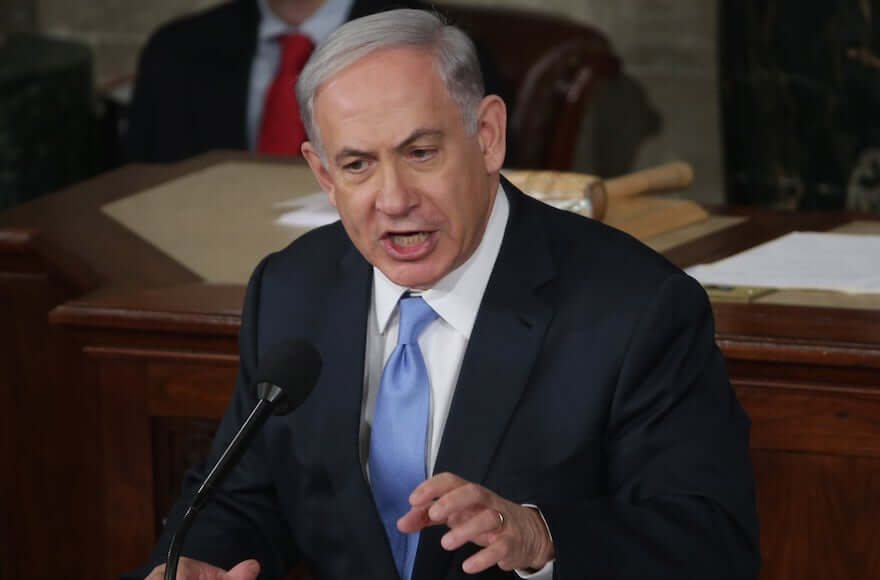
Israel Prime Minister Benjamin Netanyahu urges lawmakers to reject the Iran nuclear deal during a joint meeting of Congress in the House chamber at the U.S. Capitol, March 3, 2015. Photo by Alex Wong/Getty Images
(JTA) — Neoconservatives have some ‘splainin’ to do, as Lucy’s television husband, Ricky Ricardo used to say.
The war on Iran has turned out to be a debacle of historic proportions.
After months of military escalation, tens of billions of dollars expended, critical weapons stockpiles depleted, and a region once again thrown into crisis, the United States now finds itself humiliated. The memorandum of understanding reportedly concluded last week does not represent the culmination of victory. It represents the codification of failure.
Many understood that nuclear disarmament and regime change in Iran could not be achieved through force. As I wrote in these pages a few months ago, more than a decade ago, we reached a solution designed to avert precisely the calamity that has unfolded. It was the Joint Comprehensive Plan of Action, or, in layman’s parlance, the Iran nuclear deal.
As a certified denizen of the Swamp — I served in the Clinton White House’s communications shop and later founded a Washington, DC strategic communications firm — I was at the forefront of selling the Obama administration’s agreement to the American public.
I remember those days well — and I do not miss them.
JCPOA defenders, particularly those of us in the Jewish community, were attacked in the ugliest terms imaginable. We were called appeasers, sellouts, self-hating Jews and worse. Prime Minister Benjamin Netanyahu traveled to Washington and outrageously warned Congress that the deal might pave the way to a second Holocaust.
JCPOA advocates never argued that the agreement signed in Vienna was perfect.
Its critics pointed to the sunset provisions. They objected that the deal did not address every malign activity undertaken by the Islamic Republic throughout the Middle East. These were legitimate concerns. Politics, however, is the art of the possible; geopolitics doubly so.
That agreement nevertheless achieved something extraordinary. Iran shipped out the overwhelming majority of its enriched uranium. International inspectors gained unprecedented access. A mechanism existed to monitor and constrain Tehran’s nuclear ambitions. The prospect of military confrontation receded.
The regime’s hardliners hated the agreement. The Revolutionary Guard fought it tooth and nail. Integration into the global economy threatened entrenched interests within the Islamic Republic. A growing middle class and increasing international engagement carried risks for those whose power depended on its isolation and perpetual confrontation.
Unfortunately, hardliners were not confined to Tehran.
The maximal-pressure advocates in Washington ultimately prevailed. During the first Trump administration, the United States withdrew from the agreement. Tore it up, as the president bragged. Despite the best efforts of our European partners, who had also signed the accord, the framework collapsed beneath the weight of renewed sanctions and diplomatic abandonment.
What followed, we were promised, was supposed to vindicate the critics.
Instead, it vindicated the critics’ critics.
The maximal-pressure advocates have spent years moving the goalposts. First, we were told, sanctions would bring the regime to its knees. They did not. Then economic isolation would force Tehran to abandon its nuclear ambitions. It did not. Then military pressure would succeed where sanctions had failed. It did not. Then leadership decapitation, covert action, and military escalation would produce regime change. They did not.
Each promised but failed breakthrough gave way to another promised breakthrough.
And now comes the final indignity: the so-called memorandum of understanding.
After years of threats, sanctions, covert action, military escalation and open warfare, the United States has agreed to resume negotiations with the very regime it set out to break. The Islamic Republic remains in power. Its leadership and political system remain intact.
Nor is that all.
The agreement reportedly provides waivers for Iranian oil exports and opens the door to sanctions relief and renewed access to many billions in frozen assets. It establishes yet another negotiating process on the nuclear question rather than resolving it. It leaves unresolved many of the issues that maximal-pressure advocates once described as non-negotiable, including Iran’s missile capabilities, its regional proxy network, or the many canisters of near-bomb-grade enriched uranium — what the president calls nuclear dust.
Even the future status of the Strait of Hormuz, the critical passage for oil open before the war, and now established as a lever for Iran to exert pressure, appears destined for further negotiation rather than decisive resolution.
The advocates of maximal pressure promised a better deal than the JCPOA. They promised that Iran would be forced to make concessions unavailable through diplomacy.
Instead, after years of confrontation, Washington finds itself lifting pressure, restoring economic benefits, negotiating with a surviving regime and postponing the most difficult questions to future talks.
Hell, in Paris last week, Trump actually made the case for Iran to retain, build or buy missiles and maintain at least some nuclear power.
So, what, precisely, was achieved?
The tragedy is not merely that the war failed to accomplish its objectives. It is that we already possessed a framework that constrained Iran’s nuclear program without requiring military confrontation. The Joint Comprehensive Plan of Action was imperfect, to be sure. Its supporters never claimed otherwise. But it reduced risk, established verification mechanisms and avoided precisely the cycle of escalation that has consumed the past decade.
Its opponents insisted there was a better way.
History has now rendered its verdict.
The United States ultimately abandoned a functioning diplomatic framework in pursuit of fantasies that proved unattainable. Having exhausted sanctions, threats and military force, it has arrived back at the negotiating table poorer, weaker and in possession of less leverage than before.
I’m afraid I told you so.
The defenders of the JCPOA were mocked as appeasers. Yet the memorandum of understanding now before us amounts to an admission of the very proposition we advanced all along: However distasteful it may be, the Islamic Republic is not a problem that can be bombed or sanctioned out of existence.
Diplomacy could have spared us the war.
This article originally appeared on JTA.org.

Did you know that only 2% of Forward readers donate to support our nonprofit newsroom? That 2% make it possible for millions to read the Forward without a paywall or subscription — removing any barriers to the full and fair Jewish story.
But while the Forward is free to read, it isn’t free to produce. Big stories — like deep dives into the antisemitism data, political scoops or reporting trips to college campuses — take months of research and fact-checking. All while we keep you informed of what you need to know each day.
— Rachel Fishman Feddersen, Forward Publisher & CEO
Support our mission to tell the Jewish story fully and fairly.