Why Israel’s soccer team competes in Europe rather than Asia
The launch this month of the tournament hosted by the United States has renewed attention to Israel’s absence from the World Cup
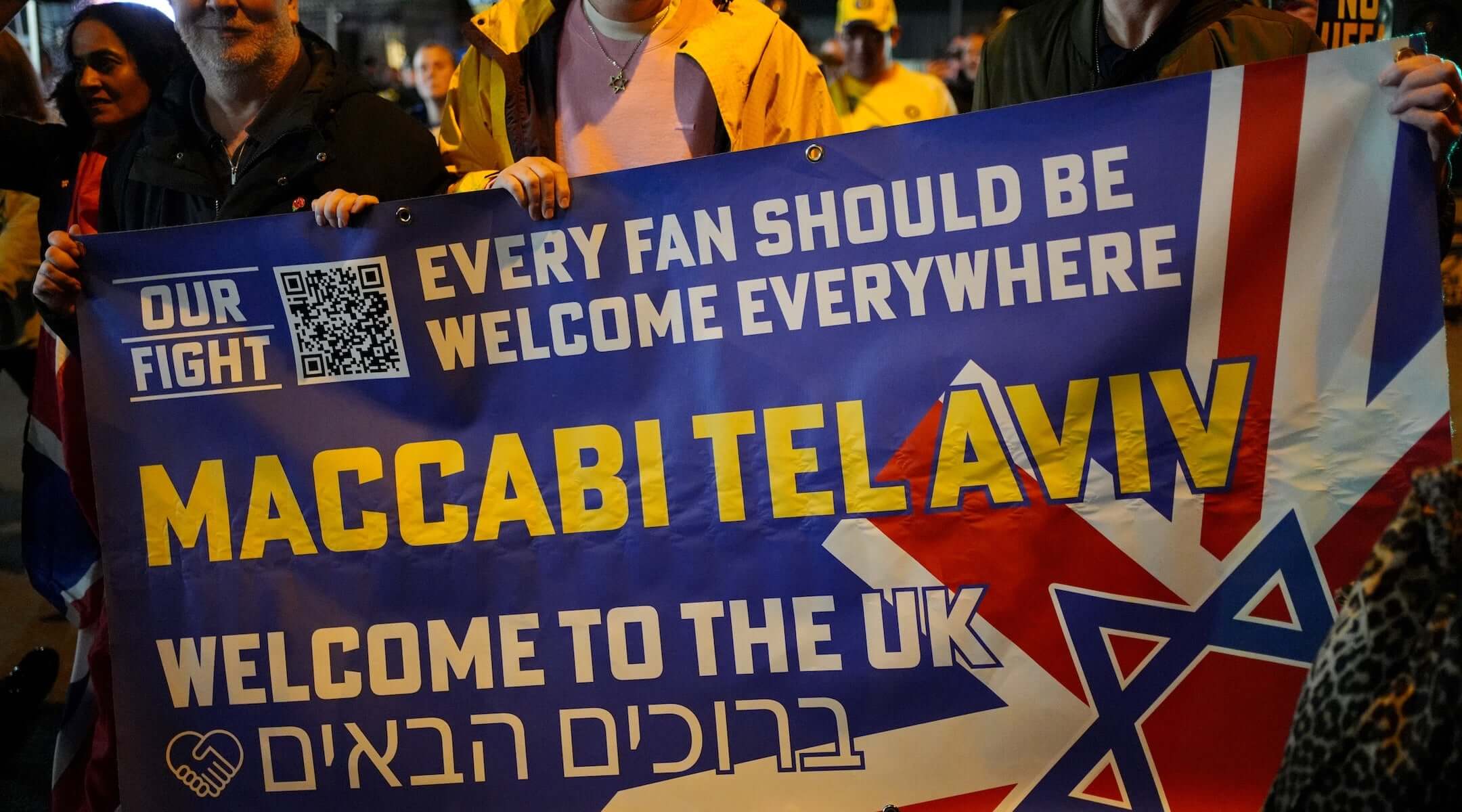
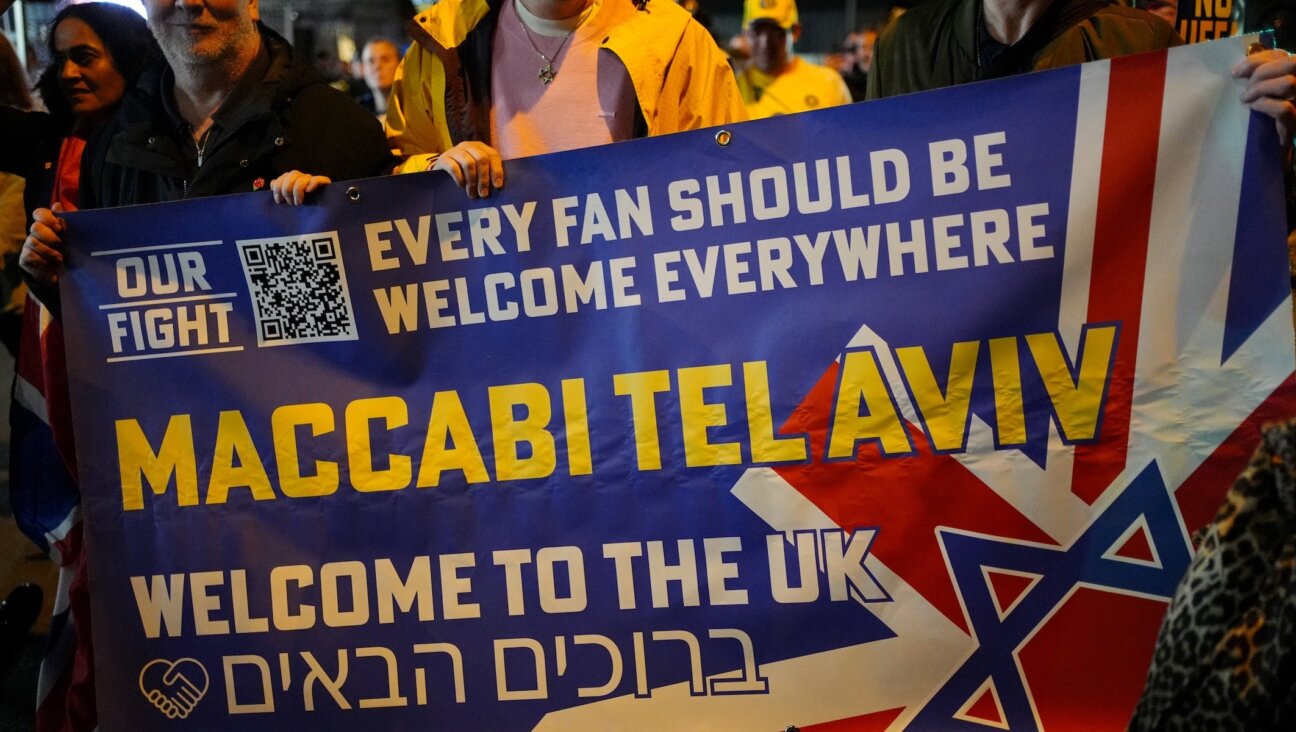
A banner is held by pro-Israel fans outside Villa Park, home of the U.K. team Aston Villa, before its UEFA Europa League match against Israel, Nov. 6, 2025. Photo by Jacob King/PA Images via Getty Images
(JTA) — TEL AVIV — More than five decades after Israel’s only World Cup appearance, the Israel Football Association says it has no intention of trying to leave Europe for the Asian regional qualifying system that once took the country to the tournament, before Arab-led boycotts helped force it out.
The launch this month of the tournament hosted by the United States has renewed attention to Israel’s absence from the World Cup. Despite a thriving local soccer scene and success in competition abroad, the only time the country appeared in the tournament was in Mexico in 1970.
That’s because Israel seeks to qualify through the Union of European Football Associations, whose ranks are so strong that even a solid campaign can become a long shot for the World Cup. Even titans like four-time World Cup winner Italy failed to qualify this year.
Israel is the only non-European country trying to reach the tournament through UEFA, while most of its neighbors seek places through the Asian Football Confederation. Israel was ousted from the Asian soccer body in 1974. It bounced around the qualifying zones for a few years — it played in the Oceania qualifiers ahead of the 1986 and 1990 World Cups — before settling in the European grouping in 1991.
Shlomi Barzel, head of communications for the Israel Football Association, said a return to Asia is not on the table, both because Israel does not want to leave European soccer, where it has built a standing, and because he does not believe the Asian confederation would accept it back.
The only upside to such a move, he joked, would be if Israel’s opponents boycotted matches against it: “Israel would automatically qualify.”
A boycott of Israel did affect the team’s path to the 1970 World Cup. North Korea was ejected from the Asian qualifying tournament after refusing to play in Israel. As a result, Israel advanced to the final round after winning only two games against New Zealand. In the finals, Israel faced an Australian team already exhausted after fending off South Korea, Japan and Rhodesia (itself in the Asian tournament after being banned in Africa over its white governing regime).
In the tournament in Mexico, Israel’s all-amateur team defied expectations, losing 0-2 to Uruguay but notching draws against Sweden and Italy before being eliminated.
Four years later, Israel was effectively ejected from the Asian Football Confederation following a resolution introduced by Kuwait that passed 17 to 13, with six abstentions. The vote came a day before a high-profile Israel-Iran game in Tehran that Iran won 1-0 on an Israeli own goal.
Today, Barzel rejects the premise that rejoining the AFC would guarantee Israel a place in the World Cup going forward.
“It would be a little patronizing and arrogant for me to say that,” he said, adding that he was not sure Israel would beat teams such as Jordan or Qatar.
Barzel also cited Israel’s place inside UEFA’s institutions as a benefit for sticking with the current arrangement. Current IFA chairman Moshe “Shino” Zuaretz was elected to UEFA’s Executive Committee in April 2025, despite the war in Gaza and growing calls to sanction Israeli soccer, while former IFA chairman Avi Luzon previously served in a senior role on the same body.
Institutional backing has extended beyond Europe, Barzel said, pointing to the 2022 World Cup in Qatar, where Israeli fans were allowed to attend despite the absence of diplomatic ties. He also cited the global soccer body FIFA’s decision to move the 2023 under-20s World Cup from Indonesia to Argentina after Indonesia objected to hosting Israel’s team. Israel went on to finish third.
Still, Israel’s formal place in international soccer has done little to shield its teams and supporters from hostility. Maccabi Tel Aviv fans were attacked in Amsterdam after a match against Ajax in November 2024, and the club’s supporters were later barred from attending an Aston Villa match in a decision that became a political and policing scandal in Britain.
Despite its absence from the World Cup, Israel has remained a political flashpoint around the event, which U.S. President Donald Trump vowed to make “an unprecedented success.” Speculation that Trump’s hopes for a World Cup untainted by war spurred his push for a ceasefire with Iran prompted a denial from the top White House official dealing with the World Cup.
That didn’t keep the conflict from seeping into the events.
In Boston on June 19, kilt-clad Scotland fans waiting in blocks-long lines to board shuttles to the stadium where their team would face Morocco accepted Palestinian flags from activists lining the route.
Hours before Canada’s opening match on June 12, activists draped a “Kick Israel out of FIFA” banner over a World Cup logo near one of Toronto’s busiest highways.
Days later, a viral video from Iran’s match against New Zealand in Los Angeles showed security guards confiscating an Israeli flag from a fan — who was told they were acting on orders from their superiors — while other spectators behind him held Palestinian flags.
Trump’s special envoy for global partnerships, Paolo Zampolli, told Israel’s Kan public broadcaster he was “very disturbed” by the incident in Los Angeles, adding that there was “no place for antisemitism or double standards in sports.” Zampolli, who had previously urged FIFA to replace Iran with Italy at the World Cup, called on the soccer body to treat the episode seriously.
Barzel drew a distinction between the flag incident, which he said was likely a poor decision by stadium staff, and any official FIFA policy against Israel, noting that Israel’s flag is displayed alongside those of other member associations at official FIFA and UEFA events. FIFA generally discourages flags of teams not playing in a given match, he said, and added that Israeli teams have grown used to seeing Palestinian flags in soccer stadiums.
“Personally, I don’t get worked up by flags — they don’t scare me,” he said.
Yoav Borowitz, head of sports at Kan, said FIFA appeared wary of flags being used as protest symbols, pointing to the Iranian lion-and-sun flag, the country’s flag before the 1979 revolution installed the current theocratic regime, which some fans waved at the same match. FIFA’s failure to clarify whether Israeli flags were allowed in stadiums in the days after the incident, he said, “shows where Israel stands at the moment.”
“There were official FIFA stewards there,” he said, “and if the fan was effectively forced to remove the flag, then I would have expected FIFA to have issued a response by now and said that Israeli flags are allowed into stadiums, just as Palestinian flags are allowed into stadiums, just as the flag of any country is allowed into stadiums.”
Any limits placed on Israel’s soccer association have been imposed solely on security grounds, Barzel said, though in October UEFA came close to holding an emergency vote on whether to suspend Israel over the war in Gaza.
At FIFA’s congress in Vancouver in April, when Palestinian Football Association president Jibril Rajoub refused to shake hands with Israel FA Vice President Basim Sheikh Suliman despite repeated appeals from FIFA President Gianni Infantino, who called on the sides to “give hope to the children.”
Despite such gestures, Israel continues to compete as usual — almost. It has been unable to host matches at home for close to three years because of war and has had to play its home World Cup qualifiers in neutral third countries. It is hosting several contests this fall in Moldova, which last year gained an Israeli embassy, and direct El Al routes, for the first time. (Russia, by contrast, has had its national teams and clubs suspended from FIFA and UEFA competitions since its invasion of Ukraine.)
Despite the controversies, FIFA has kept pressing ahead with its vision of soccer as “a force for unity, peace and hope,” including reported discussions about opening a new under-15’s tournament in the United States in September with a symbolic match between Israeli and Palestinian youth teams.
This article originally appeared on JTA.org.
Did you know that only 2% of Forward readers donate to support our nonprofit newsroom? That 2% make it possible for millions to read the Forward without a paywall or subscription — removing any barriers to the full and fair Jewish story.
But while the Forward is free to read, it isn’t free to produce. Big stories — like deep dives into the antisemitism data, political scoops or reporting trips to college campuses — take months of research and fact-checking. All while we keep you informed of what you need to know each day.
— Rachel Fishman Feddersen, Forward Publisher & CEO
Support our mission to tell the Jewish story fully and fairly.