Rep. Jared Moskowitz becomes latest Jewish lawmaker to reveal antisemitic threats
The Florida Democrat urged Americans not to tolerate antisemitism as he played threatening voicemails left for his office on CNN
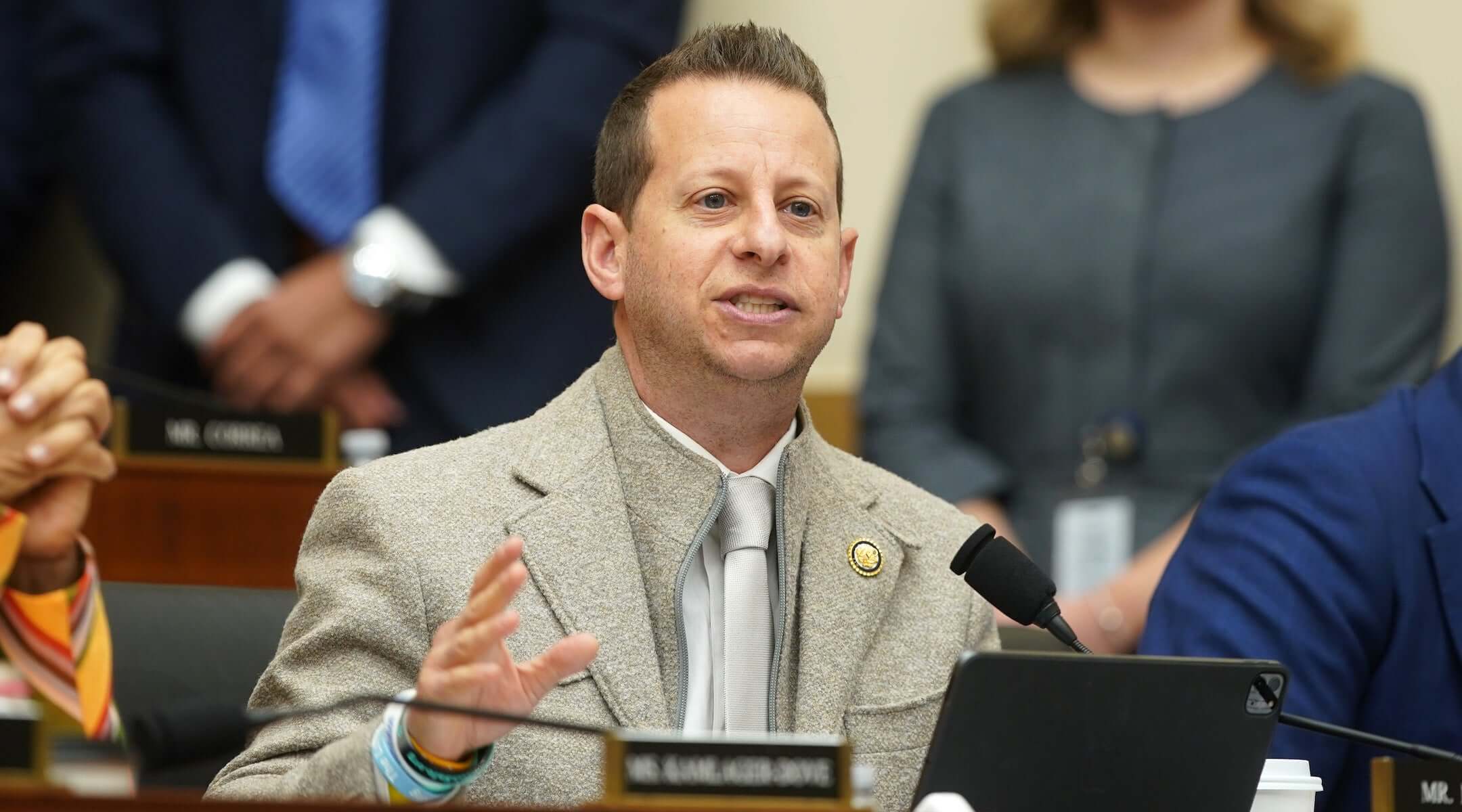
Rep. Jared Moskowitz in the Rayburn House Office Building on Capitol Hill on January 22, 2026 in Washington, DC. (Al Drago/Getty Images)
(JTA) — The messages that Rep. Jared Moskowitz said he received at his office were filled with obscenities, calls to “kill Jews” and warnings that the Florida Democrat would be “going down.”
Moskowitz played the voicemails during an interview with CNN’s Sara Sidner on Friday as he described a sharp rise in antisemitic hostility against Jewish lawmakers since Oct. 7, a trend he said reflected a broader normalization of antisemitic rhetoric in American public life.
“We seem, Sara, to have passed a Rubicon now with these antisemitic threats,” Moskowitz said. “It used to be once in a while you’d see a swastika on a building, once in a while, you know, someone would say something online. Now it’s every day, all the time, on podcasts, online, in the media, in the halls of Congress, and they’re trying to get Jews.”
CNN played multiple messages that illustrated Moskowitz’s point, with Sidner warning viewers that what they would hear was “deeply disturbing.”
Moskowitz, who is Jewish, said the spate of threats had caused him to need a police officer stationed outside his home 24 hours a day, since a man was sentenced to prison for plotting to kill him in November 2024.
“The U.S. government needs to kill Jews, you kill these f–cking nasty Jews, kill every single f-cking Zionist scumbag,” a caller said in one of the voicemails. “Zionism is treason to ‘we the people’ in our U.S. Constitution. Kill Israel.”
Another caller left this message: “Hey you Zionist Jew f-cking pig. How about no more money for Israel? Funding Israel, stealing more of our money for Israel. F-ck Israel, let them f-cking burn to the ground. You’re going down too, sir.”
Moskowitz is far from the only Jewish lawmaker to report a rapidly increasing number of antisemitic threats and harassment in recent weeks. The shift comes as both parties grapple with internal tensions about how to handle antisemitism within their ranks, and as anger about Israel and the Iran war funnels more attention to U.S. Jews. It also comes amid rising political violence in the United States.
“It’s no longer a Republican and a Democrat [issue],” Rep. Max Miller, a Jewish Ohio Republican, told Axios this week. “Both ends of our parties are wackadoos who hate Jews.”
Miller received a message warning that “antisemitism is on the rise because you guys think you own the f-cking world,” according to Axios, which said the caller added, “You guys are going to be shot dead every f-cking day.”
Among the messages highlighted by a recent Axios report on the phenomenon was a letter sent to New York Democratic Rep. Jerry Nadler, in which one constituent wrote that “Hitler was spot-on, 100% right about the filth that you Jew-bastards, you kikes are.” In a voicemail left for Ohio Democratic Rep. Greg Landsman’s office, one caller said, “I don’t like Jewish people, and the congressman should just go die.”
The lawmakers say the phenomenon is new. “Across the board, we have never seen anything like this in my lifetime in public office,” Jewish California Rep. Brad Sherman told the New York Times last month. “It’s like you turned the volume up from two to 10.”
The volley of antisemitic threats has also spilled into the real world, with Miller reporting last year that a man had attempted to run him off the road while calling him a “dirty Jew.” Last year, a man set fire to the residence of Jewish Pennsylvania Gov. Josh Shapiro hours after his family hosted a Passover seder there.
“We need good people to not be quiet,” Moskowitz said when Sidner asked him what message should be sent in response to the rise in antisemitic rhetoric targeting lawmakers.
“There are people out there, they may disagree with U.S. policy, they may not like the leader of a country, but they shouldn’t be allowing antisemites into their movement,” Moskowitz said. “They should not be embracing this sort of behavior, because they’re trying to win some sort of political point. It should be obvious.”
Moskowitz’s comments echoed a growing debate over the normalization of antisemitic rhetoric within American politics on both the left and the right, with Jewish lawmakers and watchdog groups warning that language once relegated to the fringes has increasingly become mainstream.
Last week, Texas U.S. Senate candidate James Talarico told the Jewish Telegraphic Agency that he would not campaign with Maureen Galindo, a Democratic congressional candidate in Texas who says she wants to open a “prison for American Zionists” among other incendiary remarks. Talarico said in a statement that “antisemitic rhetoric has no place in our politics.”
On Wednesday, Sen. Rand Paul’s son William apologized after he made repeated antisemitic comments directed at New York Republican Rep. Mike Lawler, who is not Jewish, including calling Jews “anti-American.”
Moskowitz told CNN that, while people may criticize the Israeli government and Israeli Prime Minister Benjamin Netanyahu, the voicemails left at his office illustrated “how quickly, you know, they go from Zionism to Jews, Israel to Jews.”
“Listen, if you don’t like Netanyahu, great, go out and criticize him all day long,” Moskowitz said. “But don’t let people into your tent that you know are threatening to kill my family or my kids.”
I’m personally matching all gifts to the Forward, up to $36,000. Can I match your gift now?

Hello, fellow Forward reader! I’m Joel Brown, a Forward reader and supporter for more than 15 years, and currently the chair of the board of directors.
I’m an avid Forward reader because it ticks so many of my essential boxes: excellent journalism, Jewish focus and diverse viewpoints. In today’s political climate, what I most appreciate is the Forward’s independence — made possible by the generosity of its membership.
The Forward is committed to bringing you unbiased, nuanced Jewish news. From my position as board chair, I see an exciting future as we expand our position as the definitive independent voice of contemporary American Judaism.
— Joel Brown, Forward board chair
Support our mission to tell the Jewish story fully and fairly.