I run The Jewish Theological Seminary. Here’s the real story about President Isaac Herzog speaking at our commencement
JTS is proud to be a home for meaningful, respectful debate, including about Israel
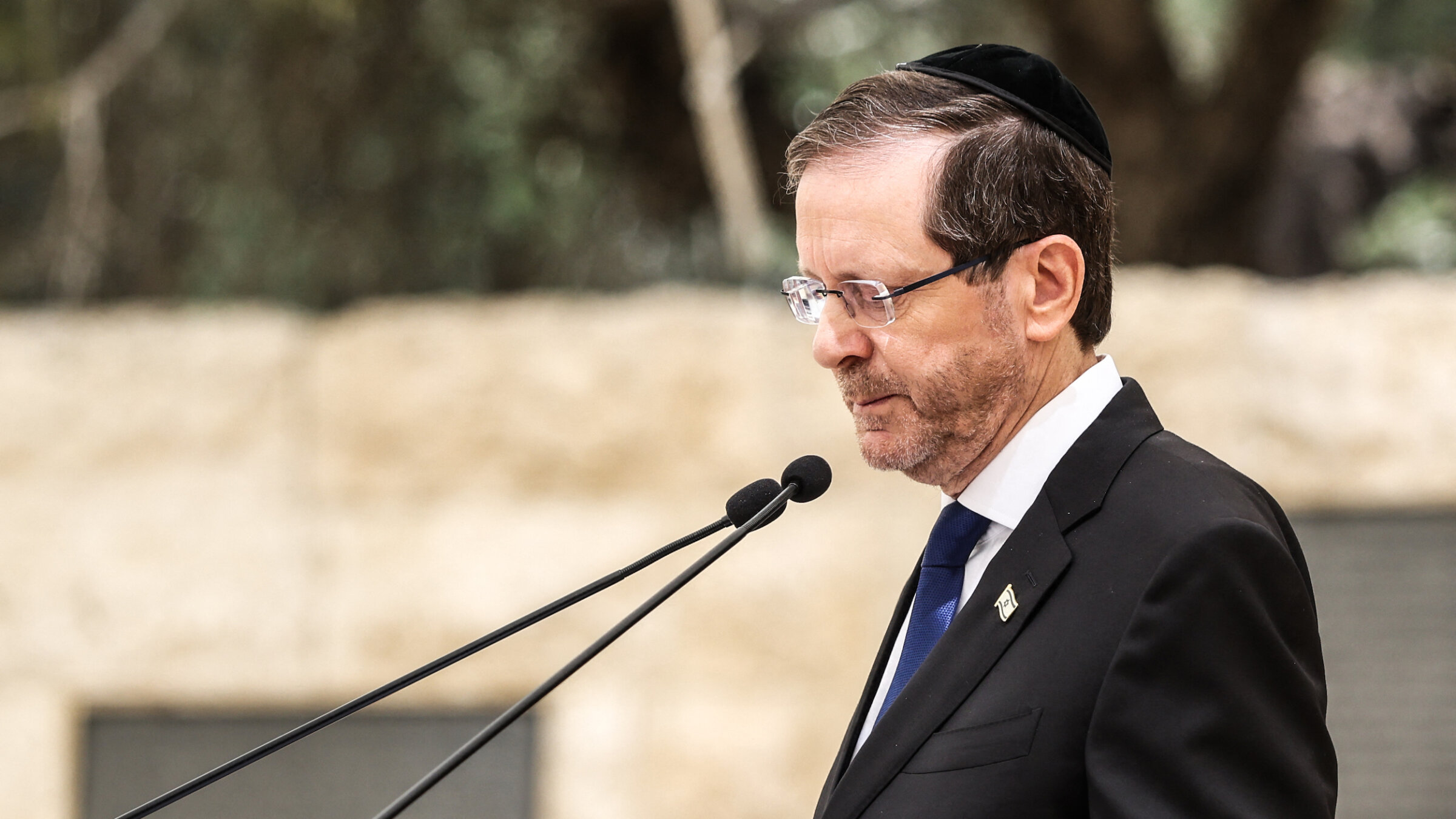
Israeli President Isaac Herzog addresses a ceremony commemorating Israel’s Remembrance Day for fallen soldiers, or Yom HaZikaron, at the Military Cemetery on Mount Herzl in Jerusalem on April 21. Photo by Ilia Yefimovich / POOL / AFP / Getty Images
Shuly Rubin Schwartz May 14, 2026
Because there have been many public misstatements and mischaracterizations, I believe it is incumbent on me as chancellor of The Jewish Theological Seminary to clarify the facts about our invitation to Israeli President Isaac Herzog to serve as our commencement speaker this year.
Herzog’s leadership and public service reflect the core principles and values that underlie JTS’s enduring commitment to the state of Israel, and to a vision of Zionism that is central to our institution. His life and work, including his advocacy for strengthening Israel’s democracy and his defense of a two-state solution, align with JTS’s mission.
Our seminary’s leadership felt that awarding him an honorary degree, and having our students hear him speak directly to them, would be both a privilege and fully consistent with our love for Israel and the people of Israel. (Herzog can no longer attend the commencement in person, but will be delivering his commencement address virtually, and will receive his honorary degree in person at some date in the future.)
I am proud that JTS serves as a forum for respectful disagreement, which our choice of Herzog as speaker prompted. The Jewish world encompasses a wide range of perspectives, particularly regarding the political situation in Israel. That diversity of thought exists both within our classrooms and beyond. I welcome the voices of those who may disagree.
What is regrettable is the extent to which respectful disagreement has been drowned out by a public media spectacle.
After our initial announcement of Herzog as commencement speaker, six seniors in JTS’s undergraduate dual-degree programs with Barnard College and Columbia University wrote a letter expressing their opposition to our decision.
Those students’ concerns focused on the policies of the Israeli government in its recent wars, and in no way challenged the legitimacy of the state of Israel. They also asked some additional students and alumni of other JTS schools to sign on in support of their objections. This list of supporters included four rabbinical students, three of whom are first-year students.
As too often happens in such circumstances, the letter was shared more widely, without the students’ prior knowledge or consent. This was dismaying to several of the students, who had intended to hand deliver it to me to spark conversation. What should have been a private exchange between students and their administrators escalated in alarming ways.
The authors were publicly criticized, misidentified as rabbinical students, and labeled “anti-Zionist,” including by some parties who purport to care deeply about JTS. Calls were made for their expulsion, and unfounded accusations were directed at their characters.
Few individuals from the community called me for clarification about what was actually transpiring before rushing to judgment publicly. Absent was the principle of “dan l’khaf zekhut” — that we should assume the best unless proven otherwise. I was deeply saddened by the outcry.
Here’s what actually happened: After I was made aware of this letter, I invited the undergraduates who authored it to meet with me for an extended and honest conversation. What they said in that conversation made it clear that anyone who labels them as anti-Zionist is misguided.
Rather, they are thoughtful individuals whose consciences are deeply troubled by many of the actions of Israel’s current government. Our conversation gave us an opportunity to discuss the role of dissent within a committed community, the importance of understanding the totality of a public figure’s career rather than focusing on isolated statements, and the distinct responsibilities of the offices of prime minister and president of Israel.
We at JTS take our responsibility as educators seriously. First and foremost, we are here to teach our students to engage with difficult issues thoughtfully, navigate disagreement and move forward in constructive and meaningful ways.
But just as important is our obligation to support and defend them when they are portrayed unfairly in public forums by those who do not know them as we do.
We take equal pride in the students who wrote the letter raising concerns about Herzog’s role in commencement, and those who wrote a letter to me expressing strong support for it — a response I heard echoed by many.
As Noam Pianko wrote in the Forward, this kind of thoughtful and respectful exchange about Israel and Zionism at JTS is not new; it is part of a longstanding tradition and precisely the kind of engagement we should continue to foster. One of our students who favored Herzog’s appearance reflected that in our courses, “the focus is not on advancing a single vision of Zionism but on confronting the deep and often irreconcilable disagreements within it. We read competing Zionist thinkers … Each author offers fundamentally different answers to what a Jewish state should be and what it should prioritize.”
We hope the Jewish community joins us in taking pride in the thoughtful young people who are working to navigate a complex Jewish world. By embracing, supporting and educating them, we can help ensure they remain deeply connected to the Jewish community, continue to be nourished by it, and contribute to its future in meaningful ways.
Did you know that only 2% of Forward readers donate to support our nonprofit newsroom? That 2% make it possible for millions to read the Forward without a paywall or subscription — removing any barriers to the full and fair Jewish story.
But while the Forward is free to read, it isn’t free to produce. Big stories — like deep dives into the antisemitism data, political scoops or reporting trips to college campuses — take months of research and fact-checking. All while we keep you informed of what you need to know each day.
— Rachel Fishman Feddersen, Forward Publisher & CEO
Support our mission to tell the Jewish story fully and fairly.