Debating Zionism is good for Jews, actually
People offended by student objections to a JTS commencement speaker are taking the wrong lessons from our history
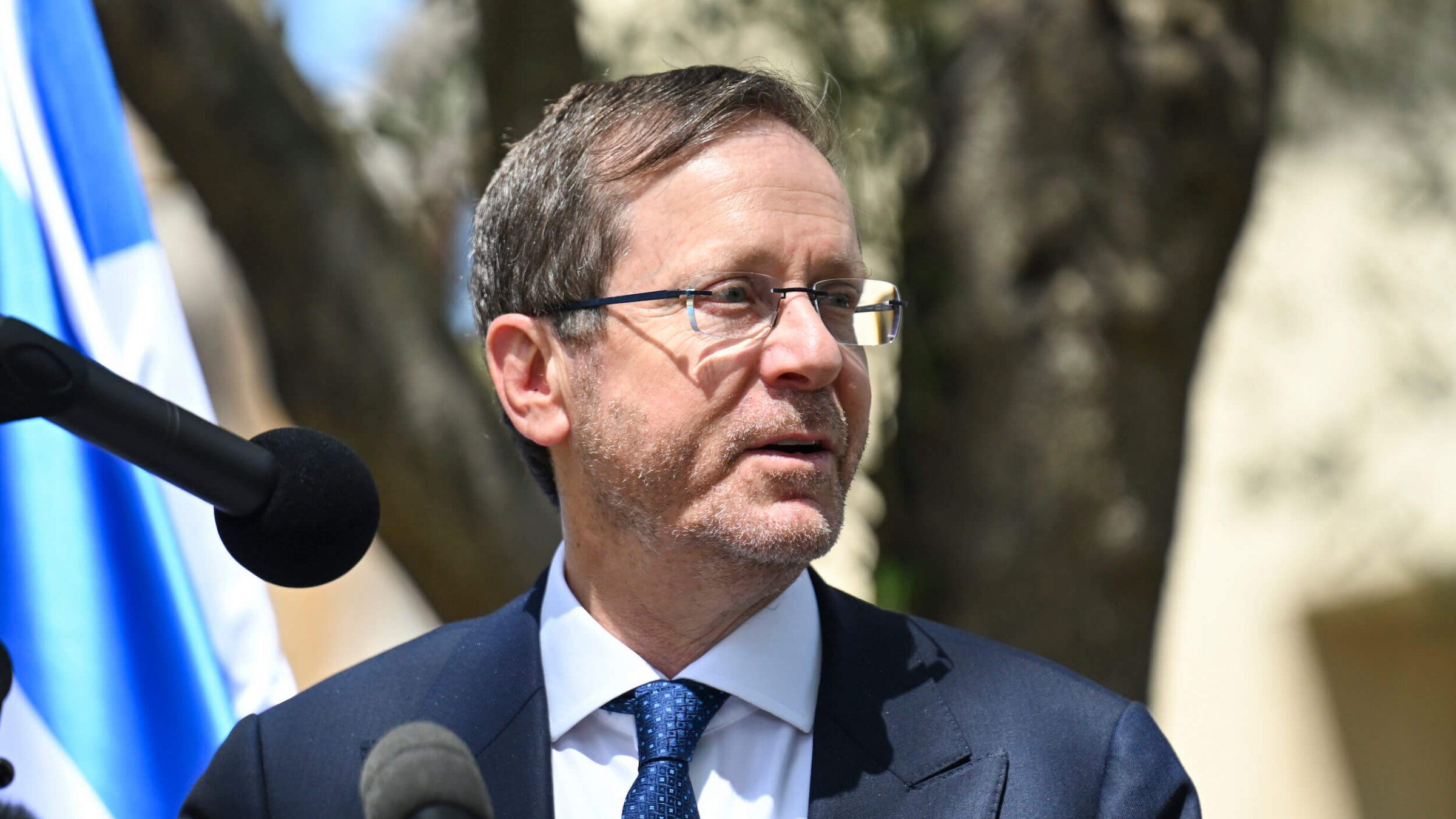
Israeli President Isaac Herzog in Canberra, Australia on Feb. 11. Photo by Martin Ollman/Newswire – Pool/Getty Images
A group of Jewish Theological Seminary students were furious with the chancellor’s position on Jewish statehood. In protest, they draped flags around campus before graduation, which the administration removed before the ceremony.
The year was 1948. The flags were Israeli. And the dissenting students were protesting Chancellor Louis Finkelstein’s refusal to make support for Jewish statehood part of academic commencement. Some students even arranged for the bells at nearby Union Theological Seminary to play “Hatikvah,” the Israeli national anthem, after JTS officials declined to include it in commencement.
As a historian of American Zionism, I have been thinking about that episode while reading the many vitriolic reactions to a few JTS undergraduates who spoke out in opposition to the seminary’s decision to welcome Israeli President Isaac Herzog as this year’s graduation speaker. Once again, a JTS commencement has become a battleground over Israel, but the sides are now reversed.
Reasonable people can disagree about whether this was the right moment to extend an invitation to Herzog to speak at commencement. What deserves attention is the outraged reaction to a group of students raising objections, and the speed with which those students’ concerns have been cast as a deviation from the historical contours of mainstream American Jewish politics.
A recent Times of Israel blog post, for example, argued that the mere fact that JTS students raised concerns about Herzog was a rupture with Judaism. “Jewish survival without sovereignty is fragile,” wrote the author, Menachem Creditor, adding that “the founders of JTS did not need to debate the necessity of Jewish self-determination,” and that Herzog “represents the state of Israel and the Jewish people.”
These claims erase JTS’s long and sophisticated engagement with Jewish nationalism and the conception of Jewish peoplehood. Reading American Zionism backward risks collapsing peoplehood and statehood, and creating traditions to ratify present assumptions out of a past that never existed.
The relationship between Zionism and JTS was nuanced from the start. Both founding president Sabato Morais and the seminary’s third chancellor, Cyrus Adler, opposed Zionism on religious grounds. Morais believed the restoration of Jewish sovereignty could only come through divine intervention at the dawn of a messianic era. Adler thought of the growth of a non-religious community in the land of Israel “as the greatest misfortune that has happened to the Jews in modern times.”
Solomon Schechter, as chancellor, brought a measure of support for the Zionist movement to JTS; shaped by the cultural Zionism of Ahad Ha-am, Schechter insisted that Zionism transcended statehood. Its primary aim, he argued, was the national regeneration of global Judaism, not the creation of a secular state that would hollow out Jewish life from within.
And the controversies over the 1948 graduation exercises revealed how far Louis Finkelstein stood from political Zionism, even after the establishment of Israel. Where some Zionists celebrated sovereignty, Finkelstein remained focused on the Jewish character of the land and its people. That orientation drew him toward Judah Magnes’s binational vision — that of a federated framework in which Jews and Arabs would each hold recognized rights and a measure of national autonomy within a single shared political entity.
This reticence to conflate Judaism, Zionism and Jewish sovereignty was not limited to the seminary’s chancellors.
Henrietta Szold, JTS’s first female student, a central figure in its intellectual orbit, and the founder of Hadassah, similarly supported a binational vision from her new home in Jerusalem. Mordecai Kaplan — a longtime JTS faculty member, committed Zionist, and one of the most influential American Jewish thinkers of the 20th century — expressed concern throughout his career about the mistake of equating Jewish nationhood with Jewish statehood. In Judaism as a Civilization, he called for a “more ethical conception of nationhood fundamentally as a cultural rather than as a political relationship.”
After Israel’s founding, Kaplan went further, arguing to David Ben-Gurion in 1958 that “the basic assumption that the state of Israel is a Jewish state is itself open to question.” The Israeli government’s task, he insisted, was to establish “a modern state, not a Jewish state, an Israeli state, not a Jewish state.”
These questions did not disappear even as JTS evolved under new leadership.
Gerson Cohen, whose chancellorship beginning in 1972 marked a shift toward a more pro-statist posture, embraced the state’s significance for Jewish life and identity in ways his predecessors had not. Yet even Cohen insisted that commitment to Judaism must rest “not on political statehood or upon geography but solely on the idea of covenant and commitment to ethos.” He argued that a flourishing diaspora was a necessity for Jewish civilization as a whole, not adjunct to Israeli interests.
His successor, Chancellor Emeritus Ismar Schorsch, was more direct, saying in a recent warning that Jews must ensure that “Judaism qua religion is not submerged and shredded by the power of the Jewish state.”
One can disagree with any of these perspectives. In fact, the disagreement itself is the point.
The leaders who built JTS debated Jewish self-determination, Zionism and statehood while living through the Holocaust, the collapse of European Jewish life, existential danger in Palestine, and the precarious birth of the state of Israel. They were not naïve about antisemitism, indifferent to Jewish survival, or ignorant of Jewish sources. Nor were they unsophisticated about Zionism.
Instead, they offered a more demanding account of Zionism: one that affirmed a Jewish homeland and insisted that Jewish power remain answerable to Jewish ethics, all without diminishing Jewish life in the diaspora.
This is precisely the perspective that has been crowded out of our contemporary discourse, not because these questions were answered, but because the space to ask them has collapsed. As the boundaries of acceptable Zionist discourse have narrowed, issues that arose from within Zionism itself — the potential dangers of equating the Israeli state with the Jewish people, the risks of elevating political statehood above other ethical and communal commitments, and the need to have diaspora Jewish life be seen as carrying independent religious and moral weight — have come to be treated as anti-Zionist rather than part of a living internal debate.
The furor over the JTS undergraduates’ letter objecting to Herzog is a troubling sign that, across American Jewish life, it has become harder to think honestly about the risks of treating support for the state of Israel not merely as a Jewish commitment, but as one that takes precedence over other all other Jewish commitments. When the past is rewritten so that the equation of peoplehood and statehood appears inevitable, American Jews are left with a false choice: either embrace the state as an unquestioned and unquestionable expression of Jewish identity, or abandon Jewish life altogether.
JTS has offered its students a richer education because, in its halls, the relationship between the Jewish people and the Jewish state has been debated and contested. That discourse is not a failure of Jewish commitment, but an expression of it. The sustained engagement with the hardest questions of Zionism is one of the best things JTS has given American Jewish life, and one of the most important gifts it still has to offer.
Did you know that only 2% of Forward readers donate to support our nonprofit newsroom? That 2% make it possible for millions to read the Forward without a paywall or subscription — removing any barriers to the full and fair Jewish story.
But while the Forward is free to read, it isn’t free to produce. Big stories — like deep dives into the antisemitism data, political scoops or reporting trips to college campuses — take months of research and fact-checking. All while we keep you informed of what you need to know each day.
— Rachel Fishman Feddersen, Forward Publisher & CEO
Support our mission to tell the Jewish story fully and fairly.