An alarming new battleground in campus fights over Israel
Education is supposed to teach students how to think — not how to condemn
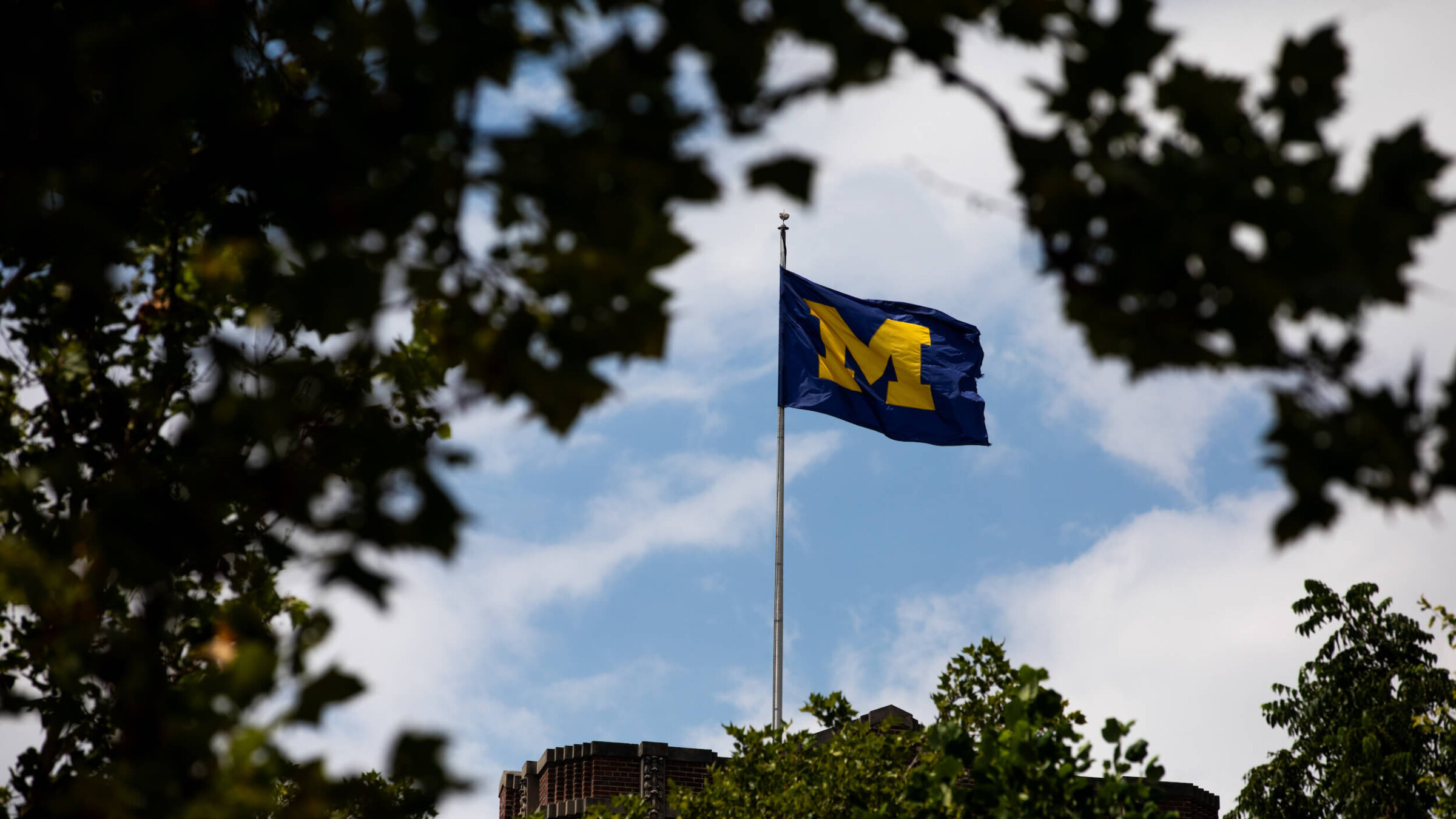
A University of Michigan flag on the Michigan Union building on campus in Ann Arbor, Michigan. Photo by Emily Elconin/Bloomberg/Getty Images

Alanna E. Cooper May 8, 2026
Graduation season is upon us, with its regalia, music, orations, crowds and controversies. This year, I’ll be attending two university ceremonies: my daughter’s graduation from Binghamton University, and the commencement at Case Western Reserve University, where I teach. As both a parent and a faculty member, I look forward to being part of the powerful ritual moment when graduates are ushered out into the world.
But I’ll also be listening with an analytical ear, attentive to what these speeches reveal about the institutions delivering them — especially in a season when the same fault lines keep opening over the Israeli-Palestinian conflict, and over who gets to speak and about what.
Amid financial, political and technological pressure, the question of what universities owe their students, and society, has rarely felt more unsettled or more contested. As speakers or planned speakers at the University of Michigan, Rutgers and Georgetown have drawn fire over their stances on the Middle East, it’s clear that while campus protests over Israel may have died down, the tensions provoked by the Israel-Gaza war are still defining the American campus environment.
A close reading of the biggest controversy to date, sparked by historian Derek Peterson’s address at the University of Michigan’s spring graduation ceremony, can help illustrate the dangers of that fact.
Peterson’s platform has few equals in American academic life. A MacArthur “genius” grant recipient and a Fellow of the British Academy, Peterson, among the most decorated scholars of his generation, addressed a crowd gathered in the largest stadium in the United States. He did so as a representative of the faculty, invited to the lectern to speak for those who actually taught these students.
This was a rare chance for a professor, an opportunity to publicly offer an answer to the question every student has implicitly asked for four years: what is all this education for?
In a brief oration, under six minutes long, Peterson structured his answer around a single elegant literary device, Michigan’s fight song.
He reframed a song usually understood to herald student athletes — “Hail to the victors valiant, hail to the conquering heroes” — by asserting the real victors are not athletes, but the activists who have fought for justice throughout the university’s history.
Sing for Sarah Burger, a suffragette who fought for women’s admission to the school, Peterson urged. Sing for Moritz Levi, the university’s first Jewish professor, who opened Michigan’s doors to generations of Jewish students fleeing antisemitism at East Coast universities. Sing for the Black Action Movement students who demanded a curriculum reflecting Black experience and identity.
Each of these invocations gestured toward a group that was once shut out of the university, and honored the activists who responded to that exclusion with repair. The crowd answered Peterson’s appeals with applause and cheers that grew louder with each invocation, as he skillfully built toward his climax.
At the high point, Peterson delivered the line that would reverberate far beyond Michigan Stadium: “Sing for the pro-Palestinian student activists,” he called out; for those “who have over these past two years opened our hearts to the injustice and inhumanity of Israel’s war in Gaza.”
The roar that followed was the loudest and longest of the entire speech. “The greatness of this university,” he summarized, “rests on the courage and the conviction of student activists who have pushed this university down the path towards justice.”
Within hours, the university president Domenico Grasso issued a public apology, saying Peterson’s words were “hurtful and insensitive.” In response, more than a thousand faculty members signed an open letter demanding Grasso retract the apology. Peterson’s defenders insisted the controversy was manufactured from a single out-of-context clip, and Peterson himself posted the YouTube link urging those offended to watch the whole thing.
Peterson’s defenders are not wrong to insist that context is everything. But they misinterpret what the context shows. Watching the full performance, and the crescendo that greeted the pro-Palestinian invocation, it’s clear that Peterson’s statement on pro-Palestinian activism was the destination the whole speech built toward.
The first three appeals each share a common logic: expand the circle and welcome the excluded. The fourth breaks that logic. Peterson did not exhort his audience to sing for students who built relationships across lines of difference, or who forwarded a vision of peace. Instead, he urged them to sing for students who drew attention to Israeli “injustice and inhumanity,” and who offered not a plan to make room for all, but instead an accusation.
That contradiction is worth naming plainly. Peterson’s other entreaties celebrated universal inclusion — all genders, all races, all religions. Then he singled out and damned the one Jewish state in the world, immediately after celebrating Michigan’s historic welcome of Jews. The speech that began by opening doors ends by pointing a finger, and that act of condemnation was offered as the moral crown of enlightened progress.
The depressing predictability of this genre of moral performance is that it builds, with apparent generosity, through history and conscience and song, only to arrive at a hackneyed, self-congratulatory denunciation of Israel as the apex of a liberal education. With so much at stake right now on our university campuses, is this really all we can offer our students as the culmination of their years of learning?
A university education is supposed to widen the aperture through which students see the world, and to equip them with the intellectual tools to engage the world with curiosity, humility and rigor. It is supposed to send them out equipped to ask hard questions, and with the tools and habits of mind to wrestle with them.
When a faculty leader uses a significant platform to show students not how to think, but what to conclude and who to condemn, he suggests something alarming: that narrowing of minds, pointing of fingers and pronouncing of verdicts is what four years of university education has amounted to.
That is a profound loss. Not only for those Jewish graduates who felt alienated and excluded by the singling out of the Jewish state, but for every student in that stadium, who invested years of time, money and intellectual effort in the hope of emerging with something larger: the capacity to engage the world by thinking freely and curiously across difference, and by imagining what real repair might actually look like.
Did you know that only 2% of Forward readers donate to support our nonprofit newsroom? That 2% make it possible for millions to read the Forward without a paywall or subscription — removing any barriers to the full and fair Jewish story.
But while the Forward is free to read, it isn’t free to produce. Big stories — like deep dives into the antisemitism data, political scoops or reporting trips to college campuses — take months of research and fact-checking. All while we keep you informed of what you need to know each day.
— Rachel Fishman Feddersen, Forward Publisher & CEO
Support our mission to tell the Jewish story fully and fairly.