I discovered anti-Zionism at the University of Michigan. I’m glad it lives on there
A controversial speech conveyed essential lessons for all Jews
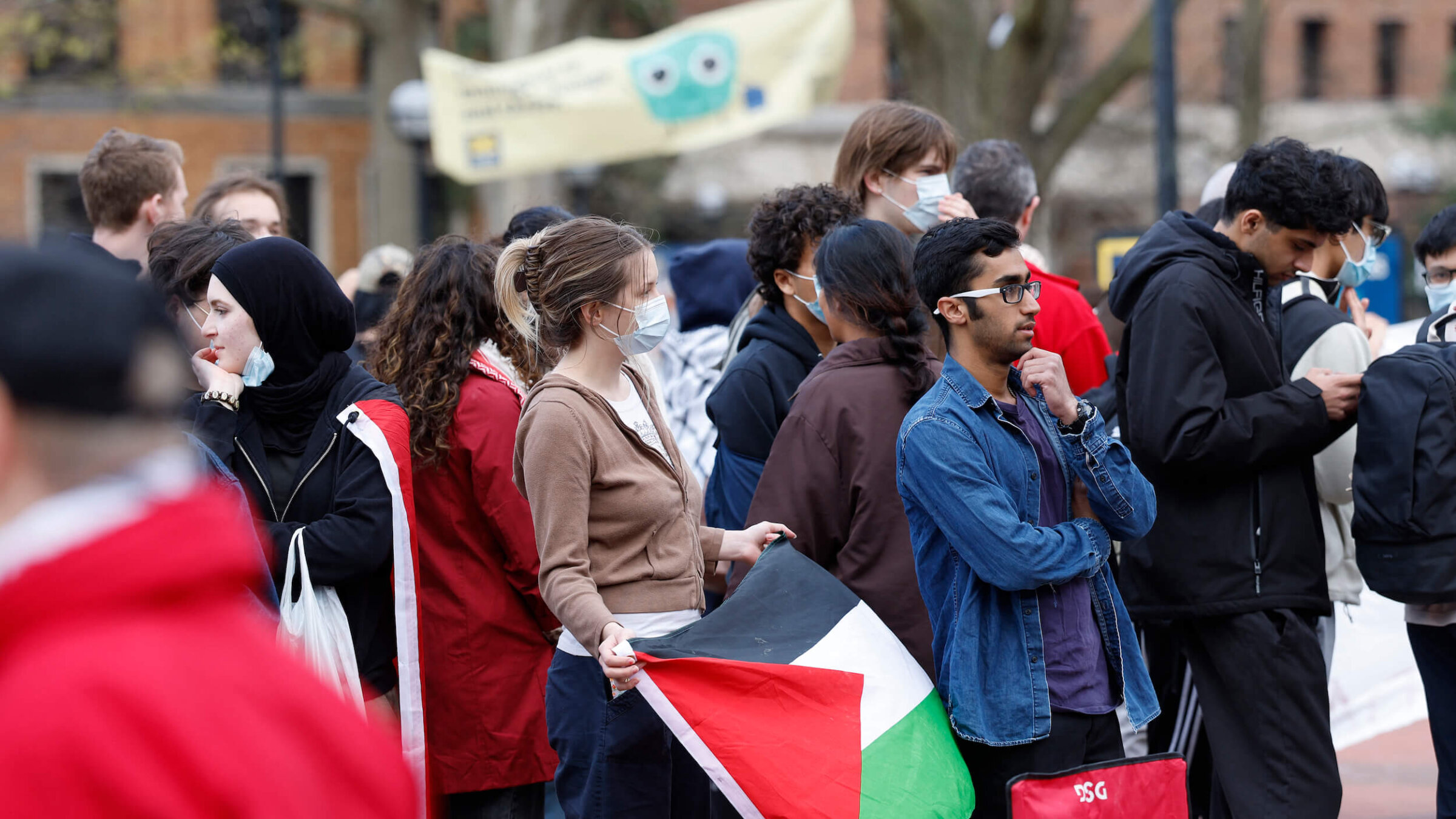
Pro-Palestinian demonstrators gather for a mock trial against the University of Michigan’s Board of Regents on the university’s campus in Ann Arbor, Michigan, on April 21, 2025. Photo by Jeff Kowalsky / AFP / Getty Images
At the University of Michigan’s recent commencement ceremony, history professor Derek Peterson delivered a five-minute speech in which he celebrated all those who have fought for justice at the university, my alma mater. Invoking our legendary sports-focused fight song, he asked the crowd to “sing” for suffragist Sarah Burger, who battled to get women admitted as students; for Moritz Levi, Michigan’s first Jewish professor; for all the students who fought for racial justice at Michigan as part of the Black Action Movement; and for the “pro-Palestinian student activists, who have over these past two years opened our hearts to the injustice and inhumanity of Israel’s war in Gaza.”
Peterson’s address was a historian’s invitation to every student and parent in the Ann Arbor stadium to recognize that the fight for Palestinian rights shares roots with our greatest movements for justice, including the struggle against antisemitism.
The backlash, predictably, was swift. The university’s president apologized; the speech was condemned by pro-Israel Jewish organizations and outlets; and I know it upset many college parents, my Gen X peers — we who were raised to believe with all our hearts that Jewish identity and Zionist identity are inextricable.
But to me, Peterson’s speech was a reminder of one of the most important lessons I took away from my time at the University of Michigan: that questioning Zionism is a necessary part of any Jewish life that aims to center justice.
I graduated from Michigan in 1989, and spent much of my last year in Ann Arbor ensconced at Hillel, where I edited a magazine for Jewish students. I’d grown up going to Young Judaea summer camps and had spent a college semester in Israel, where I’d witnessed the beginning of the first Intifada. I returned to find a shanty in the middle of campus that had been erected, a student organizer told our magazine, “to bring the uprising to the community. It is to show the conditions of the Palestinians and the brutal oppression of the Israeli army.”
The shanty evoked those then prevalent on campuses everywhere to symbolize the struggle of Black South Africans against settler colonialism and apartheid. The new shanty on our campus asserted that these words also applied to Israel.
While I was strongly against the Israeli occupation of the West Bank and Gaza — where Israel would not remove any settlements until 2005 — I was distressed and confused by the shanty’s silent, everpresent message about Israel’s past and present. Is Israel an apartheid state, I wondered?
So I put that question on the cover of our magazine.
The Hillel director called me into his office and somberly expressed his concern. But Hillel International had not yet officially clamped down on student activities that question Israel and Zionism.
So our cover story ran and we dropped our magazine in bundles across campus. At the time, I thought of myself as a liberal Zionist, and I secretly rooted for the student who tried to disprove the devastating charge. But as young journalists, my fellow magazine staffers and I were committed to exploring the views of those who erected the shanty, no matter their hostility to Zionism. We didn’t code the hostility as danger. No one thought we should report our ideological opponents — the kids who fell asleep on their books in the library just like we did — to the dean or to the government for arrest or deportation.
Over my time as an undergraduate, I’d come to recognize in these kaffiyeh-clad Palestinian, Arab, and Muslim students the same history-minded, righteous hope that animated me.
Decades later, in the spring of 2024, we all watched as pro-Palestinian student activists — including many Jewish students — set up campus encampments around the country to protest Israel’s assault on Gaza. At Michigan, the encampment was set up on the Diag, the university’s public square, where on the day of my own graduation I’d protested the university’s military research. As the mother of a recent college grad, I was humbled by the determination of these kids, who put up tents, organized teach-ins, and then suffered as police turned off their bodycams and used pepper spray against them. They were lawfully protesting for the university to divest from Israel as it bombed the people of Gaza, the children of Gaza — which is now home to the largest number of child amputees in modern history.
What I understand, and Professor Peterson understands, is that the student activists that he lauded at the commencement are fighting not against Jewish life but for Palestinians’ right to survive daily, as people, and as a people. These activists have asked us to understand, finally, that Zionism is what it does.
“It has been hard work to examine my own mind,” Tzvia Thier, a Jewish Israeli mother, wrote in an essay in the 2021 collection A Land With A People: Palestinians and Jews Confront Zionism. As a child, Thier immigrated to Israel from Romania in the wake of the Holocaust. In 2009, Thier accompanied her daughter to “protect” her while she joined an action to fight the evictions of Palestinians from their homes in the Jerusalem neighborhood of Sheikh Jarrah. Thier was 65, and realized that it was the first time in her life that she had had conversations with Palestinians. She understood then that “it was not my daughter who needed to be protected, but the Palestinians.”
“Many questions leave me wondering how I could have not thought about them before,” she wrote. “My solid identity was shaken and then broken. I have been an eyewitness to the systematic oppression, humiliation, racism, cruelty, and hatred by ‘my’ people toward the ‘others.’ And what you finally see, you can no longer unsee.”
When that shanty went up on Michigan’s campus in the late ’80s, I began to question all that I’d learned about Israel’s founding. I began to question the very idea of an ethnostate — in the name of any people, anywhere — that enshrines the supremacy of one group of people over another.
By the time I became a mother, I’d become anti-Zionist. I understood — with a grief that does not abate — that, as Jews, our history of oppression has become an alibi for Israel’s oppression of the Palestinian people.
We must reject the bad faith accusations of antisemitism that have emptied the word of meaning and enabled authoritarian repression. When students on campuses today charge Israel with apartheid and genocide, they are echoing reports from B’Tselem, Israel’s leading human rights organization. I ask the parents of my generation to read these reports and do as Thier did — to allow themselves to see what we have not wanted to see.
I stand with the more than 2,000 University of Michigan faculty, staff, students and alumni who have condemned the university’s response to the commencement address heard round the world.
For the sake of all of our children, I ask that we each do all we can to open our community’s heart to Palestinian history and humanity. That we each join the urgent struggle for the liberation of the Palestinian people.
This is the way that our Jewish college kids will find the deep and true safety of community: by leaving hatred, fear, and isolation behind; by honoring Jewish history by standing in solidarity with all who are oppressed; and by roaring in a stadium for freedom and justice, along with their entire generation.
Did you know that only 2% of Forward readers donate to support our nonprofit newsroom? That 2% make it possible for millions to read the Forward without a paywall or subscription — removing any barriers to the full and fair Jewish story.
But while the Forward is free to read, it isn’t free to produce. Big stories — like deep dives into the antisemitism data, political scoops or reporting trips to college campuses — take months of research and fact-checking. All while we keep you informed of what you need to know each day.
— Rachel Fishman Feddersen, Forward Publisher & CEO
Support our mission to tell the Jewish story fully and fairly.