University of Michigan regents race turns into Israel litmus test for Democrats
Republican Lena Epstein, with past ties to Messianic Judaism, sees an opening after Democrats nominated Amir Makled, who faces scrutiny for past Hezbollah praise and antisemitic posts, for University of Michigan Board of Regents

A pro-Palestinian student at the University of Michigan’s commencement on May 04, 2024. Photo by Nic Antaya/Getty Images

By Jacob Kornbluh April 20, 2026
A Republican businesswoman from a well-known Jewish family who narrowly lost a bid for the University of Michigan Board of Regents in 2022 suggested on Monday that Democrats may have handed her a second chance by nominating a candidate who is facing backlash for past praise of Hezbollah.
In an interview, Lena Epstein said the choice creates a “clear contrast” in a race that could be shaped by campus antisemitism and wars in the Middle East.
The Michigan Democratic convention on Sunday nominated civil rights attorney Amir Makled to run for the eight-member board tasked with governing the state’s university in the general election over incumbent regent Jordan Acker, who is Jewish. Acker had drawn criticism from pro-Palestinian students and activists over the university’s response to protests following the Oct. 7, 2023, Hamas attack and the war in Gaza.
Makled, who legally represented some demonstrators and backed calls for divestment from Israel, has since faced scrutiny over past social media posts viewed as pro-Hezbollah and antisemitic. He called Hezbollah leader Hassan Nasrallah a “martyr” after he was killed by Israeli strikes in 2024.
The controversy led the Service Employees International Union last week to rescind its endorsement of Makled. The posts were later deleted.
“Eyes are open, chills are going down people’s spines, terrified at the prospect of Makled representing their families at the University of Michigan Board of Regents,” said Epstein, a 2008 graduate of the University of Michigan’s Stephen M. Ross School of Business.
Epstein said she is now reaching out to Jewish Democrats who previously opposed her, framing the race as a nonpartisan effort to confront antisemitism and tensions over Israel on campus. Epstein lost her 2022 bid by just 0.7 percentage points in an election year when Democrats swept every statewide office. Democrats currently hold six seats on the regents board.
The Republican Party nominated Epstein last month alongside Michael Schostak, who is also Jewish and running for another open seat against incumbent Paul Brown. “When it comes to Israel and combating antisemitism on campus, there will be no greater regent than me,” Epstein said.
Epstein’s past controversies
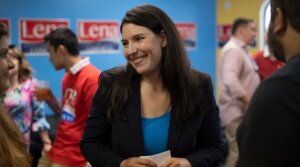
Epstein is a third-generation co-owner and board member of Vesco Oil Corporation, the business her grandfather Eugene Epstein founded in Southfield, Michigan, in 1947. Her mother’s family founded Winkelman’s department store in Detroit.
She is no stranger to controversy.
Epstein, who served as the Trump campaign co-chair in Michigan in 2016, made headlines after a country club her family had belonged to for generations canceled a scheduled fundraiser for her when she ran for Congress in 2018.
That year, days before she lost her bid for a U.S. House seat to Rep. Haley Stevens, who is now running in a Democratic primary for an open Senate seat, Epstein caused an uproar by inviting a Messianic rabbi to offer a prayer for the victims of the Pittsburgh Tree of Life synagogue massacre.
In 2023, Epstein faced scrutiny during her bid for chair of the Michigan Republican Party after saying she considered herself a “Jewish Messianic believer of Christ.” Mainstream Judaism does not accept Messianic Jews because they believe in the divinity of Christ and try to convert Jews to Christianity. Epstein later withdrew from the race.
In the interview on Monday, Epstein said she “never was” a Messianic Jew and apologized to anyone offended by it, calling it “nothing more than a blip.”
Epstein said she remains “very, very proud” of her Jewish identity and said she is actively involved in the community, including membership at Temple Beth El in Bloomfield Hills, a Reform congregation, where she said her eight-year-old daughter attends religious school, and participation in family milestones such as a recent bar mitzvah at Adat Shalom Synagogue, a Conservative congregation in Farmington Hills. She said she studies the Torah every Tuesday night with her mother and with a Chabad rabbi.
“I’m 100% Jewish,” she continued. “I apologize if any of that discussion offended anybody. But I definitely want to be very, very clear that my existence as a Jew, my love of Judaism, my commitment and passion for Judaism have never been stronger, and it’s been a lifelong pursuit.”
A test of Democrats’ Israel divide

Michigan is one of a few states in which voters play a direct role in choosing university overseers.
Makled’s nomination comes at a fraught moment for the Democratic Party, testing its coalition and approach to Israel policy amid the wars in Gaza and Iran. Michigan, home to the largest concentration of Arab Americans in the United States, was also the birthplace of the 2024 Uncommitted movement, which protested the Biden administration’s support for Israel in the war against Hamas that led more than 100,000 voters in Michigan to leave their primary ballots blank.
Anonymous text messages to state Democratic Party donors claimed that Acker, who met with Israeli President Isaac Herzog in January, would “put Israel first.” Acker’s home was vandalized in 2024 by pro-Palestinian protesters, some of whose homes were later raided by federal authorities.
Days before the convention, The Guardian reported that Acker had allegedly made “lewd” comments about a Democratic strategist in a private group chat. A lawyer for Acker said he had “doubts about the authenticity” of the evidence.
Makled is an ally of Abdul El-Sayed, a progressive U.S. Senate candidate from Michigan rising in the polls. El-Sayed, the son of Egyptian immigrants and a critic of Israel, faced backlash for appearing alongside streamer Hasan Piker, who has been accused of antisemitic rhetoric. In an interview with CNN aired Sunday, El-Sayed said that the Israeli government is “evil” like Hamas. “Killing tens of thousands of people makes you pretty damn evil,” El-Sayed said. “It’s not how evil is this one versus that one — Hamas: Evil, Israeli government: Evil. We can say both.”
Appearing at the El-Sayed campaign rally with Piker earlier this month, Makled told the Jewish Telegraphic Agency that he stood by his defense of the pro-Palestinian encampment while condemning the attack on Acker’s home.
At the Democratic convention on Sunday, Stevens, who is perceived as the preferred candidate of pro-Israel voters, was booed by delegates.
JTA contributed to this report.
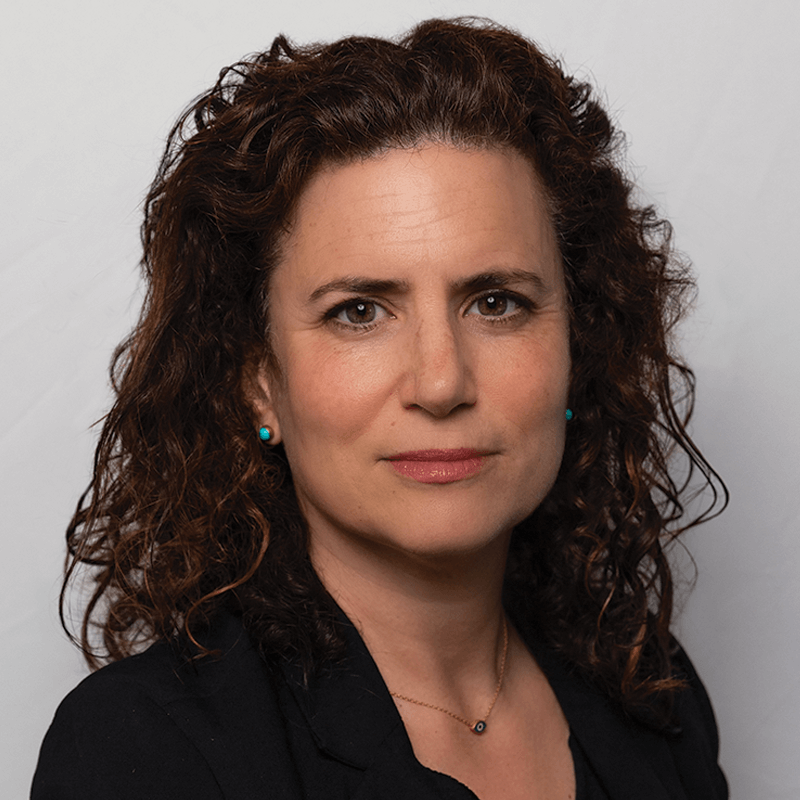
Did you know that only 2% of Forward readers donate to support our nonprofit newsroom? That 2% make it possible for millions to read the Forward without a paywall or subscription — removing any barriers to the full and fair Jewish story.
But while the Forward is free to read, it isn’t free to produce. Big stories — like deep dives into the antisemitism data, political scoops or reporting trips to college campuses — take months of research and fact-checking. All while we keep you informed of what you need to know each day.
— Rachel Fishman Feddersen, Forward Publisher & CEO
Support our mission to tell the Jewish story fully and fairly.