Jews and other minorities face similar levels of campus hostility, Brandeis survey finds
The first academic survey assessing experiences nationally finds that Jewish, Black and Muslim students all face comparable negative attitudes from peers
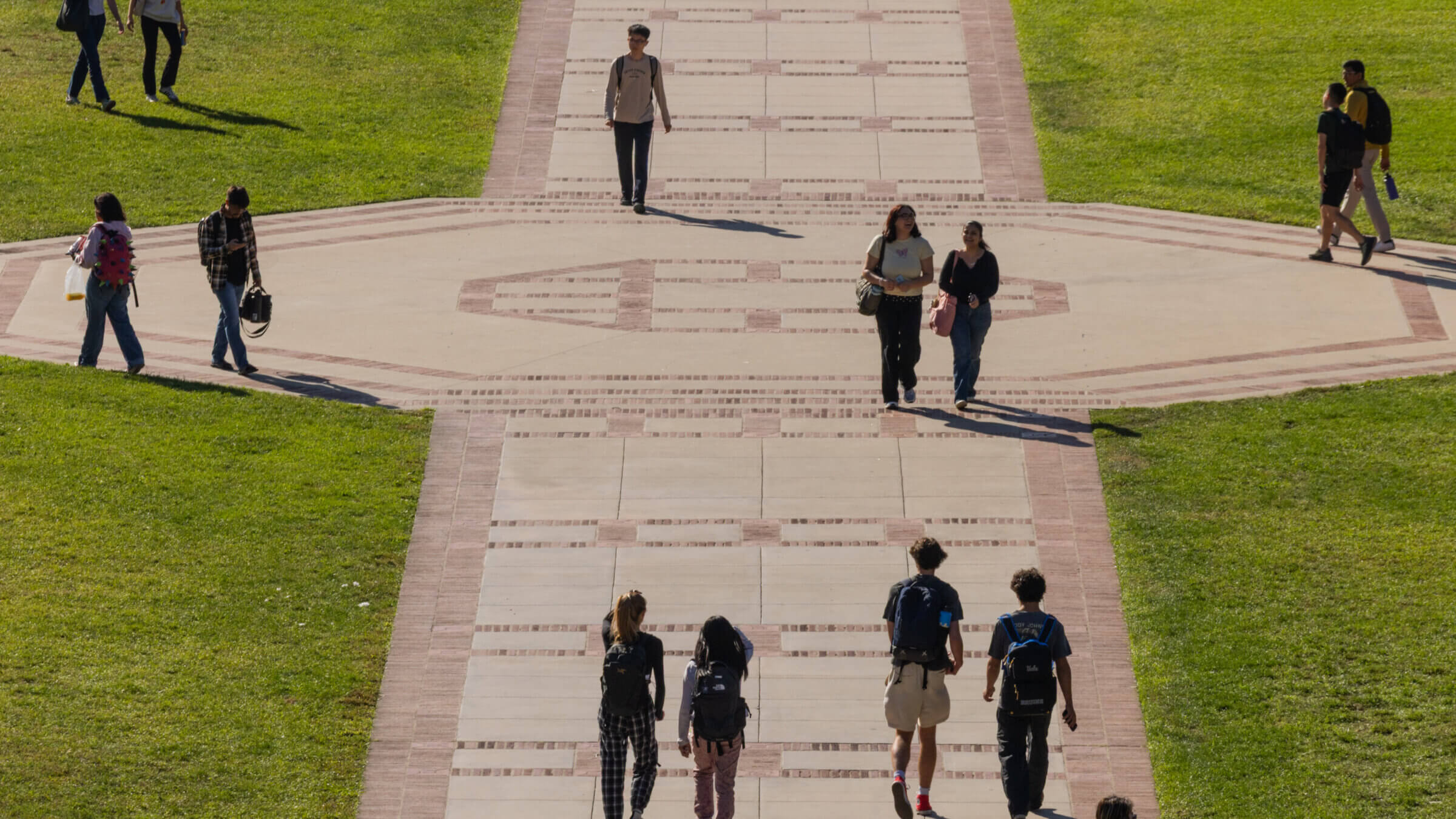
Students walk across Wilson Plaza at the the University of California, Los Angeles campus on Tuesday, Oct. 7, 2025. Photo by Juliana Yamada / Los Angeles Times via Getty Images

By Arno Rosenfeld April 14, 2026
The first academic study comparing the experience of Jewish students on college campuses to that of other minority groups found that Jews and other marginalized populations, including Black and Muslim students, face comparable levels of discrimination.
The findings were part of a national survey involving thousands of respondents focused on antisemitism that also polled student attitudes toward other identity groups.
Nearly half of Jewish students said they had experienced at least one antisemitic incident during the current academic year — mostly seeing offensive graffiti or posters — but when it came to the overall campus climate Jews were slightly less likely than Muslims, and slightly more likely than Black students, to say that their campus was a hostile environment.
“Everybody is walking around with a chip on their shoulder,” said Leonard Saxe, director of the Cohen Center of Modern Jewish Studies at Brandeis University, which produced the study released Tuesday. “Addressing prejudice toward protected groups is perhaps seen as a zero- sum game: ‘If we pay attention to Black students that’s taking away from what we can do for Jewish students, but paying attention to Jewish students means not paying attention to Muslim students.’”
While a flurry of research about campus antisemitism followed the Oct. 7 Hamas terrorist attacks in Israel and the college protests of the Gaza war that followed, few have sought to determine whether Jews are facing more or less discrimination than other students.
But the Brandeis study tracks with a less scientific study commissioned by the antisemitism task force at Columbia University in which high levels of both Jewish and Muslim students said they had felt endangered on campus amid protests related to the Gaza war.
In the Brandeis report, Jewish students were most likely to express concern related to traditional antisemitic stereotypes (62%) and antisemitism from the political right (60%) while fewer said they were worried about antisemitism related to Israel (45%) or coming from the left (also 45%).
When it came to college students overall, 9% showed a pattern of hostility toward Jews, meaning they were likely to agree with a series of antisemitic statements, compared to 17% who exhibited what researchers called “anti-Black resentment.”
Muslim, Black and Hispanic students, and those who identified as liberal or moderate, were the most likely to agree with negative statements about Jews, while white, Muslim and conservative students were most likely to agree with anti-Black views.
“It means that we need to target some of our interventions — educational interventions — to these groups if we want to have effects,” Saxe said. “If you only engage the Caucasian students, you’re not going to be addressing the problem.”
Jewish students expressed some of the lowest levels of prejudice toward other groups, according to the study, but 18% expressed “anti-Black resentment” while 3% were categorized as expressing hostility toward Jews.
The report also found that strident hostility toward Israel — opposing Israel’s “right to exist” and avoiding peers who support a Jewish state in Israel — did not neatly correlate to holding antisemitic views.
Half of “extremely liberal” students agreed with those statements about Israel but overall the very liberal population was least likely to express a pattern of hostility toward Jewish students. Very few moderate or conservative students expressed those negative views about Israel, but both groups were more likely to agree with anti-Jewish statements.
The 14% of Jewish students who agreed with the anti-Israel statements was similar to the number of students from other backgrounds who did.
The study was conducted during the fall semester last year. Researchers polled 3,989 undergraduate students at four-year colleges and universities in the U.S. through an online survey fielded by Generation Lab that included an oversample of 743 Jewish students.

Hello, fellow Forward reader! I’m Joel Brown, a Forward reader and supporter for more than 15 years, and currently the chair of the board of directors.
I’m an avid Forward reader because it ticks so many of my essential boxes: excellent journalism, Jewish focus and diverse viewpoints. In today’s political climate, what I most appreciate is the Forward’s independence — made possible by the generosity of its membership.
The Forward is committed to bringing you unbiased, nuanced Jewish news. From my position as board chair, I see an exciting future as we expand our position as the definitive independent voice of contemporary American Judaism.
That’s why I’m paying it Forward, by matching $36,000 of reader gifts. It’s an investment in the Forward’s newsroom, to continue telling the American Jewish story with truth and independence.
— Joel Brown, Forward board chair
Support our mission to tell the Jewish story fully and fairly.