The Black Jewish experience, and Black-Jewish relations, take center stage on Fifth Avenue
Manhattan’s Temple Emanu-El launches a five-year commitment to public conversations about race, antisemitism and coalition-building
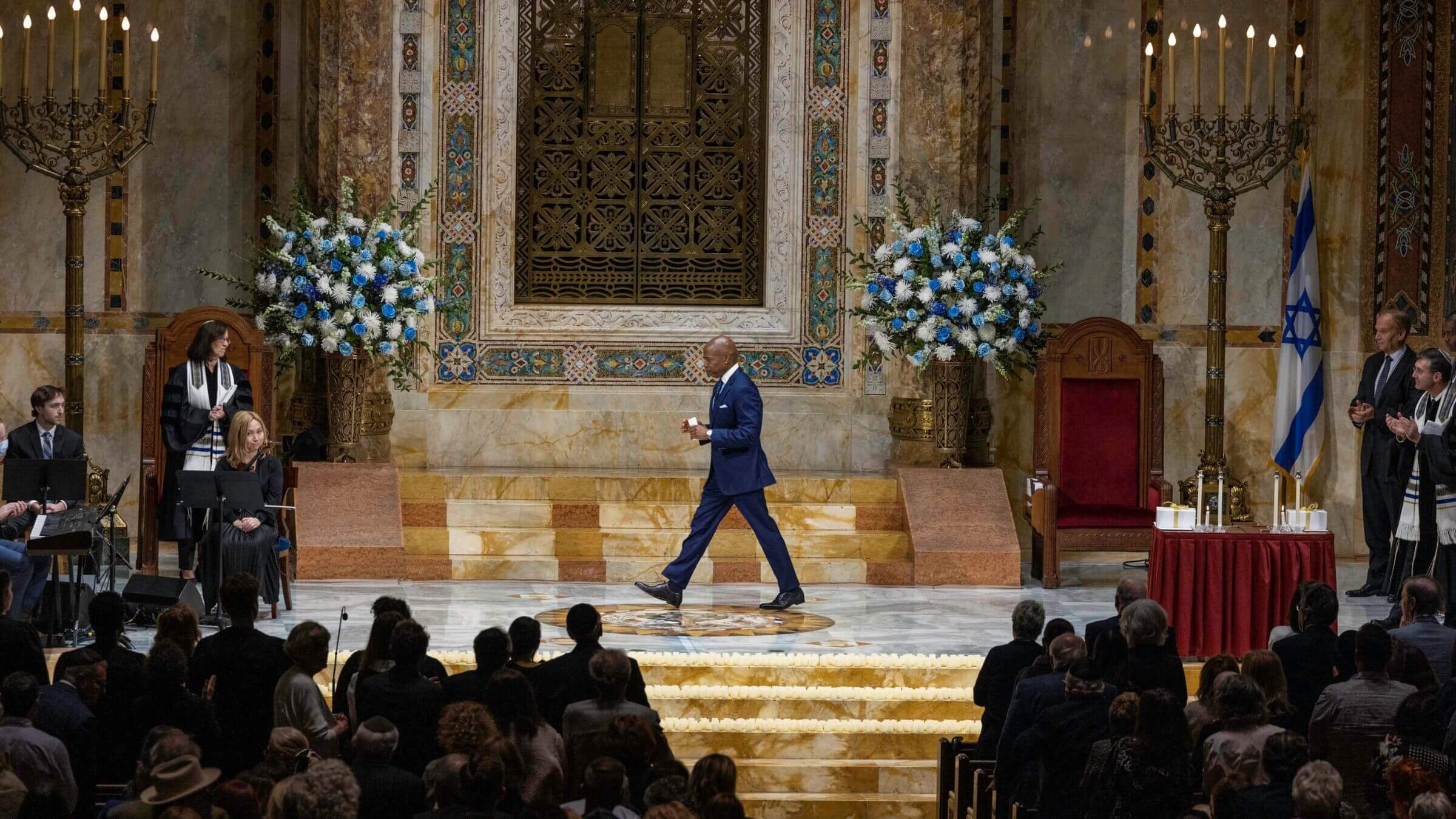
Former New York Mayor Eric Adams spoke to Temple Emanu-El’s congregation about New York’s response to the Hamas attack in Israel, Oct. 13, 2023. Photo by Alex Kent/Getty Images
By Simone Saidmehr May 21, 2026
The civil rights movement represented a kind of pax romana in Black–Jewish relations — symbolized most enduringly by the image of Rabbi Abraham Joshua Heschel marching beside Martin Luther King Jr. from Selma to Montgomery.
While many Jewish and Black Americans recall that era with a sense of wistful nostalgia, the relationship has become increasingly strained amid debates over racial justice, Israel and Palestinians.
This week, Temple Emanu-El on Manhattan’s Upper East Side, one of the country’s most prominent Reform synagogues, is launching a new five-year effort as a contribution toward rebuilding those ties while also foregrounding Black Jews.
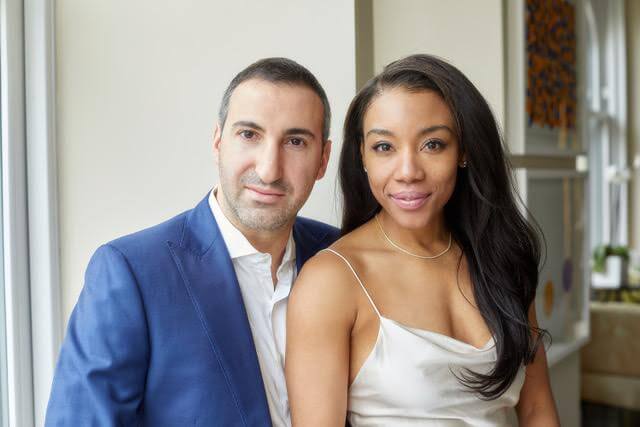
Shared Histories, Shared Futures: The Arielle Patrick & Aaron Goldstein Initiative on Black-Jewish Relations promises to bring scholars, activists, and religious leaders to the synagogue for a series of conversations on race, antisemitism and coalition-building. Its first event, set for May 29, will take place during a Friday night service.
“This is not a performance or a gimmick,” said Patrick, Managing Partner of Upland Workshops, a strategic advisory firm, who endowed the initiative alongside her husband Goldstein. “This is intentionally not during Black History Month, it’s intentionally not on MLK Day. It’s embedded in how we’d like people to think about creating a better society for our children and grandchildren.”
A frayed bond
Patrick, who is a Black Jew, said part of the inspiration behind the initiative came from her sense that the relationship between the two communities is not what it once was.
“I think a lot of Jews felt that their Black brothers and sisters were silent after Oct. 7, and perhaps jumped into the conversation about Palestine versus Israel without having the full context,” she said. “And then I also think that for a long time, the Black community has felt almost deserted by the fact that Jews were enabled to be upwardly mobile from the communities we once lived in and shared because of assimilation.”
In recent years, debates over Israel have fractured many progressive spaces, leaving some left-wing Jews who refused to disavow Israel feeling isolated from circles they once felt a sense of belonging to. Segments of the Black Lives Matter movement have explicitly linked racial justice in America to the cause for Palestinian liberation, and some of its chapters have even endorsed militant resistance to that end.
At the same time, rising antisemitism in the aftermath of Oct. 7 has shifted how some Jewish organizations engage with social justice work. The Anti-Defamation League, which for years invested in broader civil rights and democracy initiatives, pivoted from much of that programming to focus its resources on the rise in antisemitism.
Fostering the relationship is also complicated by divisions within both communities themselves. “When we think about Black-Jewish relations, we have a tendency to assume that everyone who is Black thinks one way and everyone who is Jewish thinks one way,” said Dr. Susannah Heschel, the head of the Jewish Studies Program at Dartmouth and the daughter of Rabbi Abraham Joshua Heschel. “Of course, there’s enormous diversity of all kinds: political, cultural, religious,” she added.
Relations in New York City reached a low point in 1991 after a Hasidic driver struck and killed a Black child in Crown Heights, Brooklyn, setting off days of unrest that left a Jewish student fatally stabbed and two communities grieving.
Though strain has reemerged in recent years, particularly during the rise of the Black Lives Matter movement in 2020 and the war in Gaza, organizations have emerged during that same period seeking to rekindle Black-Jewish dialogue.
“I think a lot of Jews are inspired by the civil rights era, by the fact that so many Jews participated,” said Heschel. “I know that photograph of my father marching in Selma is very important to a lot of people.”
She considers that photo a spur to new generations to continue the work. “The question is, what do you do with a photograph like that?” she asked. “Do you say, ‘Isn’t that great, what we did,’ in the past tense? Or do you take it as a challenge?”
Robert Kraft’s Foundation to Combat Antisemitism launched a partnership with Hillel and UNCF in 2024 to host unity dinners bringing together Jewish students and students at historically Black colleges and universities.
One might recall the viral Super Bowl ad, sponsored by Kraft’s Blue Square Initiative, where a Jewish boy is taunted by his classmates for being Jewish before his Black classmate fearlessly comes to his aid. The two boys walk off together in an idyllic (and, as critics have noted, somewhat antiquated) display of Black-Jewish solidarity.
Other groups, including Rekindle and CNN commentator Van Jones’ Exodus Leadership Forum, have launched programs aimed at fostering conversations between Black, Jewish, and Black-Jewish leaders. And this month, in a significant development, a National Convening on the Black-Jewish Alliance will be hosted in Miami, bringing together representatives from 75 organizations focused on cultivating the relationship.
A recent PBS series, Black and Jewish America: An Interwoven History, which came out in February also shed a light on the relationship, leaving many hoping to engage in the present — though also received pushback for not engaging seriously with the perspectives of Black Jews.
Centering Black Jews
Rabbi Joshua Davidson, the senior rabbi of Temple Emanu-El, grew up in the immediate aftermath of the civil rights movement and came to deeply value the stories of Black and Jewish communities working together.
“I knew that ultimately it would become an important part of my rabbinate too,” he said.
He says has been engaged in intercultural work for years, cultivating friendships with faith leaders across New York City, including at Abyssinian Baptist Church in Harlem and Concord Baptist Church in Brooklyn.
“One doesn’t enter into a relationship with the expectation that you’re going to get something in return,” Davidson said. “There’s a difference between allyship and friendship. The way I approach this is I want to establish friendships.”
Davidson said those relationships have allowed him to stand together with clergy members from those communities during difficult moments. Following the 2017 white supremacist march in Charlottesville, for example, he participated in a solidarity service at Abyssinian Baptist Church.
“There are times when a crisis hits, and you need allies, and so you reach out. You have no choice. But if you’ve been fortunate enough to be able to build the friendships when things were calm, you’re in a much better position,” he added, referring to the sense of abandonment many Jews felt after Oct. 7.
“I know around the country there’s been a great deal of frustration that expectations of one community showing up for another during moments of distress weren’t met. I can only say that my own experience has been different,” he said. “When something has happened to the Jewish community, I get the phone call from colleagues of other faith communities, and certainly among the leadership of the Black community in the city.”
The initiative also seeks to foreground Black Jews themselves, whose experiences are often absent from conversations about Black-Jewish relations.
“We have a tendency, all of us, to talk about Black–Jewish relations as if all Jews are white and all Black people are not Jewish,” Heschel said. “It’s gradually dawning on Jews that we have Black Jews in our community.” Estimates suggest Black Jews make up roughly 1% to 2 % of American Jews.
Patrick said she has often encountered those assumptions firsthand.
“When I go to synagogue or when I’m in a social setting, the first thing a person asks me is, ‘Did you convert?’” she recounted. “That’s not a normal question to ask anyone.”
According to a 2021 study by the Jews of Color Initiative, 80% of respondents who identified as Jews of color said they had experienced discrimination in Jewish settings. Another survey, conducted by the Black Jewish Liberation Collective, found that of 104 Black Jewish respondents, 62% reported feeling increased marginalization in Jewish spaces after Oct. 7.
Davidson hopes that bringing Black Jews to the fore, like Rabbi Tamar Manasseh — a Chicago-based activist and community leader known for her work combating gun violence, who will be Temple Emanu-El’s first speaker in the initiative alongside Heschel — will encourage more Jews of color to feel at home in the congregation.
“If you don’t acknowledge that there are Jews of color, and if you don’t find opportunities for them to be front and center, then you’re less likely to actually have that segment of the Jewish community join you,” he said.
Temple Emanu-El has committed to the initiative for at least five years — a timeline Patrick said was intentional.
“I knew that just having one fun lecture was not going to do anything,” she said. “It has to be a sustained commitment.”
Still, she hopes the work will continue long beyond that.
“In my perfect world,” she said, “I’m 95 and still doing this.”
I’m personally matching all gifts to the Forward, up to $36,000. Can I match your gift now?

Hello, fellow Forward reader! I’m Joel Brown, a Forward reader and supporter for more than 15 years, and currently the chair of the board of directors.
I’m an avid Forward reader because it ticks so many of my essential boxes: excellent journalism, Jewish focus and diverse viewpoints. In today’s political climate, what I most appreciate is the Forward’s independence — made possible by the generosity of its membership.
The Forward is committed to bringing you unbiased, nuanced Jewish news. From my position as board chair, I see an exciting future as we expand our position as the definitive independent voice of contemporary American Judaism.
— Joel Brown, Forward board chair
Support our mission to tell the Jewish story fully and fairly.