Cara Trager, beloved Queens Jewish communal leader and lifetime journalist, dies at 71
“There was nobody more pro-Israel, and a bigger Zionist, than her,” Trager’s husband, Michael, said
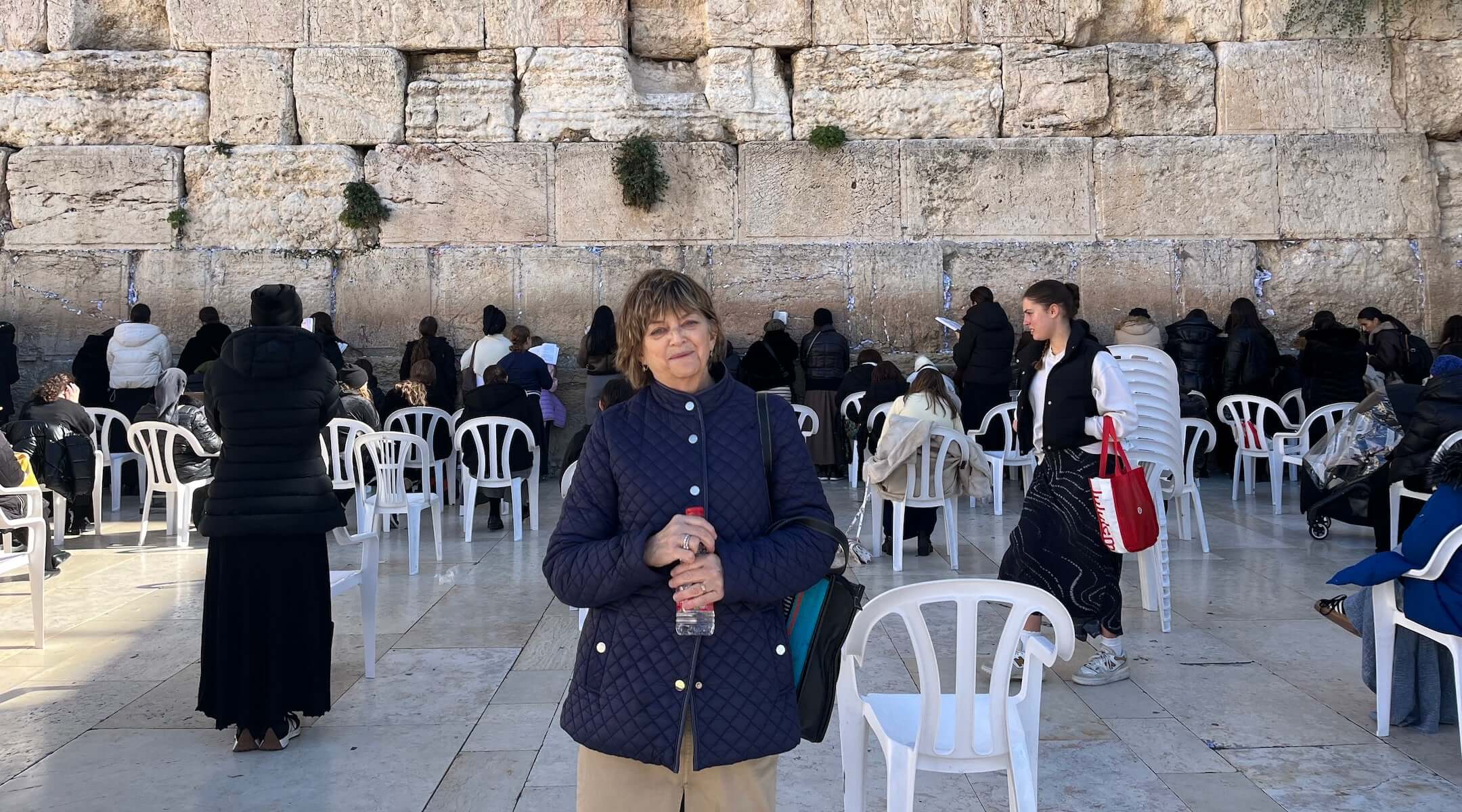
Cara Trager at the Western Wall in Jerusalem in January 2026. (Courtesy of Rachel Sales)
(New York Jewish Week) — Standing before hundreds of mourners last month, Rabbi David Wise held up a T-shirt with the words “Proud American, Proud Zionist.”
It was the shirt he had planned to wear to the Israel Day Parade that morning. Instead, he carried it to honor Cara Trager, a Queens-based journalist and congregant of his whose sudden death days earlier had left the local Jewish community reeling.
Most in attendance had planned to attend the parade, as did Trager, whose fierce support for Israel was a defining conviction of her life.
“There was nobody more pro-Israel, and a bigger Zionist, than her,” Trager’s husband, Michael, told the Jewish Telegraphic Agency. “The joke I would say is that I knew how to tell her I love you. I had to tell her I’m pro-Israel.”
Trager died May 29 from injuries sustained when she and her husband were struck by a car while returning to their home in Hollis Hills, Queens, from an Israeli restaurant four days earlier. She was 71.
“I will spend the rest of my life missing her, and wishing she was here,” Trager’s son, Eric Trager, said during her funeral on May 31. “My mother, Cara Trager, loved, and was loved deeply. This is how I will remember her, and this is how I hope she will always be remembered.”
Michael Trager said that he and his son both attended the May 27 arraignment of the driver who started the chain-reaction collision, Dawood Faisal.
Faisal, 22, has been charged with manslaughter in the second degree, leaving the scene of a collision resulting in death, reckless driving and other crimes for speeding. Faisal pleaded not guilty at his arraignment in Queens Criminal Court, and was remanded to custody without bail.
Michael Trager said that he believed that Faisal had been “looking to do damage in a heavily Jewish area.” Faisal’s attorney, Sara Pervez, did not respond to a JTA request for comment.
“As devastated as the family is, and me in particular, I’d like to at least hope that justice is served, that this puts an end, or at least helps put an end, to senseless violence,” Trager said.
But amid the grief and search for answers, Trager’s family said they remembered her for her resilience, passion and enthusiasm for life.
“In Judaism, we choose life, and she chose life again and again and again,” said Trager’s daughter, Rachel Sales. “She was never less of herself, she was always like, you get the full Cara Trager, all her beliefs, all her opinions, all her love, all her energy, all of it, you know, and we weren’t ready for … we weren’t ready, and she wasn’t ready at all.”
In addition to her husband and children, Trager is survived by her daughter-in-law, Alyssa Saunders; her son-in-law, Benjamin Sales, who worked at JTA until last year; and her grandchildren Max, Teddy, Dov and Yael.
Born on May 4, 1955, in the Bronx to Alex and Sylvia Selinger, Trager grew up in a neighborhood with few Jews. While Sales said her grandparents were “super into Jewish identity and very Zionist,” the lack of a larger Jewish community left her mother “hungry for Judaism” throughout the rest of her life.
Trager attended James Monroe High School and then Queens College, where she wrote for the school newspaper and quickly discovered a talent for storytelling. In 1975, Trager met her future husband, Michael, at a mutual friend’s party. When they reconnected at another gathering the following year, Michael Trager said he was smitten immediately.
“I wanted to marry her that night, but you know, it might be helpful to graduate college, which we did,” he said. “And it was a great marriage. It was really a great marriage.”
After graduating from college, Cara Trager went door to door with her resume, and began her career writing for trade publications, according to her family.
“She really, really wanted to be a writer,” Sales said. “And I think people said, like, ‘You’ll never be able to do it, this is impossible,’ and she was dead set on making it work.”
Before having her first child in the early 1980’s, Trager decided to leave the typical newsroom environment and strike out on her own, eventually building a successful freelance business that included bylines in the New York Post, Crain’s New York Business and Newsday, which she continued writing for until her death.
“She was a storyteller, you know, she kind of had like a flair,” Sales said. “She just liked asking a lot of questions. She was very curious about people.”
Alongside her journalism, Trager also produced publications and marketing materials for a host of Jewish organizations, including the UJA-Federation of New York, the American Jewish Joint Distribution Committee and the Jewish Theological Seminary.
“She accomplished so much in her 71 years,” Sales said. “She was definitely a trailblazer in terms of being a journalist, being able to work from home, being totally present for her kids, while also building a full career.”
Beyond her professional life, Trager dedicated herself to supporting local Jewish institutions, including serving on the board of the Solomon Schechter School of Queens, which her children attended, and serving in several leadership roles at the family’s synagogue, Etz Hayim at Hollis Hills Bayside.
Trager and her husband visited Israel 11 times together over their lives, and she was also a board member of a children’s home in Israel. Sales said that her mother would frequently tell her and her brother detailed stories about the Holocaust and the birth of the State of Israel when they were young around the dining room table.
“This was really her passion,” Sales said. “We were Conservative. She would never describe herself as observant or religious, but [it was] really more about Jewish identity and Jewish resilience and Israel.”
Known as the matriarch of her family, Trager’s family said she approached motherhood with the same passion she brought to journalism and Jewish activism.
“She was an inspiration,” Rachel Sales said. “She loved people, she loved stories, she loved life, and she was stolen from us, she was 100% stolen from us by, we don’t know why yet, but we’ll find out.”
I’m personally matching all gifts to the Forward, up to $36,000. Can I match your gift now?

Hello, fellow Forward reader! I’m Joel Brown, a Forward reader and supporter for more than 15 years, and currently the chair of the board of directors.
I’m an avid Forward reader because it ticks so many of my essential boxes: excellent journalism, Jewish focus and diverse viewpoints. In today’s political climate, what I most appreciate is the Forward’s independence — made possible by the generosity of its membership.
The Forward is committed to bringing you unbiased, nuanced Jewish news. From my position as board chair, I see an exciting future as we expand our position as the definitive independent voice of contemporary American Judaism.
— Joel Brown, Forward board chair
Support our mission to tell the Jewish story fully and fairly.