My university is enabling the Trump administration’s worst fallacies on antisemitism
As UCLA faces yet another lawsuit, it should consider a more wide-ranging approach to combatting campus hate
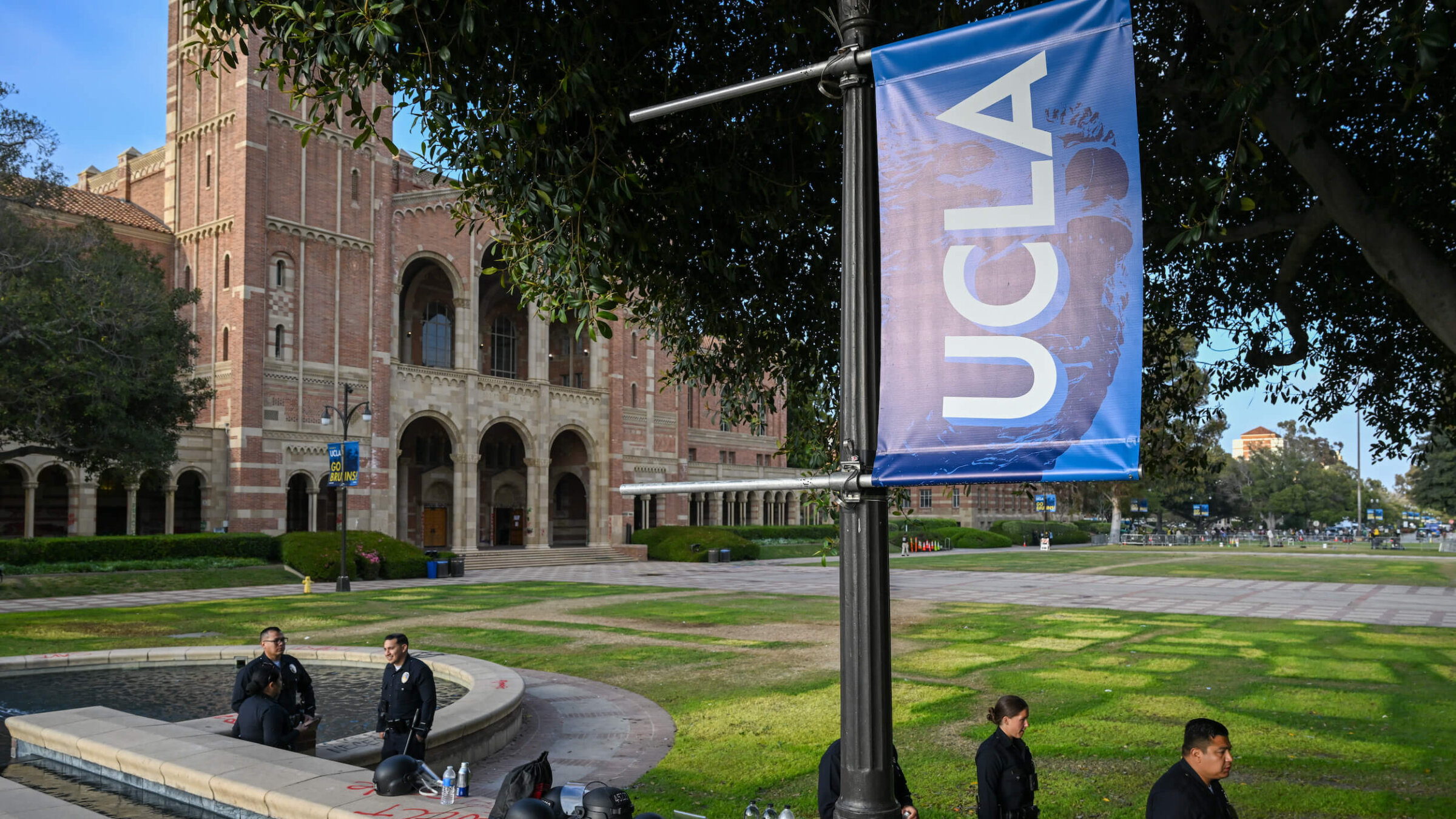
The University of California Los Angeles campus on May 2, 2024. Photo by Tayfun Coskun/Anadolu via Getty Images
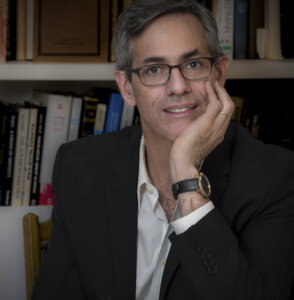
David N. Myers May 28, 2026
The Department of Justice has filed its second lawsuit of the year alleging rampant antisemitism at UCLA, where I teach.
The suit is a repetition of the same old string of allegations that President Donald Trump’s administration first made in the summer of 2025, when it froze $584 million in research funds and then tried to extract an additional $1.2 billion from UCLA. Those assertions are based on a mix of self-reporting and hearsay, assembled to make the case that the UCLA campus is awash in antisemitism.
A small number of the allegations I know or believe to be true. But the overarching claim made in the federal complaint is so partisan and partial as to be comical.
The new suit alleges that UCLA tolerated antisemitic expression and acts on campus — especially at a short-lived pro-Palestinian encampment that took place in April 2024.
It accuses UCLA of tolerating an “appalling hostile educational environment against its Jewish and Israeli students.” The fact that UCLA’s chancellor, Julio Frenk, has made the fight against antisemitism one of the pillars of his administration — and makes constant reference to the recent recommendations of a campus Initiative to Combat Antisemitism — seems not to have registered. The feds are clearly suffering from a bit of UCLA Derangement Syndrome.
This latest federal suit against UCLA succumbs to the Trumpian instinct to alter the facts to fit one’s political proclivities. In this worldview, every instance of support for Palestinians or criticism of Israel is cast as antisemitic; there can be no legitimate form of pro-Palestinian expression.
Even more remarkably, there can be no admission that the greatest display of violence that unfolded on our campus amid pro-Palestinian protests was not against pro-Israel students. Instead, it was perpetrated by pro-Israeli hooligans against the pro-Palestinian encampment activists on the evening of April 30, 2024.
Yet true to form, the complaint describes the events of that night as a battle between equals: “the occupiers and counter-protestors attacked each other with pepper spray, blunt objects, and even fireworks.” In fact, what took place was a vicious assault by one group against another — those in the encampment — that went on for more than four hours without police intervention.
This reshaping of truths seen as inconvenient betrays a tendency by Trump and his associates to adopt an exceptionally narrow lens of observation that allows for shameful distortion and denial. That tendency showed up in a farcically named 2025 executive order, “Restoring Truth and Sanity to American History,” which sought to erase any trace of racial prejudice from the annals of this country. And it continues to be present in Trump’s astounding revisionist account of January 6, 2021, which casts the violent insurrectionists as American heroes betrayed by their country.
Sadly the Justice Department’s misrepresentations in its latest complaint are founded not only on Trumpian denialism, but also on UCLA’s own antisemitism initiatives.
Both the taskforce and a subsequent action group charged with investigating on-campus antisemitism have advanced a decontextualized and one-sided story of what took place at UCLA. They have failed to acknowledge the relational nature of anti-Israeli and anti-Palestinian expression; blurred the distinction between hate speech and legitimate, albeit harsh, political expression; and left the concerns of the pro-Palestine side almost entirely unrecognized.
Paradoxically, the singular focus on antisemitism dilutes the very effort to combat it by ignoring the wider ecosystem of hate in which antisemitism operates.
I know members of the taskforce and the action group, as well as Chancellor Frenk. They are colleagues and friends of mine. But I disagree with the way they have gone about the work of combatting antisemitism at UCLA.
To begin with, none of the six UCLA scholars who hold chairs in Jewish studies and whose work touches on antisemitism — myself included — were part of the taskforce that issued its report, or the action group that followed in its wake. Some were initially invited to be part of the taskforce but chose to step down because they did not feel in sync with its direction.
Why?
Because that direction was grounded in a flawed equation of antisemitism with anti-Zionist and anti-Israel expression.
The UCLA action group’s most recent recommendations call for the adoption of the International Holocaust Remembrance Alliance definition of antisemitism, which largely advances this understanding. The recommendations give lip service to the assertion that not all criticism of Israel is antisemitic, but neither the taskforce nor the action group has ever indicated when, if ever, criticism of Israel is not anti-Israel — a category so capacious as to leave little room for criticism of any sort.
An additional concern: many of the recent action group recommendations focus on “time, place, and manner” restrictions on campus debate. While ostensibly intended to promote a safe campus environment, in practice they seem to be largely aimed at inhibiting pro-Palestinian forms of expression.
What about an alternative strategy that leverages what we do best at universities: education?
Restricting conversation has never led to positive social change. What could is a major new educational effort devoted to a multi-disciplinary analysis of antisemitism, perhaps alongside Islamophobia. The university could investigate more deeply the interconnected nature of hate in our time by supporting research efforts like those of the UCLA Initiative to Study Hate — which, full disclosure, I direct.
A more expansive tack like this stands a better chance of being effective in bringing various campus stakeholders, including students, into the fight against identity-based hate — which includes but is not restricted to antisemitism. That, rather than narrowing space for free speech, should be the goal.
Unfortunately, our own campus’ efforts to combat antisemitism move in another direction, a choice the Trump administration is working hard to reinforce with their ill-intentioned weaponization of antisemitism. I fear that UCLA will suffer for this — and that, at the end of the day, little will be done to reduce hatred and prejudice against Jews.
Did you know that only 2% of Forward readers donate to support our nonprofit newsroom? That 2% make it possible for millions to read the Forward without a paywall or subscription — removing any barriers to the full and fair Jewish story.
But while the Forward is free to read, it isn’t free to produce. Big stories — like deep dives into the antisemitism data, political scoops or reporting trips to college campuses — take months of research and fact-checking. All while we keep you informed of what you need to know each day.
— Rachel Fishman Feddersen, Forward Publisher & CEO
Support our mission to tell the Jewish story fully and fairly.