A staggering act of antisemitic hate proves the danger of Israel’s death penalty
New laws that would subject convicted terrorists to the death penalty will make Jews less safe, not more
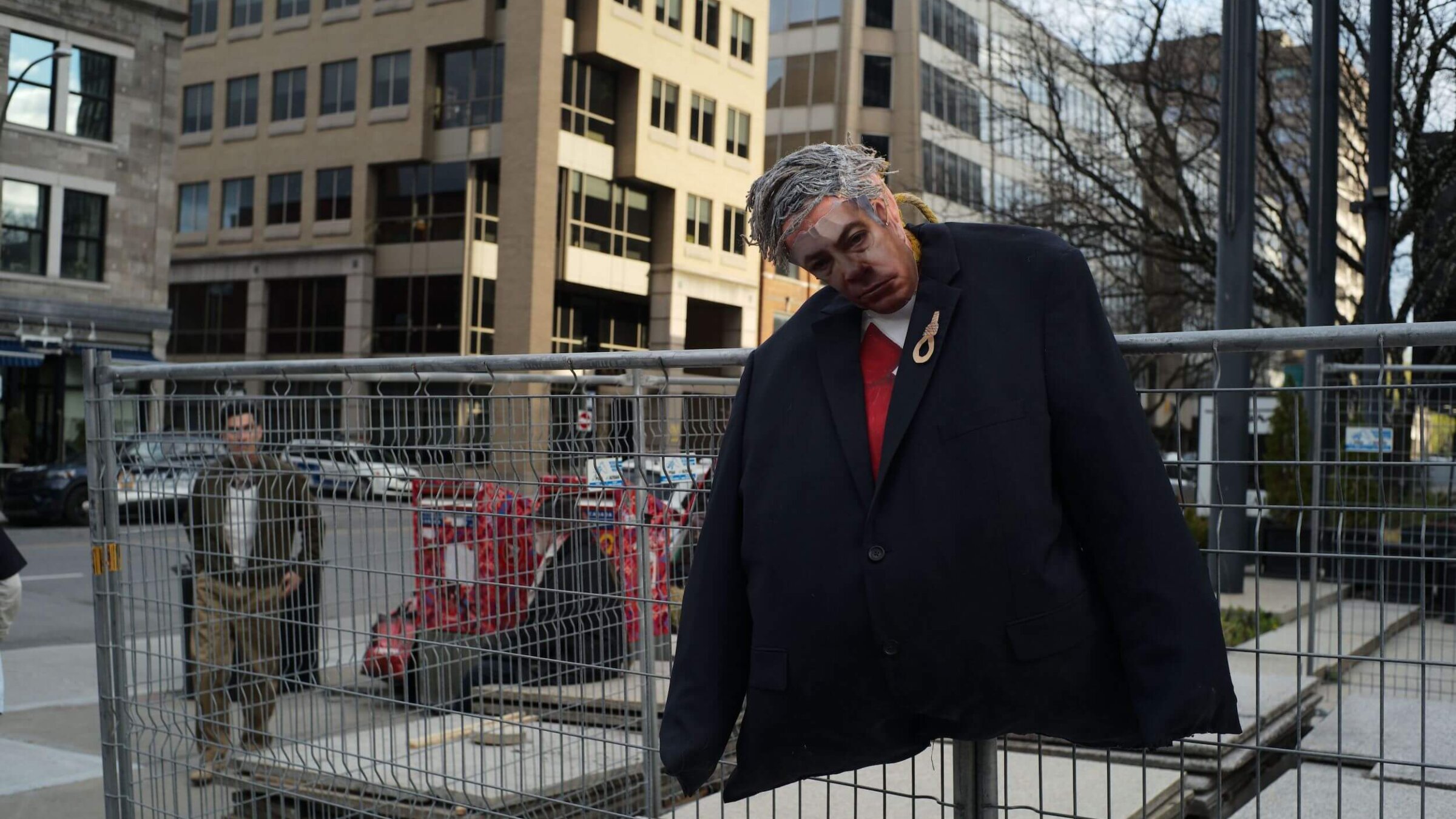
An effigy of Israel’s Prime Minister Benjamin Netanyahu was hung on a fence in front of Israel’s general consulate building in Montreal, Canada, on May 16. Photo by Giordanno Brumas/SOPA Images/LightRocket via Getty Images
A recent pro-Palestinian rally in Montreal featured something shocking: hanging effigies of Israeli Prime Minister Benjamin Netanyahu, United States President Donald Trump, and Israeli National Security Minister Itamar Ben-Gvir. They were the latest nauseating reminder that calling for executions only feeds the cycle of violence — a reminder that Israel itself needs, after the Knesset enacted two laws calling for the death penalty for terrorists.
There is no excuse for the antisemitic horror of this recent display in Canada, where I live. But there is also no doubt that Israel’s new death penalty laws will only ripen the environment in which this insidious kind of hate takes root and festers. The fact that the executed effigies of Ben-Gvir and Netanyahu both wore the same noose lapel pin that Ben-Gvir wore as he championed these death penalty laws through the Knesset underscores this point.
The lesson is simple: calls for death only fuel the urge for more killing.
This was made apparent by Hamas’ reciprocal call for violence against IDF soldiers in response to the death penalty acts. It is for this reason — the simple truth that killing tends to beget more killing — that Elie Wiesel prophetically warned of capital punishment: “Death should never be the answer in a civilized society.”
An affront to humanity
The Canadian effigies — captured in videos posted on social media — are now the subject of a hate crimes investigation, and drew widespread condemnation from local and provincial politicians across Canada, as well as Jewish groups. Montreal4Palestine, the group that hosted the mobilization where the effigies were filmed, wrote on Instagram in response that it “strongly condemns the defamatory accusations and deliberate distortion of events” and said that it has “stood firmly against all forms of hate, including antisemitism.”
The effigies, the group added, “were directed specifically at political figures” and were not “intended to represent Judaism, Jewish people, or any religious, ethnic, or identifiable community.”
What Montreal4Palestine missed, while advocating in its statement for “values of human dignity,” is the reality that any call for execution runs counter to those values.
Intention and effect
This holds true across countries and ideologies: once killing is legitimized, it becomes hard to control.
Montreal4Palestine should have understood that pretending to execute politicians who have called for executions can only raise the temperature, not lower it. Using this same principle, Israel could, perhaps, have anticipated that Hamas leadership would call for the kidnapping of IDF soldiers in response to the death penalty laws. That development only confirms a fear that opponents of Israel’s renewed execution push have articulated time and again: that these laws will jeopardize the safety and security of Jews across the globe.
In the document that was published by Israeli Public Broadcaster KAN News, Hamas leadership stated clearly that it is planning to intensify efforts to kidnap Israeli soldiers, describing such action as the only effective means of securing the release of Palestinian prisoners who might otherwise face the death penalty in Israel.
Hamas described one of the death penalty laws as a “fascist law.” The group also warned that if Israel were to execute any Palestinian prisoners, the result could be more clashes between Hamas and Israeli soldiers in Gaza. “Any harm to the life of a prisoner is an explosive that will lead to the eruption of a volcano,” the letter read.
A chance to turn back
There is still a chance to avoid this escalation. The Israeli Supreme Court will soon debate the legality of the first of the death penalty laws. If the Supreme Court fails to repeal the act, the ensuing executions will stain the moral fabric of Israeli society, and antisemitic extremists will assuredly blame all Jews for the escalation in Israeli state violence.
It will be yet another piece of data to fit into an already-warped view of Israel, and perhaps, as well, of Judaism. For some, that may be all it takes to replace hanging effigies with attacking human beings.
If repeal at the Supreme Court level succeeds, however, it could also set a precedent for the eventual repeal of the second death penalty law, which specifically targets convicted terrorists who carried out the reprehensible Oct. 7, 2023 massacres across Israel.
Repealing both laws would help to lower the global temperature. It would make Jews safer in Israel, in Montreal, and everywhere.
For this reason, amid many others, the Israeli Supreme Court must act. It must forcefully encourage Israel to return to the civilized, abolitionist path for which Wiesel called. Only then can we begin to halt the seemingly endless cycle of violence and killing.

Did you know that only 2% of Forward readers donate to support our nonprofit newsroom? That 2% make it possible for millions to read the Forward without a paywall or subscription — removing any barriers to the full and fair Jewish story.
But while the Forward is free to read, it isn’t free to produce. Big stories — like deep dives into the antisemitism data, political scoops or reporting trips to college campuses — take months of research and fact-checking. All while we keep you informed of what you need to know each day.
— Rachel Fishman Feddersen, Forward Publisher & CEO
Support our mission to tell the Jewish story fully and fairly.