Alan Greenspan, longtime Fed chairman who inspired Jewish pride and antisemitic conspiracy theories, dies at 100
The free markets champion did not play up nor try to hide his Jewish background, although both Jews and their enemies took notice
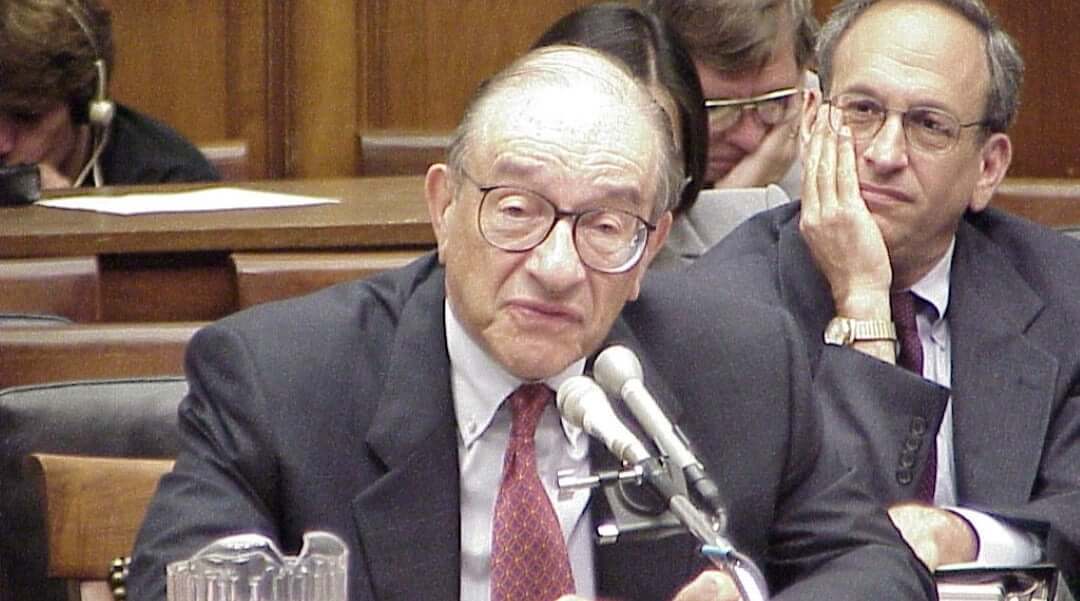
Alan Greenspan testifies before the House Financial Services Committee, Feb. 19, 2015. (Wikimedia Commons)
By Ron Kampeas June 22, 2026
(JTA) — WASHINGTON – Alan Greenspan, the free markets champion whose longevity shaping the American economy was grist for the mills of Jewish pride and antisemitic conspiracy mongering alike, has died at 100.
Greenspan, who led the Federal Reserve under presidents of both parties for 18 years, died Monday, according to a statement by his widow, veteran NBC correspondent Andrea Mitchell.
“Alan passed away at our home this morning at the age of 100 from complications of Parkinson’s disease,” Mitchell said in a statement she shared with her employer. “He was a giant of a man who helped shape the U.S. economy for decades under presidents of both parties, but was always honest in acknowledging his mistakes.”
The “mistakes” he acknowledged included first and foremost the housing bust in 2008, two years after he retired as Fed chairman.
“Yes, I’ve found a flaw,” he confessed in congressional testimony that year when Rep. Henry Waxman, the Jewish California Democrat, asked Greenspan if he regretted his laissez faire approach to keeping interest rates low. “I don’t know how significant or permanent it is. But I’ve been very distressed by that fact.”
Greenspan’s Jewish profile was low key: government He was a member of two predominantly Jewish clubs, Harmonie in New York and Hillcrest in Los Angeles. He rarely if ever headlined Jewish events, but he campaigned in the Jewish community for his favored candidates, including for Ronald Reagan in 1980, when the Republican ousted Jimmy Carter from office.
He was among a coterie of Reagan advisers who assured Jewish leaders in a New York meeting that Reagan would be a better friend to Israel than Carter, who had clashed with the government of Prime Minister Menachem Begin.
Because of his prominence, Greenspan became an avatar of postwar Jewish success. When Sen. Joe Lieberman became in 2000 the Democratic vice presidential candidate, commentators reflexively named Greenspan as one of the prominent Jews who had helped create an environment that paved the way for Lieberman’s ascent.
Greenspan’s successors as Fed chair, Ben Bernanke, and then Janet Yellen, were Jewish; by the time Yellen assumed the job in 2013, that fact seemed hardly worth mentioning.
That didn’t spare Greenspan from being fodder for antisemitic conspiracy theorists. Hutton Gibson, the extremist who shaped the views of his son, Hollywood megastar Mel Gibson, placed Greenspan at the center of his fantasies of Jewish malign influence and once said Greenspan should be hanged.
By the time he assumed the Fed chairmanship in 1987, Greenspan was a prominent Republican deeply involved in economic politics. President Richard Nixon named him chairman of the White House Council of Economic Advisers in 1974; he assumed the position just after the scandal-plagued Nixon resigned and then worked throughout President Gerald Ford’s term.
Greenspan, a prominent analyst and consultant since his early 20s, had in 1967 joined Nixon’s presidential campaign as a top domestic affairs consultant.
He came to Republican politics by way of his infatuation with the works of Ayn Rand, the Russian-born Jewish philosopher whose extreme libertarianism wrapped up in didactic, potboiler novels like “The Fountainhead” shaped generations of post-World War II conservatism. He invited Rand to his swearing-in as chairman of the White House council.
“As I got to know her better and read her materials and had conversations with her, she had a sort of effect similar to that of a favorite college professor,” Greenspan told The New York Times in 1989.
Still, for all of his attachment to Rand’s philosophy of rationalist self-interest, which she dubbed “Objectivism,” Greenspan was known above all for his caution in addressing the government’s role in distributing resources and addressing inequality.
Reagan tasked him with reforming Social Security, and some of the recommendations of the commission Greenspan headed became law. At the time, he said he had to temper his ideals, which would have scrapped the system, in order to reform a system which kept millions of retired Americans solvent.
“Do I like the present Social Security system? No,” he told The New York Times in 1983. “If you asked me whether it would be necessary in the ideal society, I’d say no. Our type of economy is far removed from where I would like to see it, but you have to be careful about moving from one type of society to another.”
A throwaway line in a 1996 televised speech referring to the “irrational exuberance” of investors caused markets to plunge and reinforced for Greenspan the importance of caution in whatever he said.
His caution and his maintenance of low interest rates steered the U.S. economy through its massive 1991-2001 boom, and helped the economy recover from the crisis precipitated by the Sept. 11, 2001 terrorist attacks. But his laissez-faire policies also were blamed for the 2000 dot-com bust and the 2008 mortgage crisis; his critics said he gave banks too much freedom, leading to abuses.
Born in 1926 in New York City, Greenspan was steered toward music school by his mother, a Jew of Hungarian descent. His father worked as a stockbroker and financial analyst. Alan attended the prestigious Julliard school and played saxophone in swing bands. On breaks between gigs, he was a voracious reader, and a book on markets led him to leave Julliard for New York University, where he studied economics.
He preserved his love for music throughout his life. Eric Alterman, the liberal Jewish commentator, recalled his conversation with the Fed chair after an introduction by Mitchell.
“I have you on CD with Woody Herman’s Thundering Herd,” Alterman, a pop music enthusiast, recalled saying. “How did you like my playing?” Greenspan said. “Better than your monetary policy,” Alterman said, and Greenspan ended the conversation.
Greenspan’s only survivor is Mitchell, whom he married in 1997 in a ceremony officiated by Jewish Supreme Court Justice Ruth Bader Ginsburg.
The Genesis Prize, the organization that awards people for commitment to Jewish values, in a social media post on Monday, said Greenspan’s virtues exemplified Jewish values.
“One of Greenspan’s guiding principles was a Jewish value of l’dor v’dor — from generation to generation: decisions made today should not mortgage our children’s future,” the organization said. Another was cheshbon hanefesh, or moral self-accounting and self-critique. After the 2008 financial crisis, Greenspan — a vocal proponent of free market policies — publicly acknowledged where his assumptions had fallen short, demonstrating a willingness to reconsider prior convictions in light of evidence.”
Did you know that only 2% of Forward readers donate to support our nonprofit newsroom? That 2% make it possible for millions to read the Forward without a paywall or subscription — removing any barriers to the full and fair Jewish story.
But while the Forward is free to read, it isn’t free to produce. Big stories — like deep dives into the antisemitism data, political scoops or reporting trips to college campuses — take months of research and fact-checking. All while we keep you informed of what you need to know each day.
— Rachel Fishman Feddersen, Forward Publisher & CEO
Support our mission to tell the Jewish story fully and fairly.