In ‘Waiting for Godot,’ the tragedy and comedy of the Jewish experience
Samuel Beckett’s classic baffled Miami audiences in 1956. Today, it couldn’t seem more a propos.
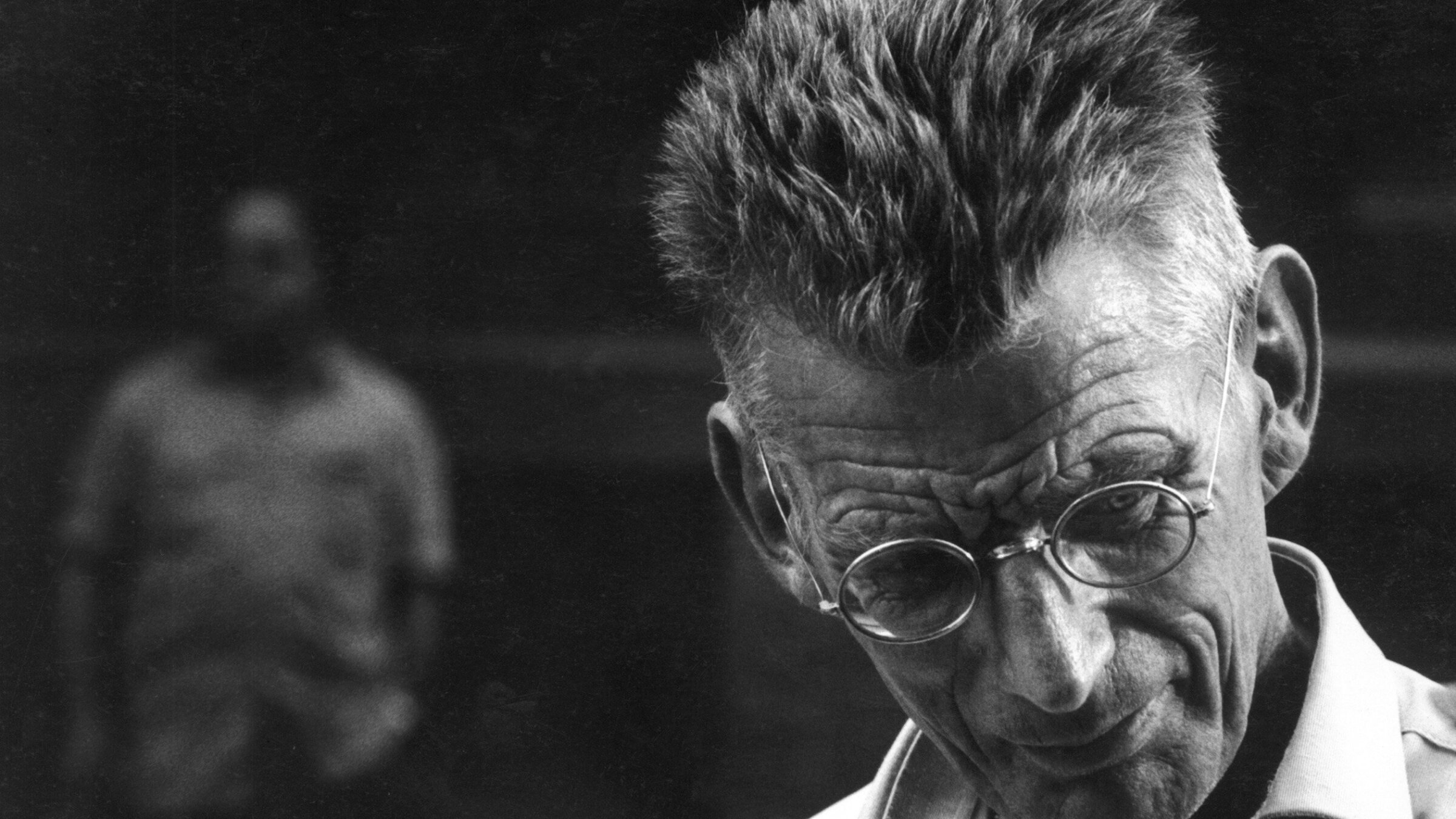
Samuel Beckett, 1964. Photo by I.C.Rapoport/Getty Images
By Robert Zaretsky May 19, 2026
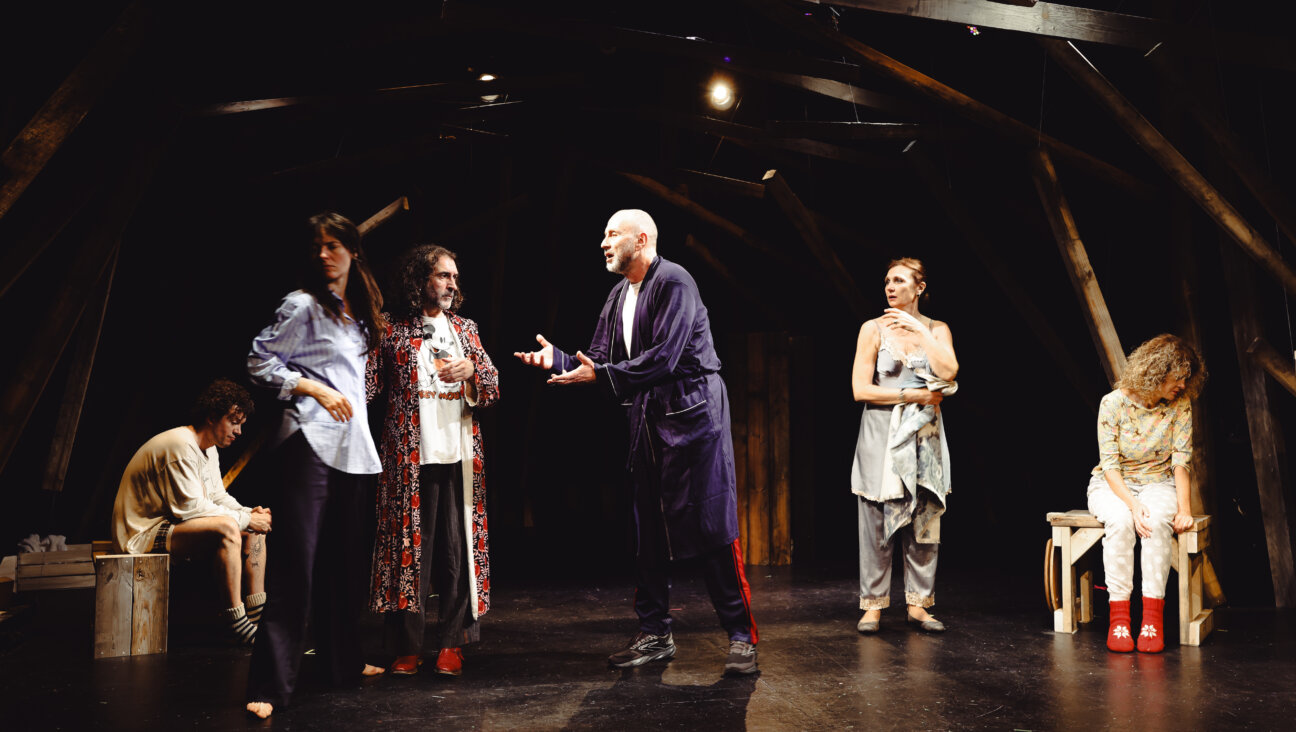
Seventy years ago, in the Coconut Grove Playhouse in Miami, of all places, the curtain opened on the American premiere of Samuel Beckett’s Waiting for Godot. The theater had promoted the play as the “laugh sensation of two continents.” By intermission, half the audience had walked out. My guess is that few of them were laughing.
Of course, Beckett had the last laugh. His two-act play, one in which the critic Vivian Mercer famously quipped that nothing happens — twice — became arguably the most influential and iconic play of the 20th century.
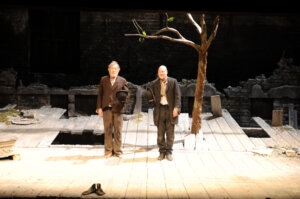
Since the theatrical debacle in Coconut Grove in January 1956, the world has not only come to terms with the play, but it has literally become the play. Of course, this happens on an individual scale, where each of us, in countlessly different ways, finds there is no way forward. No less alarmingly, it unfolds on a global scale as well, one where the world seems to be waiting, with a mixture of dread and hope, for the arrival of, well…what?
Don’t ask Beckett. He almost always insisted he had nothing to say about his plays, not to mention contemporary events. This claim is reflected in stage sets as bare and bleak as the dialogue — dialogue which gradually withers into monologues, then drifts into the mute gestures of mimes. When a French radio producer who was preparing a show on the play asked what it meant, Beckett told him, “All that I have been able to understand I have shown. It is not much. But it is enough, and more than enough for me.”
This was not enough for Bert Lahr, best remembered as the Cowardly Lion in The Wizard of Oz, who had been cast as Estragon in the Coconut Grove production. His son, the theater critic John Lahr, recalled in a New Yorker essay that the elder Lahr was terrified not that he would forget his lines, but instead that he would never understand them. Still, the younger Lahr who, when he was 14, ran the play’s lines with his father, recalled: “If Dad was mystified by the play’s idiom, he understood all too well its psychological terrain: waiting, anguish, bewilderment.”
There are certainly clues enough to the play’s meaning in the world wracked by world wars and cold wars, genocidal regimes and totalitarian ideologies, the poisoning of our natural resources and denaturing of our political discourse. Obviously, Beckett could not fully remove himself from this world. As one of his favorite thinkers, Arthur Schopenhauer, observed, even Dante mined the material for his hell from his medieval world.
Similarly, Beckett found his hell in a modern world ever more brutalized in ever more technologically advanced ways. The play’s stage set — a bare tree, an empty road, a rocky mound — suggests the world that, a few years earlier, had been the scene of death camps and death marches. As a volunteer at a pile of rubble that was once a hospital in the liberated, and almost entirely obliterated, French city of Saint Lô, Beckett saw firsthand the unfathomable cost of total war. He was no less stricken by what the war cost European Jewry. As Germany defeated and occupied France in 1940, Beckett was among the earliest recruits to the French resistance. He was appalled by what the Nazi occupation meant for French Jews, including his friend Alfred Péron. (When Beckett’s resistance network, “Gloria,” was uncovered by the SS, he just managed to escape to southern France, but dozens of fellow résistants, including Péron, were captured and imprisoned.)
Though it is always a dicey matter to connect settings and dialogue from fiction with those from fact, there are instances in Godot that, like Estragon, beg for such attention. An early exchange between Didi and Gogo anticipates the work on antisemitism by Hannah Arendt, who managed to hide in Montauban, a city a few dozen kilometers from Roussillon, the city where Beckett was hiding.
Vladimir: Your Worship wishes to assert his prerogatives?
Estragon: We’ve no rights anymore?
[Laugh of Vladimir, stifled as before, less the smile.]
Vladimir: You’d make me laugh if it wasn’t prohibited.
Estragon: We’ve lost our rights?
Vladimir: [distinctly] We got rid of them.
Or take another exchange between the two displaced and disoriented friends, one that evokes what was revealed to the world with the liberation of Auschwitz.
Vladimir: Where are all these corpses from?
Estragon: These skeletons.
Vladimir: Tell me that.
Estragon: True.
Vladimir: A charnel-house! A charnel-house!
Estragon: You don’t have to look.
Vladimir: You can’t help looking.
There are many other clues, some so obvious that Beckett dropped them from the final draft. For example, Estragon was originally named Lévy. (More than 1,500 individuals by that name, the most common Jewish name in France before the war, were deported to the death camps.) Or that estragon, as commentators have remarked, is a bitter herb that is rooted in the practice of Passover.
But to over-emphasize these possible meanings of Beckett’s play is to underestimate a broader and deeper meaning. Didi and Gogo offer something of immeasurable value — apart, that is, from uneasy laughter. They embody the virtues of solidarity and compassion — virtues that, paradoxically, go hand in hand with Beckett’s pessimism. In this tragicomedy, there are luminous moments of goodness, as when Didi cares for Gogo by offering him carrots, calming him with a song, and covering his shoulders with his own coat while Gogo sleeps.
For Beckett, this was and remains, as Pozzo declares in the play, “a bitch of a world.” And yet, Gogo and Didi, who always threaten to go, nevertheless always fail to do so. Of course, this offers a very dim prospect. But the image of these friends reminds us that Beckett never gave up on humanity. We must not, either.
I’m personally matching all gifts to the Forward, up to $36,000. Can I match your gift now?

Hello, fellow Forward reader! I’m Joel Brown, a Forward reader and supporter for more than 15 years, and currently the chair of the board of directors.
I’m an avid Forward reader because it ticks so many of my essential boxes: excellent journalism, Jewish focus and diverse viewpoints. In today’s political climate, what I most appreciate is the Forward’s independence — made possible by the generosity of its membership.
The Forward is committed to bringing you unbiased, nuanced Jewish news. From my position as board chair, I see an exciting future as we expand our position as the definitive independent voice of contemporary American Judaism.
— Joel Brown, Forward board chair
Support our mission to tell the Jewish story fully and fairly.