They told Willy Loman he was everything; ’twas a great American lie
In a new Broadway revival of Arthur Miller’s ‘Death of a Salesman,’ a ‘King Lear’ for our time
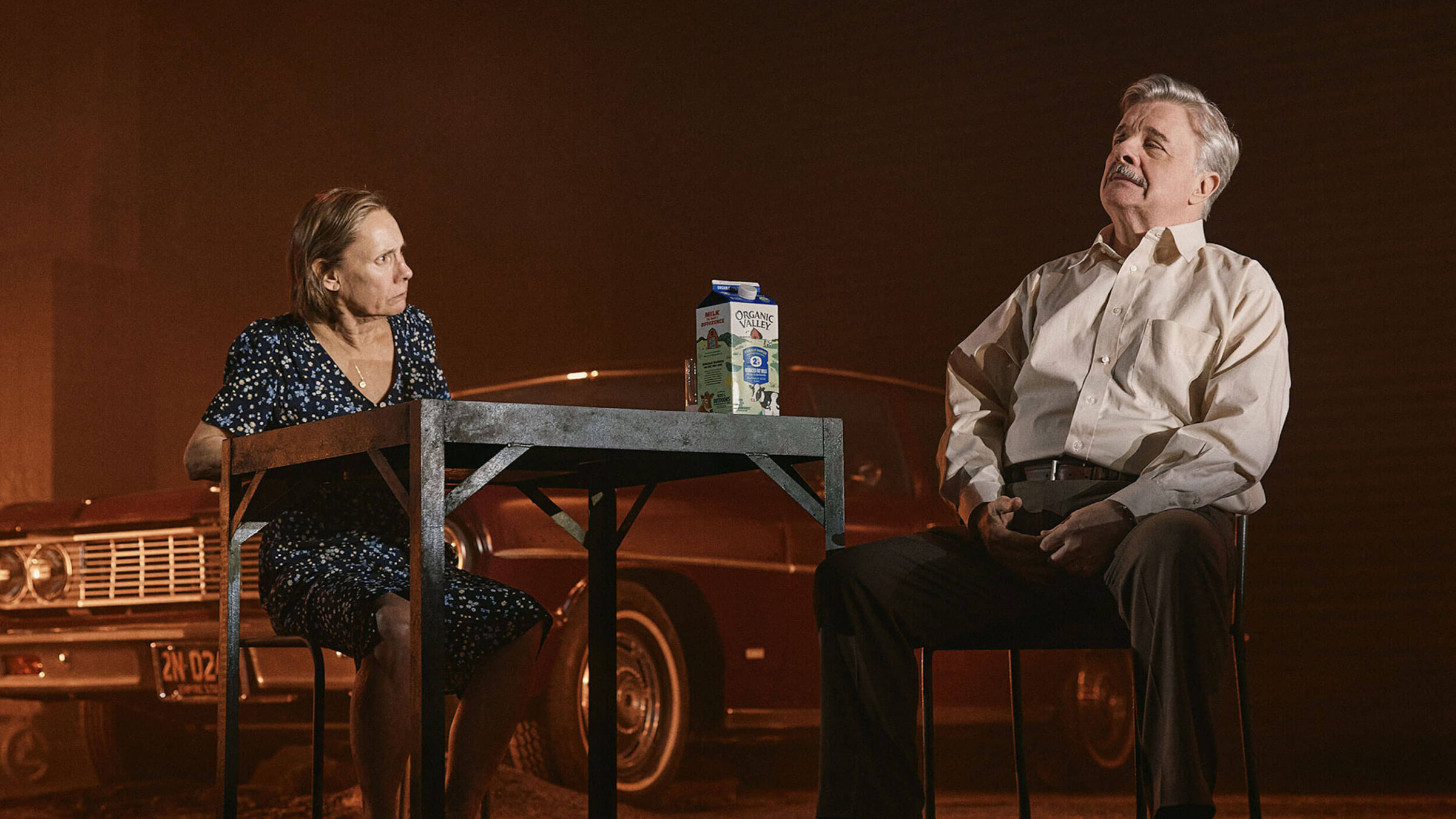
Laurie Metcalf and Nathan Lane in ‘Death of a Salesman.’ Photo by Emilio Madrid

By Talya Zax April 28, 2026
The great innovation of Shakespeare’s King Lear is that its patriarch has no sons. This problem — Lear has a vast estate, and only daughters to inherit it — marks the onset of a disaster. Because the king has no obvious heir, he is able to remake his world as he sees fit. But his choice to split his kingdom between his three daughters, based on the degree of fealty they express toward him, is catastrophic. It can be argued that Lear suffers from an excess of liberty. Without a rulebook to follow, he wreaks destruction on the country he had hoped to preserve in his image.
Arthur Miller’s Death of a Salesman is a kind of American Lear. In the midcentury United States, every man can be his own king, leaving Willy Loman suffering from a version of Lear’s affliction. Willy has arrived at a time in life at which he is keen to secure his own legacy. Unlike Lear, he has only sons, and is painfully committed to having his first-born take on his mantle. But in the land of the free, he has perversely and perhaps unconsciously spent his life glorying in his ability to make the wrong choices.
Spoilers: Willy’s choice of how to bequeath his kingdom, such as it is, will work out almost as tragically as Lear’s.
A new Broadway production of Death of a Salesman, starring an excellent Nathan Lane as the archetypal failed American father, leans into the quasi-Biblical nature of this story. It is a tale for Americans to pray over: May we become wiser and stronger as a people by learning from our forefather’s mistakes. And it is a tale to atone over, as well. Just shy of eight decades since the play’s debut in 1949, there is a great and ever-mounting body of evidence to suggest we have done very little learning at all.
Death of a Salesman follows two days in the life of the Loman family, who live in Brooklyn and have, at long last, very nearly paid off their mortgage. But they have perhaps never felt more insecure. Bills are piling up. Willy’s job as a traveling salesman has stopped paying him a salary. In his 60s, he is beginning to feel his age, and as he works for scant commissions, he’s started to exhibit a faltering grasp on reality, and an increasingly vigorous drive toward self-destruction. His wife Linda — played by Laurie Metcalf, who is, as always, stellar — senses terrible possibilities just around the corner.
Meanwhile, adult sons Biff (Christopher Abbot) and Happy (Ben Ahlers, although I caught Jack Falahee in a fine understudy performance) are in the midst of the sort of drawn-out coming-of-age crisis that each generation seems to invent anew. They don’t know who they are. They can’t see a way toward making enough money. They’re unwilling to commit to anything or anyone. They yearn for big American lives — cattle ranches, an endless stream of available women, the dream of finally pulling one over on the boss — and are only just beginning to question whether that yearning has anything to do with the big American emptiness they feel.
The pressure created by the family’s unfulfilled dreams — of financial security, a sense of purpose, a bit of rest — turns most explosive between Willy and Biff. Willy yearns for his eldest son, once a promising boy who idolized his father, to become the business bigshot he never quite managed to become himself. But, at 34, Biff no longer seems able to stand anything about his father — up to and including the flashy American brilliance Willy sees himself as bequeathing. The tension between the father with a dream, and the son who refuses to fulfill it, comes to tragedy.
In this way, Willy’s problem is an inversion of Lear’s: His obsession with his firstborn son drives him and his family to a kind of ruin. (Youngest child Happy’s story is the quietest tragedy in Death of a Salesman; he is an overgrown boy, developmentally frozen by his desire for Willy’s never-forthcoming approval, or even attention.) And as Shakespeare’s great tragedy illustrated certain formative flaws in the English national character — I cannot recommend James Shapiro’s The Year of Lear enough — so Willy’s obsession casts a damning light on the country that created him.
Willy is all-American: He loves cars, football, fantastic get-rich-quick schemes and womanizing. He sees his chosen profession as evincing great American values: “respect, and comradeship, and gratitude,” not to mention the glory of the open road.
He’s also an individualist who has abundantly reaped the costs of that posture. He has exactly one friend, a neighbor called Charley, whom he appears not to actually like. He sees himself in constant competition with his fellow man, and carries a strain of exceptionalism that borders on the delusional. His conviction that he lives in a land of boundless opportunity has poisoned him against reality. He understands, on some level, that he hasn’t completely succeeded in achieving glory, but he can’t let himself accept that understanding. As it turns out, he would rather die.
These flaws are particularly painful to encounter at this moment, when the country has less a president than a salesman-in-chief. Willy’s preoccupation with a certain kind of smoke-and-mirrors business success now seems less like a reflection of the country Miller knew than a prediction of the ways in which it would decline. The fallacy that liberty is inherently tied to financial success has warped the nation, just as it warped Willy himself.
Biff rejects the exceptionalist mindset Willy strives to instill in him: “Pop, I’m a dime a dozen, and so are you!” he rages in a climactic argument. But Happy buys into his father’s worldview, celebrating him as a great possessor of “the only dream you can have — to come out number-one man.” When Happy insists that he will follow in Willy’s footsteps and “beat this racket” — the obscure American system that seems to keep the common man down, despite the country’s promise — the audience can easily imagine what will follow: a lifetime of disappointed entitlement, and, in the end, a legacy as meager as his father’s.
Willy might see it as an insult for Happy, whom he’s always treated as an afterthought, to seize the title of his true heir. Like Lear, his preoccupation with the question of what he’ll leave behind, and who will treasure it, has prevented him from understanding the truth about his children and himself. Lear is too attached to the concept of his own majesty to bother with effective governance; Willy is so devoted to his false idol of success that he departs the world without knowing much about it. In both cases, the playwrights understood what their characters couldn’t: that children, like countries, learn by example.
Correction, April 28: A previous version of this piece misnamed the understudy who portrayed Happy.
I’m personally matching all gifts to the Forward, up to $36,000. Can I match your gift now?

Hello, fellow Forward reader! I’m Joel Brown, a Forward reader and supporter for more than 15 years, and currently the chair of the board of directors.
I’m an avid Forward reader because it ticks so many of my essential boxes: excellent journalism, Jewish focus and diverse viewpoints. In today’s political climate, what I most appreciate is the Forward’s independence — made possible by the generosity of its membership.
The Forward is committed to bringing you unbiased, nuanced Jewish news. From my position as board chair, I see an exciting future as we expand our position as the definitive independent voice of contemporary American Judaism.
— Joel Brown, Forward board chair
Support our mission to tell the Jewish story fully and fairly.