It looks like a kaffiyeh, but this pro-Israel activist wants you to wear a sudra
Rudy Rochman is leading the charge to bring back a head covering Jews wore across the Middle East
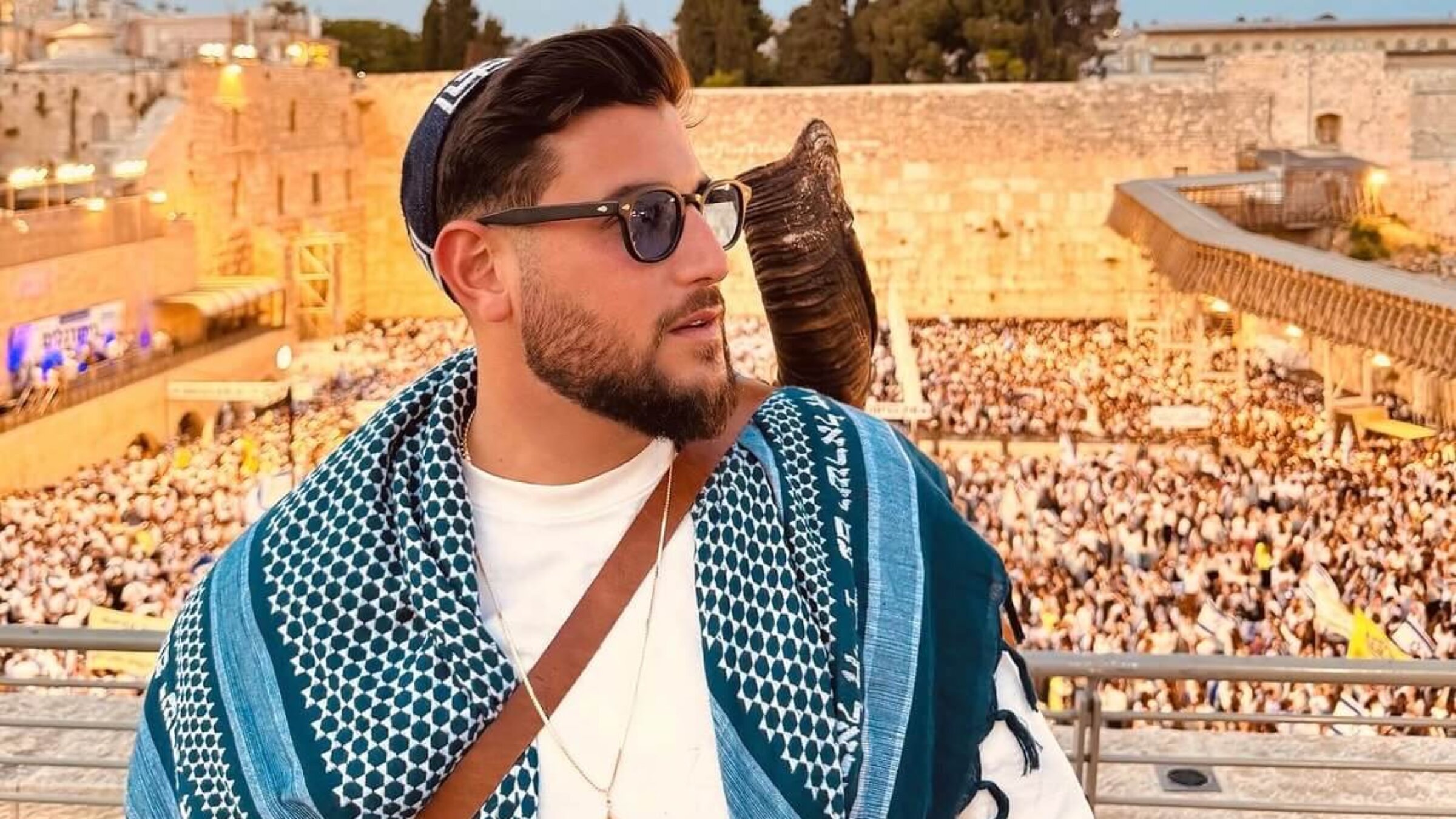
Rudy Rochman wearing a sudra at the Kotel in Jerusalem, Israel Courtesy of Rudy Rochman

By Simone Saidmehr May 17, 2026
In a recent viral Jubilee video viewed more than 1.5 million times, pro-Israel activist Rudy Rochman sits across from a group of 20 pro-Palestinian activists, debating the Israeli-Palestinian conflict. Draped around his neck is a black-and-gray checkered scarf that looks almost identical to a kaffiyeh.
Look closer, and the pattern resolves into something else: tiny Stars of David clustered together, alongside Hebrew lettering spelling out Am Yisrael Chai — “the people of Israel live,” which has became a mantra after Oct. 7 and the hostage crisis. It’s not a kaffiyeh, Rochman says, but a modern twist on the sudra, a cloth head covering once worn by Jews across the Middle East — and he wants to bring it back.
Since the Gaza War, the kaffiyeh has become an increasingly visible symbol of pro-Palestinian activism. Now, Rochman is part of a small but growing effort to revive the sudra as a marker of Jewish identity rooted in the Middle East. Since 2016, he has run the company My Sudra, promoting and selling the garment online, where it has been embraced by young pro-Israel influencers.
Rochman, a 32-year-old Jew whose family lived in Morocco and Algeria for decades, said he and his family wore sudras during celebrations like bar mitzvahs and weddings. In old family albums, Rochman says most photos of his grandfather and great-grandfather show them donning the garment in Morocco.
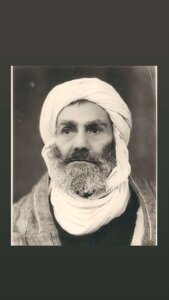
As a child, Rochman understood the head covering as Middle Eastern rather than distinctly Jewish. Once he learned about its connection to Judaism, he set out to revive it, beginning to create sudras while a student at Columbia University.
The term sudra appears in rabbinic literature, including the Mishnah and Talmud, as a general term for a cloth typically worn as the religiously prescribed head covering, though some sources describe Jews wearing it around their necks. Experts say Jews across the Middle East wore sudras, likely before the Middle Ages, with styles varying by region and period.
From the Middle Ages into the modern era, Jews in the Middle East, classified as dhimmis, sometimes faced legal restrictions on dress. One notable prohibition during certain periods was the wearing of a headscarf or turban by Jews, including the sudra.
“This form of headgear by Jewish men was not tolerated in many communities,” said Gillian Vogelsang-Eastwood, a textile historian specializing in Middle Eastern dress. “Men could wear the kippah, but nothing significant in public on the head.”
Over time, she said, those constraints contributed to the fading of the custom.
“For me, it’s about reviving an aspect of our culture that was beaten out of us by force,” said Rochman. “It’s not like we consciously made a decision. ‘Hey, we want to stop wearing sudras.’ We were forced to stop wearing it.”
Historically, sudras did not usually feature identifiably Jewish symbols. The Kurdish sudra is an exception, incorporating circles and dots with religious meaning. Even in Rochman’s own family photos, his ancestors typically wore plain white sudras.
Rochman, however, has deliberately added Jewish symbols to make the garment legibly Jewish to contemporary eyes.
Rochman sells sudras in various colors, including a dark blue-and-fwhite version that looks exceptionally similar to the Palestinian version of the kaffiyeh. Instead of the pattern of zig-zag stripes and criss-crossed squares that can be found on that kaffiyeh, Rochman’s sudra has stars of David juxtaposed to create a checkered pattern, as well as Jewish symbols like the menorah, along with the phrase Am Yisrael Chai.
The resemblance to the kaffiyeh is not accidental.
The kaffiyeh is widely seen today as a symbol of Palestinian identity and resistance, but it did not always carry that meaning.
According to Vogelsang, “The kaffiyeh is basically regarded as a 19th-century development worn by farmers in Syria,” she said. “The Jordanian army later adopted it as part of their uniforms.”
Vogelsang says its political symbolism developed in the 20th century, particularly through its association with Palestinian nationalism and figures such as PLO leader Yasser Arafat, who popularized the black-and-white kaffiyeh widely worn today.

Some say the patterns on the Palestinian black-and-white kaffiyeh represent different aspects of Palestinian culture. The criss-cross lines represent the Palestinian ties to the Mediterranean Sea because of their resemblance to fishnets; the black stripes symbolize trade routes through Palestine; and the curved lines are said to symbolize olive trees.
But Vogelsang and other experts say that this symbolism is a modern interpretation of older patterns. “They didn’t have these meanings. The Palestinian community has given them these meanings,” she said.
Patterns like checks and stripes were often used for garments in the Middle East, not because of any particular symbolism, but because “they are just an easy, convenient design to make,” said Vogelsang. Both Jews and Muslims used whichever fabrics were locally available, often checkered and striped patterns commonly associated with the modern-day kaffiyeh.
In a similar way, Rochman’s sudra takes on explicit political meaning through the inclusion of the phrase Am Yisrael Chai, popularized in the 1960s as a rallying cry for Soviet Jewry and now widely used at pro-Israel demonstrations. In that sense, his garment does not just revive a historical practice, but imbues it with ideological significance.
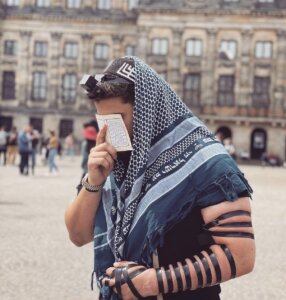
“Being a Zionist outwardly was kind of seen as excessive before Oct. 7, but after Oct. 7 it became something that was cool again,” Rochman said, adding that interest in — and sales of — his sudras increased following the attacks and the war in Gaza that followed.
I asked Rochman if he’s ever worried about being mistaken for wearing a kaffiyeh or accused of cultural appropriation. Dozens of Reddit threads are dedicated to the topic online. In the Jubilee video, one Palestinian activist tells him, “Are you going to pretend that the kaffiyeh you’re wearing is not a culturally appropriated kaffiyeh? And you just added the Hebrew and all of that to it.”
But he is not particularly bothered by either accusation.
“I look at it as just an opportunity to tell that person, whether a Jew or not a Jew, that doesn’t know anything about a part of Jewish culture, who we are and what we are.”
And while Rochman’s main goal is to help younger generations of Jews understand a part of their history that has faded, he hopes that more Jews wearing the sudra will also foster a greater understanding of Jewish history in the Middle East.
“We need to know where we’re from,” Rochman said. “And if it helps us connect with other Middle Eastern peoples, that’s amazing too.”
I’m personally matching all gifts to the Forward, up to $36,000. Can I match your gift now?

Hello, fellow Forward reader! I’m Joel Brown, a Forward reader and supporter for more than 15 years, and currently the chair of the board of directors.
I’m an avid Forward reader because it ticks so many of my essential boxes: excellent journalism, Jewish focus and diverse viewpoints. In today’s political climate, what I most appreciate is the Forward’s independence — made possible by the generosity of its membership.
The Forward is committed to bringing you unbiased, nuanced Jewish news. From my position as board chair, I see an exciting future as we expand our position as the definitive independent voice of contemporary American Judaism.
— Joel Brown, Forward board chair
Support our mission to tell the Jewish story fully and fairly.