The Israeli song that almost won Eurovision was about far more than the breakup of a love affair
Sung by Noam Bettan, ‘Michelle’ is a tribute to Jewish multilingualism with a message for the entire world
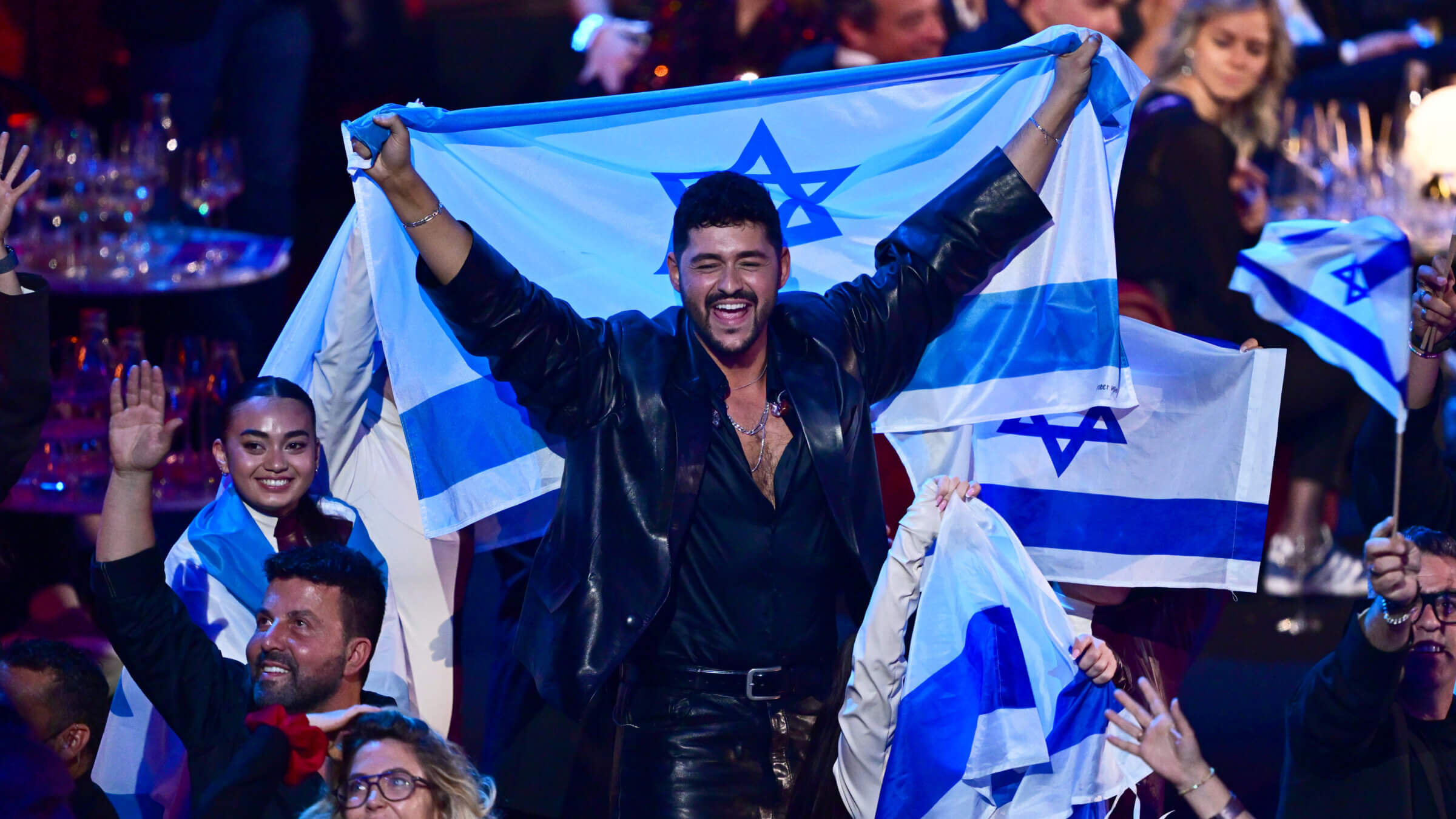
Noam Bettan celebrates during Eurovision. Photo by Christian Bruna/Getty Images
By Aviya Kushner May 18, 2026
Noam Bettan, Israel’s Eurovision candidate who took second place in the competition, sang in three languages, and chose to start his performance in Hebrew. Meanwhile, the winner — from Bulgaria — sang entirely in English.
In all the news coverage of Eurovision, the tradition of Jewish multilingualism — and Bettan’s moving pride in his languages — was left out. But it’s an important part of Bettan’s family history, and it’s also a repeating theme of Jewish history.
Bettan’s parents immigrated to Israel from Grenoble, France, and before that, the Bettans lived in Algeria. Noam Bettan was born in Israel and grew up in Ra’anana, which is home to many English speakers.
As a child, he found it difficult to connect with members of his own family, because he was the only one who was born in Israel. He was also the only one who spoke Hebrew as a mother tongue, he told Israel’s Walla in 2021.
“Michelle,” the song Bettan sang in competition, is a rare trilingual song. It starts in Hebrew, the language in which Bettan feels most at home. Then it moves to French, the language of Bettan’s parents; his French is impeccable, and it was a nod to the importance of non-English languages in a contest that often favors English.
Last year’s winner, Austria’s JJ, performed “Wasted Love” entirely in English. When Israel won Eurovision in 2018 with Neta Barzilai’s “Toy,” the performance was also entirely in English.
When Bettan reached the third language of his song, English, which he likely heard in Ra’anana’s streets growing up, he mentioned walking through the Tel Aviv neighborhood of Florentin. His English was fine, but not as strong as his French.
He then moved back to Hebrew, and visibly moved at the end of his own performance, with tears in his eyes, ended with Am Yisrael Chai — “the people of Israel live.”
To what extent do Bettan’s language skills represent Israel?
More than 80% of Israelis speak more than one language; around 85% have some English proficiency, because English is mandatory in schools. Two percent of Israelis speak French as a mother tongue.
About 1 in 5 Israelis speak fluent Russian. Ten percent of Israeli Jews understand some Arabic but only 2.6% can read and understand Arabic-language media, according to a 2018 study by Sikkuy, an NGO which promotes equality between Israeli Jews and Arabs. Meanwhile, 53% of Israeli Arabs rated their Hebrew “good” or “very good,” according to Israel’s Central Bureau of Statistics. An estimated 250,000 Israelis speak Yiddish, and around 140,000 speak Amharic.
In the controversy over this year’s Eurovision, in which Spain, the Netherlands, Ireland, Slovenia and Iceland, all quit to protest Israel’s inclusion, some online commentators claimed that Bettan was singing about more than a breakup with a woman named “Michelle.” They thought he was singing to Europe, including the countries that walked out because he was on stage.
Mitpalel alayich, sh’tizki le’ehov—“I pray over you, that you will be privileged to love,” he sang. Bein dim’aa l’dimaa, yesh mi sh’yishma. “Between one tear and another tear, there will be someone who hears….”
Some believed that he was singing about the complex Jewish relationship with the European continent, the site of the greatest slaughter in Jewish history, now seeing a resurgence of antisemitism. He was singing, in French, telling Europe — nicknamed “Michelle” — that he was leaving.
But then, at the end, he sang in Hebrew that he hoped something good would happen to us.
That’s the mindset of many Jews right now, who no longer feel welcome in their prior homes — whether that’s a city, a country, or a profession. That pain may have morphed into an award-winning, trilingual song heard by millions, transliterated into English here, which might be about a girl — or, perhaps, about an entire people.
I’m personally matching all gifts to the Forward, up to $36,000. Can I match your gift now?

Hello, fellow Forward reader! I’m Joel Brown, a Forward reader and supporter for more than 15 years, and currently the chair of the board of directors.
I’m an avid Forward reader because it ticks so many of my essential boxes: excellent journalism, Jewish focus and diverse viewpoints. In today’s political climate, what I most appreciate is the Forward’s independence — made possible by the generosity of its membership.
The Forward is committed to bringing you unbiased, nuanced Jewish news. From my position as board chair, I see an exciting future as we expand our position as the definitive independent voice of contemporary American Judaism.
— Joel Brown, Forward board chair
Support our mission to tell the Jewish story fully and fairly.