How a wedding in Oklahoma taught a group of police officers and SWAT team members to care about Judaism and Israel
Before my daughter’s marriage, many attendees had never met a Jew
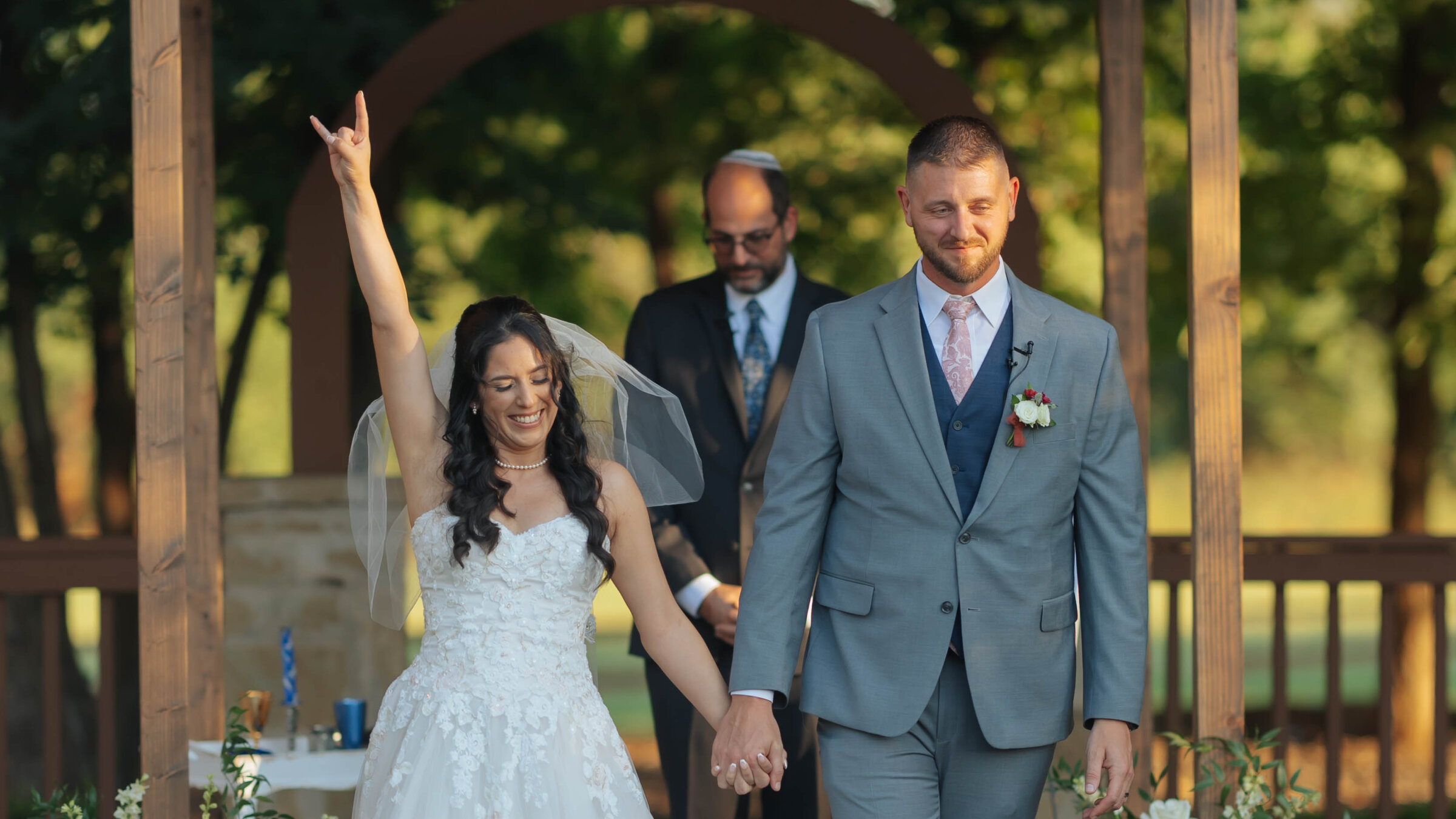
The bride and groom on their wedding day. Courtesy of Carla Singer
I told the rabbi who was about to officiate at my daughter’s wedding that the guests would be an unusual mix — about 100 law enforcement officers, EMTs, dispatchers, sheriffs and SWAT team members, many of whom had never met a Jew other than my daughter.
“In fact, they may not know that she is Jewish,” I said, “The other 50 guests will be our family from London, New York, Canada, Israel, a very different crowd.”
My daughter and Zac are both police officers in Oklahoma. Zac isn’t Jewish, but they both had wanted a Jewish wedding. It wasn’t easy finding a rabbi they actually liked who would officiate an interfaith marriage. The wedding was held Sept. 2, 2023. There was an outdoor garden and a bridge that led to the ceremony. The chuppah was constructed from an Amazon set of interlocking wooden bricks that the groom and his father assembled proudly. We decorated it with flowers but it looked like it could tilt over at any moment. The bride was bride-beautiful, a tiny 5-feet-1-inch with her handsome groom, a very tall 6-feet-6-inches.
They were exquisitely happy and stood together as Rabbi Michael conducted the service, making sure to explain everything including the Hebrew parts. At the end of the ceremony, Zac even stepped on the glass and crushed it. The police officers, EMTs, firefighters, and SWAT teams were all riveted.
The party was held in the nearby barn, which was decorated with chandeliers and flowers and a DJ playing a mix of music. We danced the hora and the SWAT team managed to lift Zac and Martine high in the air as is tradition — a novel experience for most of our guests.
Then Oct. 7 happened in Israel.
I got a call from my daughter: “Mom, my phone is ringing with many of the law enforcement people who were at our wedding. They want to know how they can help Israel.”
I was touched; they were responding because of the wedding they had attended.
Later that day my daughter called again: “Mom, I’m at the military supply store downtown, and the owner says she has 27 IFAK emergency medical kits. She wants to help Israel and will give the kits to me at cost. What should I do?”
By now I had heard from my friends in Israel that the government had been unprepared for the attacks and supplies were lacking.
“How much do they cost?” I asked. “Buy them all. While you’re at it, buy a bunch of tourniquets.”
From that moment on we tried to get these professional emergency medical IFAK kits to the IDF. The problem was that there was a backlog at the airport in Tel Aviv; donations were piling up because the IDF hadn’t been able to authorize them yet.
Because I had lived in Israel and had experienced another surprise October war in 1973, I had many Israeli contacts. I spoke to an IDF representative.
“We’re desperate for IFAKs. Yes, we need them,” he said.
“How do we get them to you?” He had no answer.
After a day of trying, I ran out of contacts and let my daughter continue. After all, she’s an excellent police officer and investigator.
Another day passed before I talked to my daughter again.
“Martine, how are you doing with the IFAKs?” I asked.
“Mom, they’re in Israel with a paratrooper unit,” she said.
I was shocked. “How did you get them there?” I asked.
Apparently, she had managed to track down a man who runs a volunteer retired military airlift organization. He wanted to help but said that his planes were flying medical supplies to Ukraine. Understanding the urgency, he gave her the name and contact information for his neighbor Moshe in Texas. Moshe was a retired Israeli commander of paratroopers.
“Take all of your IFAKSs out of their wrappings. Put them in a duffle bag and ship them to this address in Greenwich Village in New York City. Someone there will receive it and get it to a unit in the field in Israel,” Moshe told Martine.
Two months later at Christmas time, my daughter visited me in New York and we had family over for dinner. I urged her to tell the story.
“Well, Mom,” she said, “I have the video of the soldiers that they sent to me as a thank you.” She queued up her cell phone so we could see it.
Two soldiers stood alone in the dark — one held a machine gun and stood guard; the other held a sheaf of papers. “Martine, thank you for sending us the medical kits. We really need them,” he said. “Thanks also for the letters you sent with them. Yes, we will take you and your husband to the club you mentioned in your letter when you come to visit next time.”
Letters?
Martine had sent a long letter in the duffle bag, with others that had been written by police officers who had been at her wedding. They had been in the military before joining the police force. Their letters were short: “We have your backs. We support you and know what you’re going through. We were in Iraq, Afghanistan, and wish you the best.” They had heard about the duffel bag as word spread among the wedding guests and they wanted to do something. They did.
Recently, with antisemitism running rampant, a few of Martine’s police officer friends have quietly approached her. “We’ve been discussing where we would hide you, and protect you if our country turns against its Jews like they did in Germany,” they’ve told her. “You’ll be safe with us.”
One Jewish wedding educated a group of people. At one ceremony. At one party. In one night.