Liberal-thinking Jews like me need a new way to think about Hanukkah
The author of a new prayer book for non-theistic Jews imagines a holiday that doesn’t celebrate military might or the supernatural
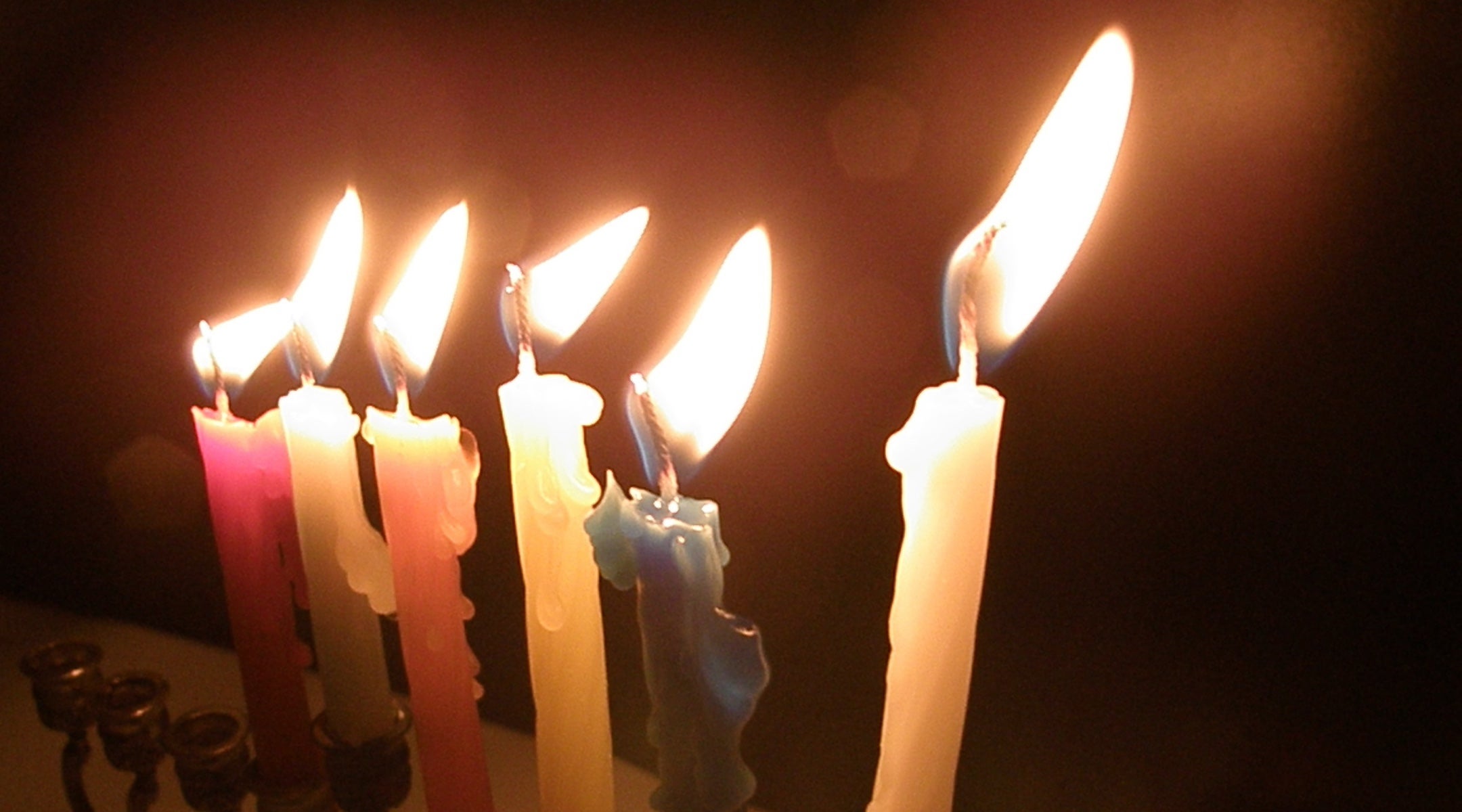
Photo by Ron Almog/Wikimedia Commons
(JTA) — We may not yet realize it, but we need a new story of Hanukkah, lest we lose the next Jewish generation to disillusionment with Jewish power and might.
I grew up in the generation that delighted in Israel’s victory in the Six-Day War of 1967, only to discover on my first trip to Israel in 1969 that the exercise of Jewish power meant ruling over the Palestinian people that also wanted its own homeland. Since then, I have been committed to coexistence and equality as the only viable path. I have also, as a poet, sought a “new old” Jewish spirituality that doesn’t rely on the supernatural, and now have written a prayerbook that puts the universe, the earth and Jewish tradition, not God, at the center of our prayers.
What do I make of Hanukkah, our most overtly political and militaristic holiday, in the context of my beliefs? How do I as a liberal thinker approach a holiday that has become a celebration of supernatural miracles and divine intervention?
I stand in a long line of Jews wrestling with these issues. The Talmud famously asks “What is Hanukkah?” as if the rabbis having the conversation had never heard of it. They go on to tell the story of the miracle made by God: how one day’s supply of oil lasted for eight days, enabling them to rededicate the Temple that had been polluted by Israel’s Greek-Syrian oppressors. That is the story we have been telling our children ever since.
At the beginning of the 20th century, the great Yiddish and Hebrew writer, Mendele the Book Seller (in Hebrew, Mendele Mocher Seforim) wrote a story asking the same question: “What is Hanukkah?” The story presents a little boy in Russia who angers his father by asking for Hanukkah to last a whole year, so that he could have a permanent vacation from the cheder and its rigors. His father slaps him, knocking the kippah off his head, and sends him looking for other sources of knowledge. He eventually finds volumes written by enlightened Jews who present Hanukkah in a wholly new guise: as both an anti-imperial war and as a civil war of Jewish loyalists against modernizing Jewish Hellenists.
This second story, which we have been telling for the past century, has been reinforced by the Zionist approach to the holiday, which is evident in the secular song, “Mi Yimalel.” “Who can retell the things that befell us/ Who can count them?/ In every age, a hero or sage came to our aid.” The sage was a concession in the English translation of the song; the Hebrew version features only the gibbor, the hero, celebrated for his valor. It is no surprise that in Israel Hanukkah became the nationalist holiday par excellence.
In our time, neither the religious story of childhood’s miracles, nor the account of Maccabean military might, rings true. This year especially it will be hard for many American Jews to celebrate Hanukkah as a holiday glorifying a Jewish military victory. So many of us have come to see that militarism will not guarantee peace for the people of Israel, but rather only contribute to a cycle of endless war. The spiritual visionaries of early Zionism — Ahad Ha-am, Martin Buber, Judah Magnes, Henrietta Szold —foresaw that a nation state using power for self-preservation would be in an eternal war with the Arab people and would inevitably deform the values of Judaism that they held dear. We needed a nation state to save the Jews of the world after the Holocaust and our expulsion from Arab lands. We still need a place of refuge from antisemitism, not a state that generates more antisemitism through its actions. Now we need our nation state to share the land with the other people that holds it dear.
In a world where Jewish identity is often defined by culture rather than faith, interpreting Hanukkah as a truly spiritual story is also no easy task. Long ago, the rabbis picked for the Haftarah of Hanukkah a lesson from Zechariah. In Debbie Friedman’s popular version, it goes like this: “Not by might and not by power, but by spirit alone shall we all live in peace.” American Jews crave spirituality, though few of us believe in a God who makes miracles. We speak of the Hanukkah miracle to our children, all the while knowing that it is but a children’s story. Most university-educated Jews would have been counted among the Hellenizers; we would not have survived the Maccabee’s zealous hatred of all that was modern.
So, for the mostly non-observant, celebrating Hanukkah as a victory over assimilationists is highly ironic, especially when we stage it for our children in the materialist, commercial idiom of the dominant culture.
So we Jews need a new story of Hanukkah. Many have begun to focus on the lights themselves, making Hanukkah a holiday of searching for sources of inner light in the midst of a dark time — an annual dark time of year in yet another dark time in the history of the world, a world that is always broken and always needing repair, tikkun olam.
That sort of spirituality is what I am trying to get at in this contemporary Hanukkah prayer, “Meditation before the Hanukkah Candles”:
At a great distance from wondrous miracles,
I sit and watch the tiny candles
Burning in my deep diaspora,
Competing with their small light
Against the giant blaze of Christmas,
And feel grateful for a festival of small lights,
Because only from small actions—
Giving a soft answer,
Turning away anger,
Increasing peace at home—
Is the world sustained.
Blessed is our tradition
Dedicating small candles
To great deeds.
There is an irony, of course, in comparing the small ethical and moral actions in one’s life to the great deeds of the Hanukkah story, but that is precisely the point. It is time for a new Hanukkah, kind and compassionate, turning narrow nationalism into a universalist pursuit of the world to come promised by our prophets. With kindness, the world to come can come now.
The views and opinions expressed in this article are those of the author and do not necessarily reflect the views of JTA or its parent company, 70 Faces Media.
This is a moment of great uncertainty. Here’s what you can do about it.
We hope you appreciated this article. Before you go, we’d like to ask you to please support the Forward’s independent Jewish news. All donations are still being matched by the Forward Board - up to $100,000 until April 24.
This is a moment of great uncertainty for the news media, for the Jewish people, and for our sacred democracy. It is a time of confusion and declining trust in public institutions. An era in which we need humans to report facts, conduct investigations that hold power to account, tell stories that matter and share honest discourse on all that divides us.
With no paywall or subscriptions, the Forward is entirely supported by readers like you. Every dollar you give is invested in the future of the Forward — and telling the American Jewish story fully and fairly.
The Forward doesn’t rely on funding from institutions like governments or your local Jewish federation. There are thousands of readers like you who give us $18 or $36 or $100 each month or year.

Support our mission to tell the Jewish story fully and fairly.