How the chicken man of Crown Heights became a Hasidic St. Francis of Assisi
Near Lubavitcher Headquarters, 21-year-old Daniel Yeroshalmi keeps watch over the 20 hens in the Crown Heights Homestead
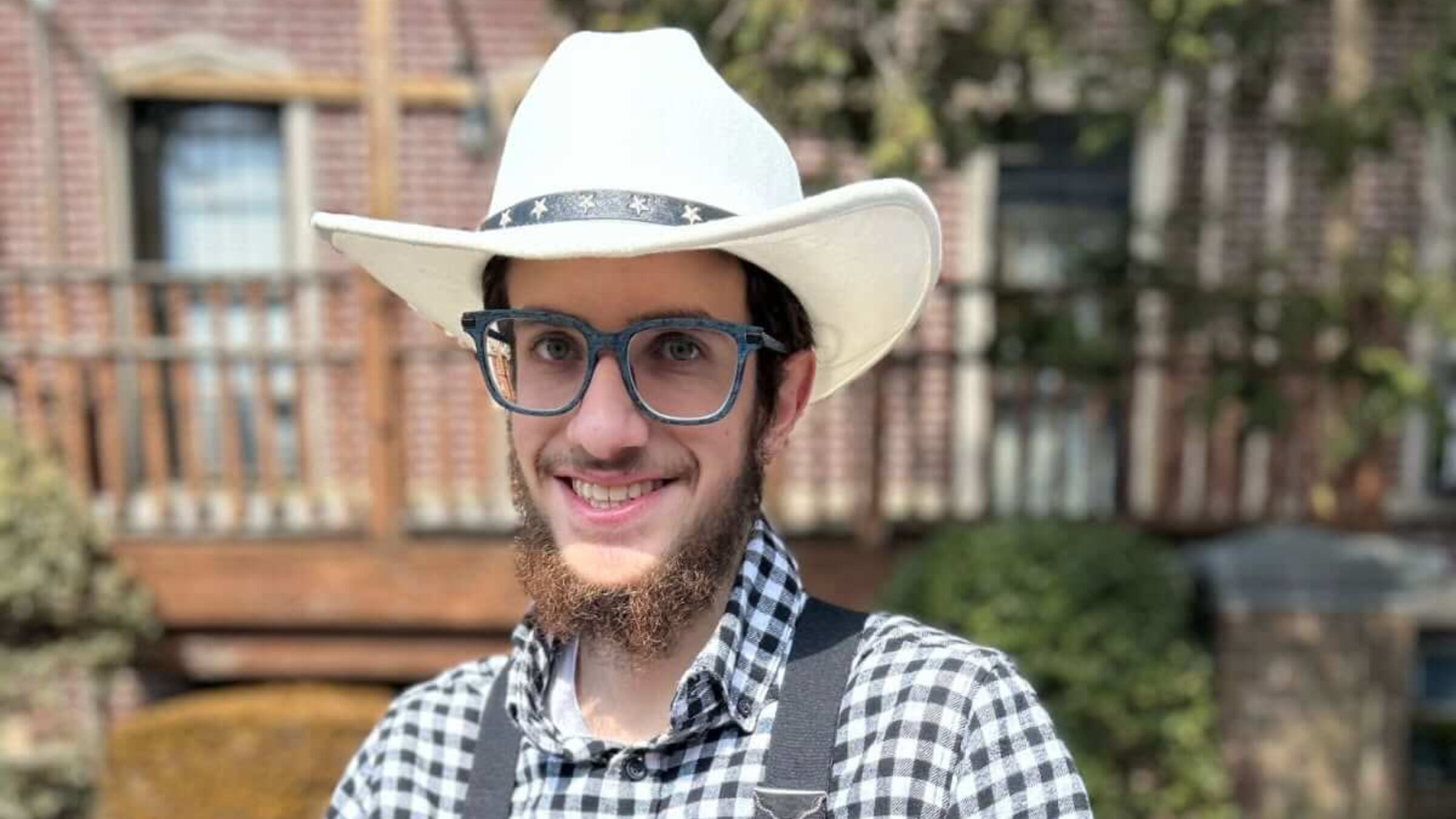
For Purim 2024, Daniel Yeroshalmi of the Crown Heights Homestead dressed, appropriately enough, as a farmer. Courtesy of Daniel Yeroshalmi
The chicken coop is located about 300 feet from Lubavitcher World Headquarters in Brooklyn. It’s part of The Crown Heights Homestead, which, according to Google Maps, is “permanently closed,”
Don’t believe everything you read on the Internet. The Hasidic homestead was very much in operation when I visited on a recent frigid weekday afternoon. Emerging from the Kingston Avenue subway station, I walked over to the four-story building that is home to Daniel Yeroshalmi and his family. Yeroshalmi, 21, is a member of Chabad.
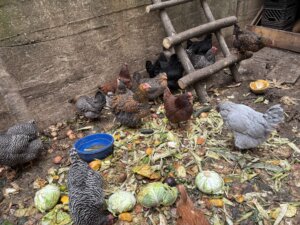
He showed me the 20 hens he keeps in his cement backyard and I watched as he retrieved a single egg from the chicken coop he built.
“I got a lot more eggs when they were younger,” Yeroshalmi told me. “But as they get older they lay a lot less.”

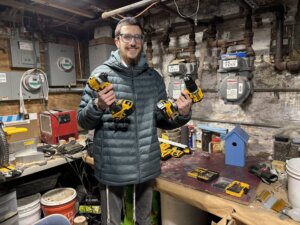
Built from bookshelves Yeroshalmi salvaged from a yeshiva renovation, the chicken coop is a demonstration of his tech chops, which extend into video production, social media and security surveillance. The insulated coop has an automatic door that goes up in the morning and down at night.
As I stood next to him and marveled at the chickens scurrying about, I felt my foot sink into something mushy. It turned out to be a huge piece of squash that had been left on the ground for the chickens to eat.
A local yeshiva donates squash and other produce that he feeds to the flock.
“Whatever they have that’s going bad, they give to me,” Yeroshalmi explained.
The urban homesteader also composts the yeshiva donations, as evidenced by a huge pile of eggplants and cucumbers decomposing in his yard. At the base of the compost pile on the day I visited were several esrogim, the yellow citron used during the holiday of Sukot.
“A lot of Crown Heights people don’t know what compost is. They just wonder why I’m piling up vegetables in my front yard,” he said.
His homestead may be Hasidic but the soil is too acidic to grow corn and wheat. Yeroshalmi tried.
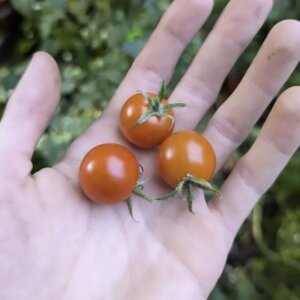
He did grow 10-foot tall sunflowers. And his garden has yielded tomatoes, cucumbers and peppers, a veritable Israeli salad. There are cherry and fig trees, some of which were propagated from the branches of fig trees his family brought to America from Iran over the years. One of the fig trees is a variety known as the Chicago Cold Hardy Fig, but Yeroshalmi, who davens three times a day, is following the commandment known as orlah that forbids consuming a tree’s fruit during the first three years.
Yeroshalmi’s quest to make green things flourish in this Kings County soil started early. A 2012 Google Maps photo shows him planting radishes in the front lawn when he was seven.
“I think there’s more of a connection between Judaism and plants than people think about,” he told me.
A calling that’s for the birds
Over the hours I’ve talked and texted with Yeroshalmi, I have come to think of him as a Hasidic version of St. Francis of Assisi, the charismatic figure who preached to the birds in 13th Century Italy — even though St. Francis had thousands of followers while Yeroshalmi has a little less than a thousand on Instagram, where his Crown Heights Homestead logo depicts the iconic three-story Gothic Revival headquarters of Chabad atop a farm field.
Two years ago, he told me, he confronted a couple of teenagers who were throwing potatoes from a food pantry at pigeons. When he was 12, a group of Lubavitcher kids were harassing an injured dove on the sidewalk during Shabbos.
“I stood there with the bird in between my legs for the next hour until Shabbos was over and I was able to scoop it up and take it home,” Yeroshalmi told me. But the dove died after a couple of days.
Another dove made a nest in a tree next door to his house. The nest looked unstable, so Yeroshalmi added a wooden cup-shaped structure to support it.
“It worked well,” he said. “The original two doves have turned into about 18 that I see on a daily basis. Within the last two years I’ve seen so many babies!”
Yeroshalmi’s passion for God’s winged creatures is perhaps best exemplified by a single maple tree in his front yard where a dozen of his handmade birdhouses painted green, blue and red are attached to the tree. One day he came home to find a stranger had left him a painting of the tree with all the birdhouses along with a note that explained they had passed the tree every day on their way to work.
But it is his dedication to the chickens that is perhaps most impressive. In 2024 he dressed up as a farmer for Purim. Wearing a cowboy hat, a plaid flannel shirt and a pair of suspenders to which he pinned a QR code directing people to his Instagram account, Yeroshalmi wheeled several members of his flock around Crown Heights in a yellow metal wagon covered with chicken wire. The flock includes Rhode Island Reds, New Hampshire Reds and Barred Rocks. A few have names. He had a rooster named Rafi that the chick hatchery inadvertently sent along with the pullets.
“That was the best mistake to ever happen,” he wrote in an Instagram caption. “I don’t want to sound like a crazy Chicken lady. But he was a great rooster.”
There are predators hungry for the poultry in Crown Heights. Yeroshalmi said a possum killed one of his chickens and that there are also raccoons in the area.
Last summer he took all 20 hens to a camp for Orthodox Jewish boys in the Midwest, transporting them in poultry crates more than 800 miles in a rented truck. Yeroshalmi was tasked with fixing and building stuff at the summer camp. Immediately upon arriving, he built a chicken coop.
The camp director told me that for many of the boys the chickens were the most exciting part of the camping experience and said it was therapeutic for them to be around live animals, which most of the campers don’t get to do at home.
“A lot of the kids had their favorite chicken,” he told me. “It was kind of like having a pet for the first time.”
A New Yorker — at least until he flies the coop
Both of Yeroshalmi’s parents were born in Iran. His father, a dentist who practices in Borough Park, was the first member of the family to become a Lubavitcher. He was part of the wave of Iranian Jews who came to America in 1979. Yeroshalmi’s mother is a pharmacist and so is one his aunts. Another uncle is the head of pediatrics at a municipal hospital in the Bronx.
“There are probably 35 doctors in my family among my close cousins, uncles, aunts,” he told me.
Yeroshalmi himself earned a B.S. in Business Administration before he turned 19, currently has a job that he works at night, and is prepping to take the LSAT’s. He earns a little money selling firewood he gathers from fallen trees and pruned branches in the neighborhood. And he sells a few eggs when he has extras.
Yeroshalmi’s homesteading has been trying for his parents, he says.
Walking past piles of lumber stacked vertically on a cement walkway leading from his basement workshop to the backyard, Yeroshalmi told me: “They do give me grief about hoarding lumber, tools, everything. I’m very thankful they haven’t thrown me out yet.”
Yeroshalmi says he wants to become a lawyer but has no immediate plans to go to law school.
During our texting he confided that it hasn’t been easy for him to live in Crown Heights. He was bullied a lot growing up and once wrote an essay for a Crown Heights blog titled Beaten and Robbed By My Own People. The essay detailed how a group of Hasidic thugs broke his glasses, stole his hat and yarmulke and stomped on his tefillin.
Yeroshalmi acknowledged that many of his fellow Hasids consider him an odd duck for pursuing his agricultural passions.
“Crown Heights people don’t seem to like greenery,” he told me
In an Instagram video that served as a tutorial for power tools, he dedicated it to “all the useless Crown Heights people who’ve never picked up a drill in their life.”
Still, he added, “If I have to live in New York City, I would definitely choose Crown Heights.”
“But,” he added, “If I had an option to move out, which I will in the future, I would definitely not stay in Crown Heights. Or the city at all.”
This is a moment of great uncertainty. Here’s what you can do about it.
We hope you appreciated this article. Before you go, we’d like to ask you to please support the Forward’s independent Jewish news this Passover. All donations are being matched by the Forward Board - up to $100,000.
This is a moment of great uncertainty for the news media, for the Jewish people, and for our sacred democracy. It is a time of confusion and declining trust in public institutions. An era in which we need humans to report facts, conduct investigations that hold power to account, tell stories that matter and share honest discourse on all that divides us.
With no paywall or subscriptions, the Forward is entirely supported by readers like you. Every dollar you give this Passover is invested in the future of the Forward — and telling the American Jewish story fully and fairly.
The Forward doesn’t rely on funding from institutions like governments or your local Jewish federation. There are thousands of readers like you who give us $18 or $36 or $100 each month or year.
Support our mission to tell the Jewish story fully and fairly.