The Department of Labor told us to embrace ‘Americanism.’ What’s that?
The phrase has a long history with the Ku Klux Klan
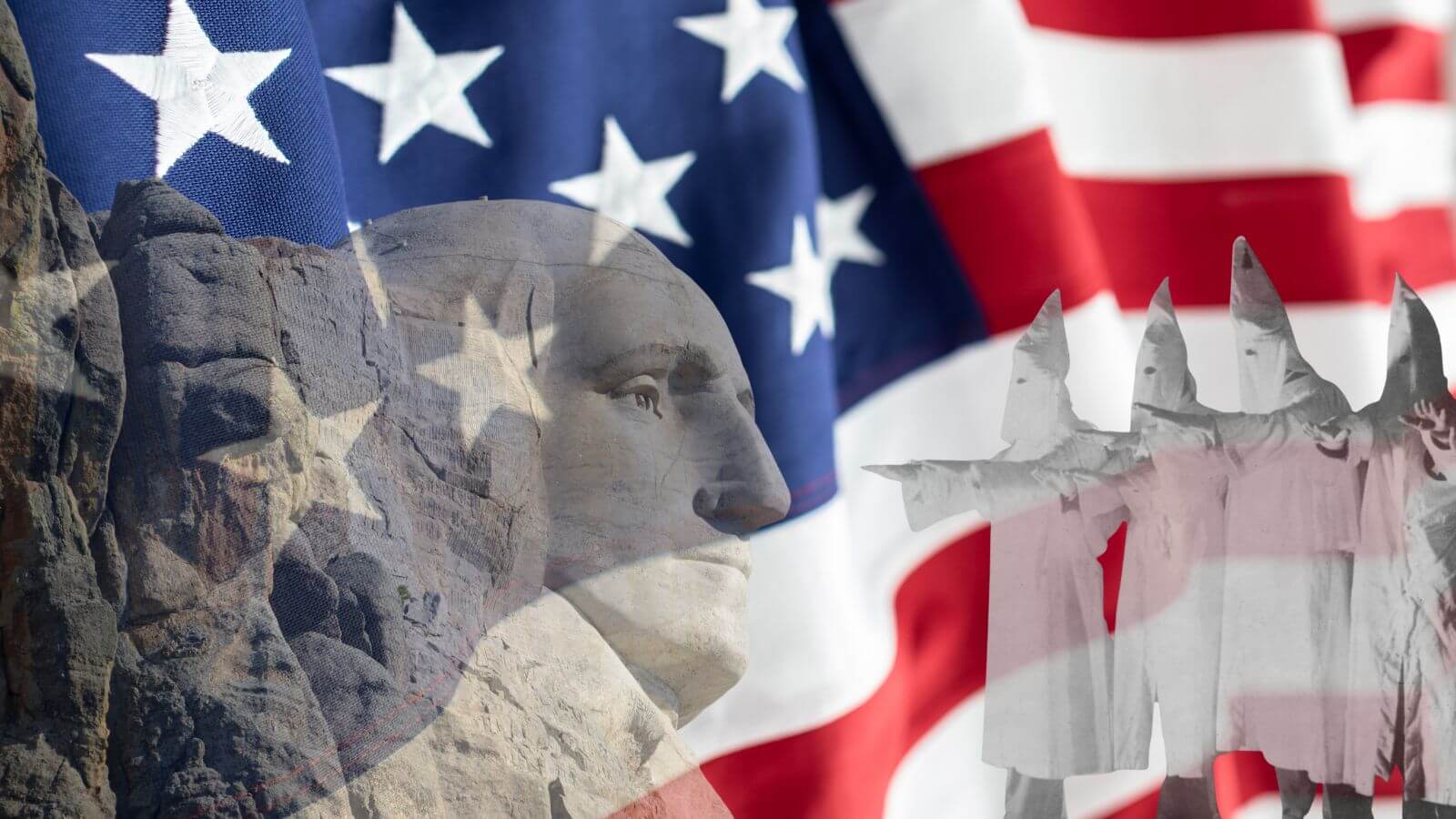
Americanism is an undefined term, but one that has been embraced by racist organizations. Graphic by Canva/Mira Fox

By Mira Fox January 16, 2026
“Embrace Americanism,” reads a graphic shared by the U.S. Department of Labor on X, featuring a photo of George Washington’s bust on Mt. Rushmore. “America is for Americans,” the accompanying post says.
What, exactly, is Americanism? Though it may sound like a made-up term that Donald Trump might sling in his speeches off the cuff, in fact it has been around for at least two centuries, since the early days of the U.S.
Yet its definition has never been clear. While the word connotes some ideology of adherence to American values, a unified culture or an idealized vision of the nation, the exact vision of what that set of values or culture is remains so vague that the term has been used by Theodore Roosevelt, the American Communist Party and the Ku Klux Klan.
Early American figures, including John Adams, simply used Americanism to mean a belief in a new republic defined by Democratic ideals and freedom of religion, a commitment to the culture of America. But that culture had not yet been defined — was it white and Christian, or was it a diverse melting pot?
Since its first use, the term has been claimed most often by the KKK. A 1926 paper by Klan Imperial Emperor and Wizard Hiram Wesley Evans, published in The North American Review, is titled “The Klan’s Fight for Americanism.” In it, Evans says that the KKK arose as an answer to an influx of “aliens and alien ideas” in the country — namely that of Jews, Catholics and Black people.
Evans does not define the Americanism he’s fighting for. But he’s clear about what it isn’t. He praises the Klan’s work fighting “radicalism, cosmopolitanism, and alienism of all kinds” — “rootless cosmopolitanism” being a pejorative regularly levied at Jews — and says that “racial instincts” are essential to preserving Americanism.
Those racial instincts are necessary, Evan writes, because anyone who is not an “old-stock American” of “Nordic blend” is fundamentally incapable of understanding or upholding Americanism. (The article largely avoids the term “white” to exclude groups like Eastern and Southern Europeans, as well as Jews and Catholics, who today we might consider white.)
The 1920s were a time of great debate over Americanism, but the term has largely fallen out of use in the modern day. So is this the Americanism the Department of Labor is telling people to embrace one that excludes Jews, Black people, Asians, Catholics and anyone who isn’t a white Protestant — is it a dog whistle for the nativist, KKK ideology that defined the term when it was last popular? The DOL did not respond to a request for comment in time for publication, so we can’t know how the government came to adopt the word. But without specifying which Americanism they mean, it will be easy for white nationalists to see a post from the government using a term with a long racist history, and feel emboldened.
Still, maybe the values of Americanism they meant are something new entirely, synonymous with the Trump administration’s fight against trans people and DEI, or perhaps a simple declaration of patriotism.
Or maybe the DOL used Americanism in the sense that Earl Browder, president of the American Communist party in the 1900s, did when he attempted to reclaim the term and proclaimed that “Communism is 20th century Americanism.”
Probably not, though.
This is a moment of great uncertainty. Here’s what you can do about it.
We hope you appreciated this article. Before you go, we’d like to ask you to please support the Forward’s independent Jewish news this Passover. All donations are being matched by the Forward Board - up to $100,000.
This is a moment of great uncertainty for the news media, for the Jewish people, and for our sacred democracy. It is a time of confusion and declining trust in public institutions. An era in which we need humans to report facts, conduct investigations that hold power to account, tell stories that matter and share honest discourse on all that divides us.
With no paywall or subscriptions, the Forward is entirely supported by readers like you. Every dollar you give this Passover is invested in the future of the Forward — and telling the American Jewish story fully and fairly.
The Forward doesn’t rely on funding from institutions like governments or your local Jewish federation. There are thousands of readers like you who give us $18 or $36 or $100 each month or year.
Support our mission to tell the Jewish story fully and fairly.