The Jewish women who kept Confederate graves from disappearing
In Virginia, they cared for the graves of Jewish Confederate soldiers — turning burial, not ideology, into an act of obligation and memory
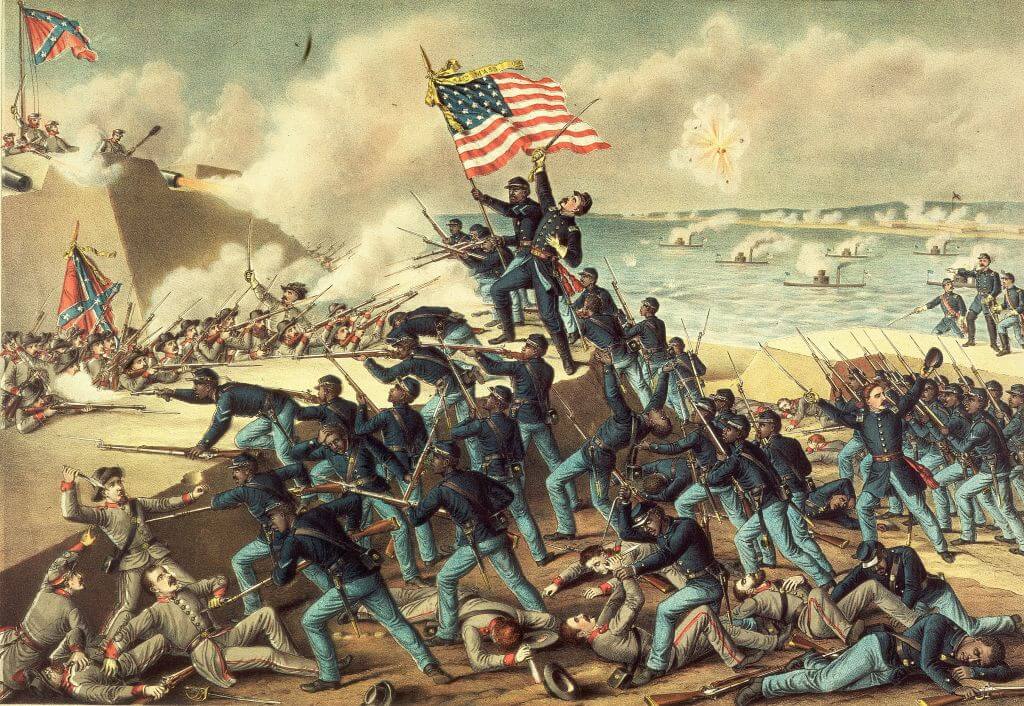
The July 1863 storming of Fort Wagner during the Civil War. Photo by MPI/Getty Images
By Austin Albanese January 18, 2026
In June 1866, just over a year after the Civil War ended, young Jewish men in Richmond, Virginia, removed their coats and set to work among the graves of their fallen comrades. Some were “frail of limb,” a newspaper noted. They wheeled gravel and turf, filled the graves, and tamped the earth down “in a very substantial manner.” It was the last sad tribute they could offer.
The work that day was organized by Jewish women in the city. Their aim was permanence: to enclose the soldiers’ graves, to mark them, and to ensure they would not disappear “before the relentless finger of time.”
The Hebrew Cemetery in Richmond was established in 1816, decades before the Civil War reshaped the nation and long before the city became the capital of the Confederacy. It was the second burial ground for the Beth Shalome Congregation, Virginia’s first synagogue. Tucked within its grounds is the Soldiers’ Section, where 30 Jewish Confederate soldiers are buried, in what is believed to be one of only two Jewish military cemeteries in the world outside Israel.
They came from across the South, including Georgia, Mississippi, South Carolina, Virginia, and beyond. A bronze plaque at the entrance reads: “To the glory of God and in memory of the Hebrew Confederate soldiers resting in this hallowed spot.”
What matters here is not only who is buried — but who remembered them, and how.
The work the war left behind
In 1866, just a year after the war’s end, Jewish women in Richmond organized the Hebrew Ladies’ Memorial Association. That same year, the group issued an appeal “to the Israelites of the South” for aid to enable the society to care for the graves of Jewish Confederate soldiers from all over the South who lie buried in the cemeteries of Richmond.
It was a duty, an act of chesed shel emet, Hebrew for the truest form of kindness, performed for those who could not repay it.
Newspaper accounts from the period are striking for their clarity and urgency. These women understood that the work of memory is laborious — physical, ongoing, and vulnerable to neglect. Graves, they warned, could vanish unless someone acted.
So they took responsibility.
By the late 1860s and 1870s, the Association’s work had grown to include an annual memorial service. Reports describe flowers laid carefully on each grave, marble slabs placed at the head of each burial, names and regiments inscribed so those resting there would not slip into anonymity.
An 1868 account observed that “each grave has been marked in a manner that ensures that the names of the still tenants of this beautiful spot will be preserved from oblivion; and handed down to be further cherished by the generations yet to come.”
That language echoes a Jewish concept. Zachor. Remember.
Memory, they understood, does not preserve itself.
Importantly, these memorial services were not closed affairs. One report from 1868 noted that the crowd gathered in the cemetery “was not confined to any one denomination.” Jewish lives were honored in the public view, but still held apart from Richmond’s larger Confederate cemeteries, Hollywood and Oakwood, which were not consecrated for Jewish burial and could not accommodate Jewish ritual requirements, including separate sacred ground.
Tending the dead
The care itself remained constant, but the language surrounding it did not.
What is striking in early accounts of the Soldiers’ Section of the Hebrew Cemetery is not the absence of politics, but how its weight changes over time.
In the earliest years, memory and the war were still closely bound. The 1866 appeal issued by the Hebrew Ladies’ Memorial Association spoke openly of a “glorious cause” and framed the soldiers’ deaths within the language of Confederate sacrifice. Like other women’s memorial groups in the postwar South, these Jewish women used care for the dead to assert dignity and a claim to sacrifice in a defeated society.
Yet even then, the work itself was grounded in restraint. The focus was on names, tending, and preservation — on preventing the graves from vanishing. The labor was physical, repetitive, and unglamorous. Whatever meanings surrounded it, the work remained the same.
As decades passed, the emphasis shifted. By the 1930s, memorial services featured a cadet, Walter McDonald of the Catholic Benedictine College, sounding taps and the ceremonial laying of wreaths. Confederate organizations were invited to attend. In 1940 and 1941, the public was welcomed to observe the 74th and 75th annual memorials. After 1941, the Hebrew Ladies’ Memorial Association continued to participate alongside other organizations in Memorial Day observances, but it appears that by 1947 the local observance of “Hebrew Memorial Day” or “Jewish Confederate Memorial Day” faded as a distinct commemoration.
Across generations, the observance persisted, a refusal to abandon the dead to neglect. Memory grew larger than any one explanation. The women’s work became less about what the war had meant, and more about what the living still owed to their dead.
A refusal to forget
This is a complex story that shows how history so often complicates memory. It sits at the intersection of some of America’s most divisive episodes and a small minority faith community declaring its presence and its sacrifices over decades.
When the Civil War ended, Jews needed to be buried. What followed was a choice.
The Hebrew Ladies’ Memorial Association chose to take responsibility. To remember “many a loved brother, son, and husband.” To insist that whatever judgment history would render, oblivion was not acceptable for “Israelitish soldiers of the Confederate army.”
Today, the Soldiers’ Section in Richmond’s Hebrew Cemetery remains. Names are still remembered. The work begun in 1866 was not temporary.
This is a moment of great uncertainty. Here’s what you can do about it.
We hope you appreciated this article. Before you go, we’d like to ask you to please support the Forward’s independent Jewish news this Passover. All donations are being matched by the Forward Board - up to $100,000.
This is a moment of great uncertainty for the news media, for the Jewish people, and for our sacred democracy. It is a time of confusion and declining trust in public institutions. An era in which we need humans to report facts, conduct investigations that hold power to account, tell stories that matter and share honest discourse on all that divides us.
With no paywall or subscriptions, the Forward is entirely supported by readers like you. Every dollar you give this Passover is invested in the future of the Forward — and telling the American Jewish story fully and fairly.
The Forward doesn’t rely on funding from institutions like governments or your local Jewish federation. There are thousands of readers like you who give us $18 or $36 or $100 each month or year.
Support our mission to tell the Jewish story fully and fairly.