‘The Pitt’ tackled the trauma of the Tree of Life attack. Here’s how survivors of the synagogue shooting reacted to the episode.
The HBO Max drama evoked the deadliest antisemitic attack in U.S. history to show how trauma’s aftereffects endure
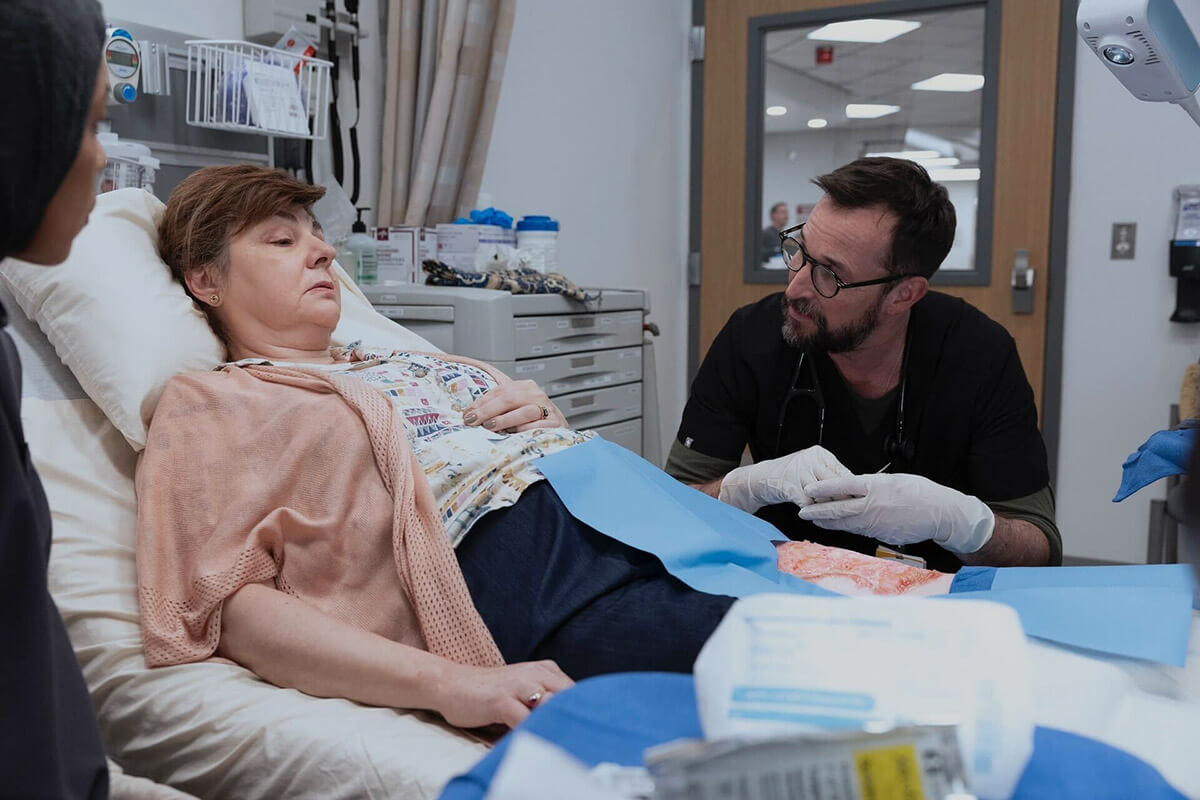
Irina Dubova, left, and Noah Wyle in a scene from “The Pitt.” Dubova portrays a survivor of the Tree of Life synagogue shooting who is still experiencing trauma years later. Courtesy of HBO Max
By Benyamin Cohen January 23, 2026
When Audrey Glickman, a lifelong Pittsburgher and a survivor of the Tree of Life massacre, sat down to watch The Pitt Friday morning, she knew exactly what was coming. And still she found herself moved by it.
On Thursday’s episode of the HBO Max medical drama, which is set in Pittsburgh, a patient arrives at the emergency room with a burn. It’s the Fourth of July. Fireworks crackle outside. In her kitchen, the woman had been using a samovar — a traditional metal urn often used in Jewish homes to heat water — when the sudden noise startled her and she dropped it.
The scalding water spilled onto her leg.
When her doctor asks what happened, she offers an explanation that reaches further back than the holiday. “I was on my way inside,” she says. “October 27, 2018.”
She doesn’t need to say more.
The episode never recreates the Tree of Life synagogue shooting, the deadliest antisemitic attack in American history. There are no gunshots, no flashbacks, no swelling score. Instead, the trauma surfaces the way it often does in real life: indirectly, years later, triggered by noise, memory, or the body’s refusal to forget. The scene assumes the audience already carries the weight of that day. That restraint reflects how the show has handled Jewish moments.
In its first season, The Pitt established – not through backstory but through behavior – that its protagonist, Dr. Michael “Robby” Rabinovich (played by Noah Wyle), is Jewish. In one episode, after a brutal shift, he sits on the floor of a makeshift morgue, clutching a Star of David and reciting the Shema prayer. The moment is brief and unresolved; he later admits he isn’t even sure he believes the words he’s saying. It’s not a declaration of faith so much as a reflex — what surfaces when language runs out.
In the new episode, the survivor, named Yana Kovalenko and portrayed by actress Irina Dubova, asks Dr. Robby where he goes to synagogue.
“Rodef Shalom,” he replies, naming an actual Reform shul in Pittsburgh.
Kovalenko says she is a Tree of Life member and was at the synagogue on the day of the attack.
“They’re rebuilding,” Dr. Robby says.
“Yes, something new,” she says, adding, “Remember, rebuild, renew,” echoing the same phrase Tree of Life uses on its website.
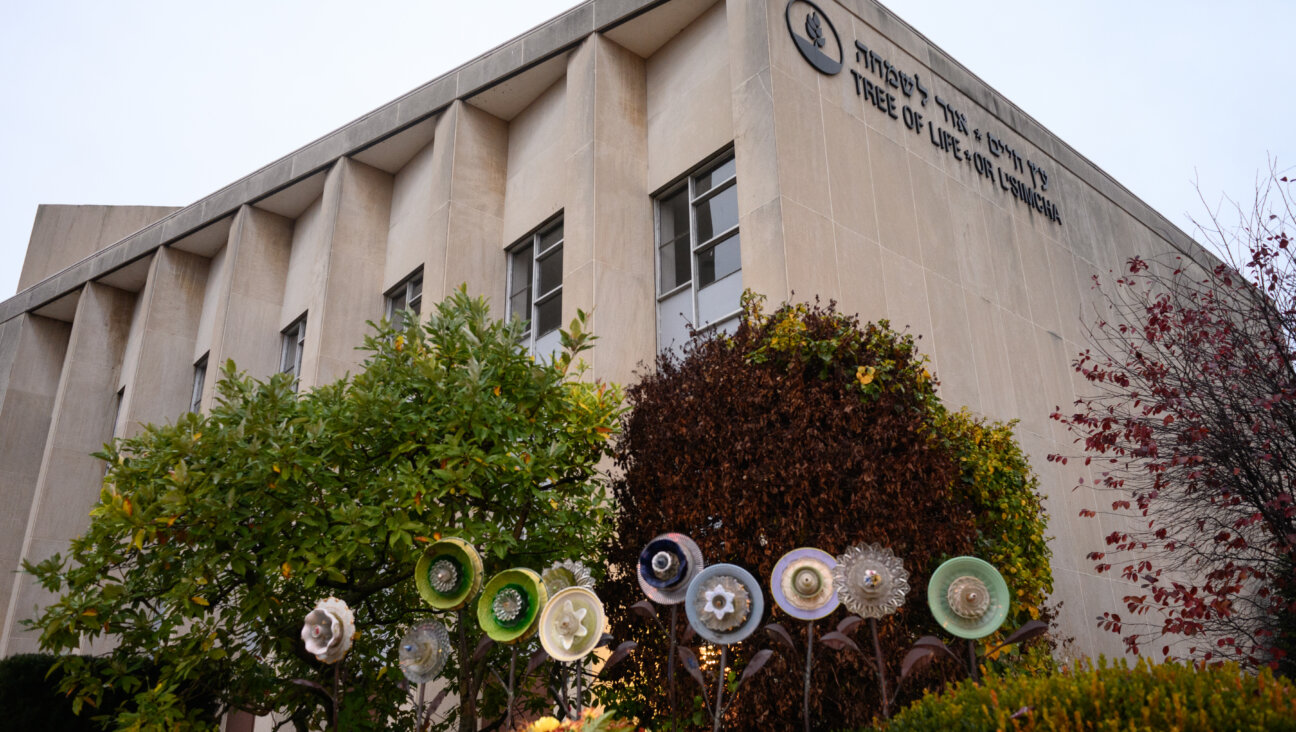
That exchange gains more meaning if you know that Tree of Life is, in fact, rebuilding on its original site — and that, for now, its congregation meets in Rodef Shalom’s building. That insistence on local specificity extends beyond the script. Wyle, who is Jewish and whose parents met while attending college in Pittsburgh, has said authenticity is key to the series, which was inspired by the city’s Allegheny General Hospital.
Glickman said friends texted her about the episode Friday morning, so she was prepared for the reference but was still affected by how it unfolded.
“It’s really delightful,” she told the Forward. Not because every detail was perfect — she laughed about the accents, and the samovar struck her as more inherited than typical — but because the episode captured something truer than procedural accuracy.
“They do a lot of calling out of Pittsburgh,” Glickman said. “They treat it the way other shows treat New York or San Francisco. It lends authenticity, and it’s kind of exciting.”
Television often treats trauma as singular and spectacular, something that happens once and violently to one person at a time. The Pitt depicts it instead as communal and environmental, something that hums in the background long after the event itself has passed. “There is no clock on how long it takes,” Dr. Robby tells his patient.
Barry Werber, another Tree of Life survivor, knows that trauma personally. Werber was in the basement with his fellow congregants when they heard gunfire. He escaped into a storage room with two others, Carol Black and Melvin Wax. “We couldn’t find the light switch,” he later recalled. “It was pitch black.”
After a few moments, Wax, who was hard of hearing, thought the shooting had ended, so he took a fateful step outside the storage room and was instantly shot dead. His body fell back into the storage room, and the shooter, Robert Gregory Bowers, stepped inside. Through the darkness, Werber said, Bowers could not see Black hiding behind the door or himself toward the back of the room.
“To this day, I can’t go into a room and sit with my back facing the door,” he told the Forward.
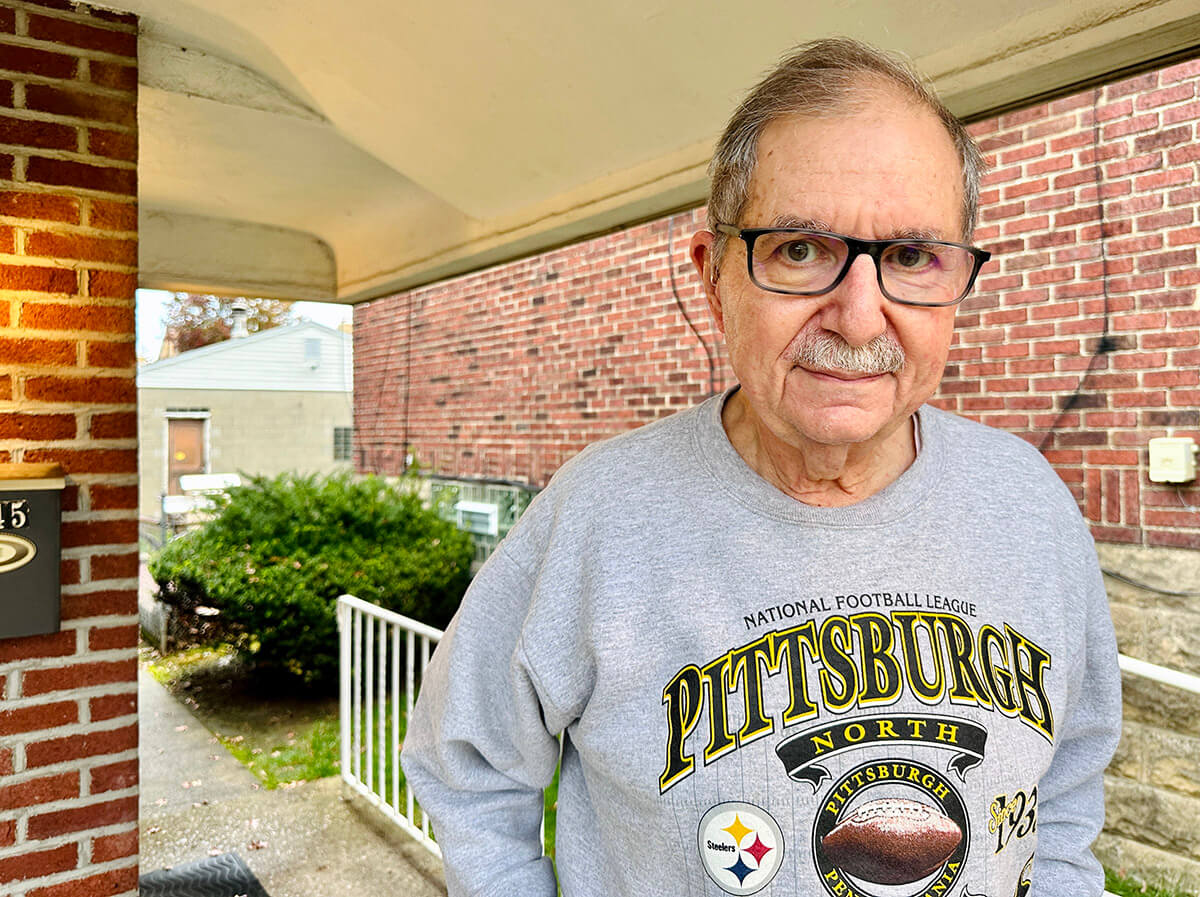
Years later, that vigilance remains. Werber is still in therapy. He avoids crowds. He instinctively scans buildings for security. He attends synagogue services now via Zoom — partly because his wife is ill, and partly because being in a room full of people still doesn’t feel safe. “It took a lot out of me,” he said.
Werber, who worked for nearly 40 years for the healthcare company that inspired the show, has yet to see the episode. He doesn’t subscribe to Max. “I spend enough on cable,” he said. “I don’t think we’ll get HBO. I’ll see if any of my friends have watched it.”
Carol Black, who was hiding in the same basement storage area as Werber during the attack, said the episode’s portrayal of flinching felt immediately familiar. “Every little unexpected sound still makes me jump,” she told the Forward. “If somebody sneezes and I’m not expecting it, I jump.” She said she has learned to live with the reflex. “You’re never going to get over it,” she said. “You just get used to it.”
Black, whose brother Richard Gottfried was among the 11 people killed in the shooting, said she was grateful to see the story reach a wider audience. “I don’t want the story of what we experienced to go cold,” she said. “This is a very popular show. People need to know about this.”
One of the episode’s most quietly revealing moments comes when the patient asks the nurse tending to her burns if she is Muslim. When the nurse says yes, the patient thanks her — not for the care she’s receiving in the room, but for what came years earlier. After the shooting, she recalls, it was the Muslim community that showed up, raised money, and paid for funerals.
Wyle, who also co-wrote this episode, told Variety that the interfaith solidarity “was the most underreported aspect of the story, and perhaps the most hopeful moving forward.” R. Scott Gemmill, an executive producer, added: “You can’t do a medical show, set in Pittsburgh, with a Jewish doctor without addressing that.”
The exchange in the episode is brief, almost awkward. The nurse doesn’t know what to say. The patient waves it off. “Anyway,” she says. “Thank you.” The show doesn’t pause to turn the moment into a lesson. It lets it pass, the way lived history often does.
That restraint resonated deeply with Glickman, who remembers the support across religious lines that followed the attack, and the ache of realizing how rare that feeling now seems. “I hope it means we’re going to get past the divisions we’re having right now,” she said. “We were there before. We can be there again.”
She also laughed at a detail few critics would think to note: Before arriving at the hospital, the patient treats her burns with honey. “That is so us,” Glickman said with a laugh. “That is so Jewish.”
#ThePitt’s Noah Wyle, who wrote Episode 3, talks with @TVLine Senior Editor Ryan Schwartz about revisiting the Tree of Life shooting and the Muslim community's support and solidarity in the aftermath. https://t.co/KEHiBVeuUu pic.twitter.com/WTDSeL2Gkg
— TVLine.com (@TVLine) January 23, 2026
This is a moment of great uncertainty. Here’s what you can do about it.
We hope you appreciated this article. Before you go, we’d like to ask you to please support the Forward’s independent Jewish news this Passover. All donations are being matched by the Forward Board - up to $100,000.
This is a moment of great uncertainty for the news media, for the Jewish people, and for our sacred democracy. It is a time of confusion and declining trust in public institutions. An era in which we need humans to report facts, conduct investigations that hold power to account, tell stories that matter and share honest discourse on all that divides us.
With no paywall or subscriptions, the Forward is entirely supported by readers like you. Every dollar you give this Passover is invested in the future of the Forward — and telling the American Jewish story fully and fairly.
The Forward doesn’t rely on funding from institutions like governments or your local Jewish federation. There are thousands of readers like you who give us $18 or $36 or $100 each month or year.
Support our mission to tell the Jewish story fully and fairly.