Is there life after Lubavitch?
In his memoir ‘Brooklyn Odyssey,’ ex-Hasidic sociologist Schneur Zalman Newfield turns his gaze inward
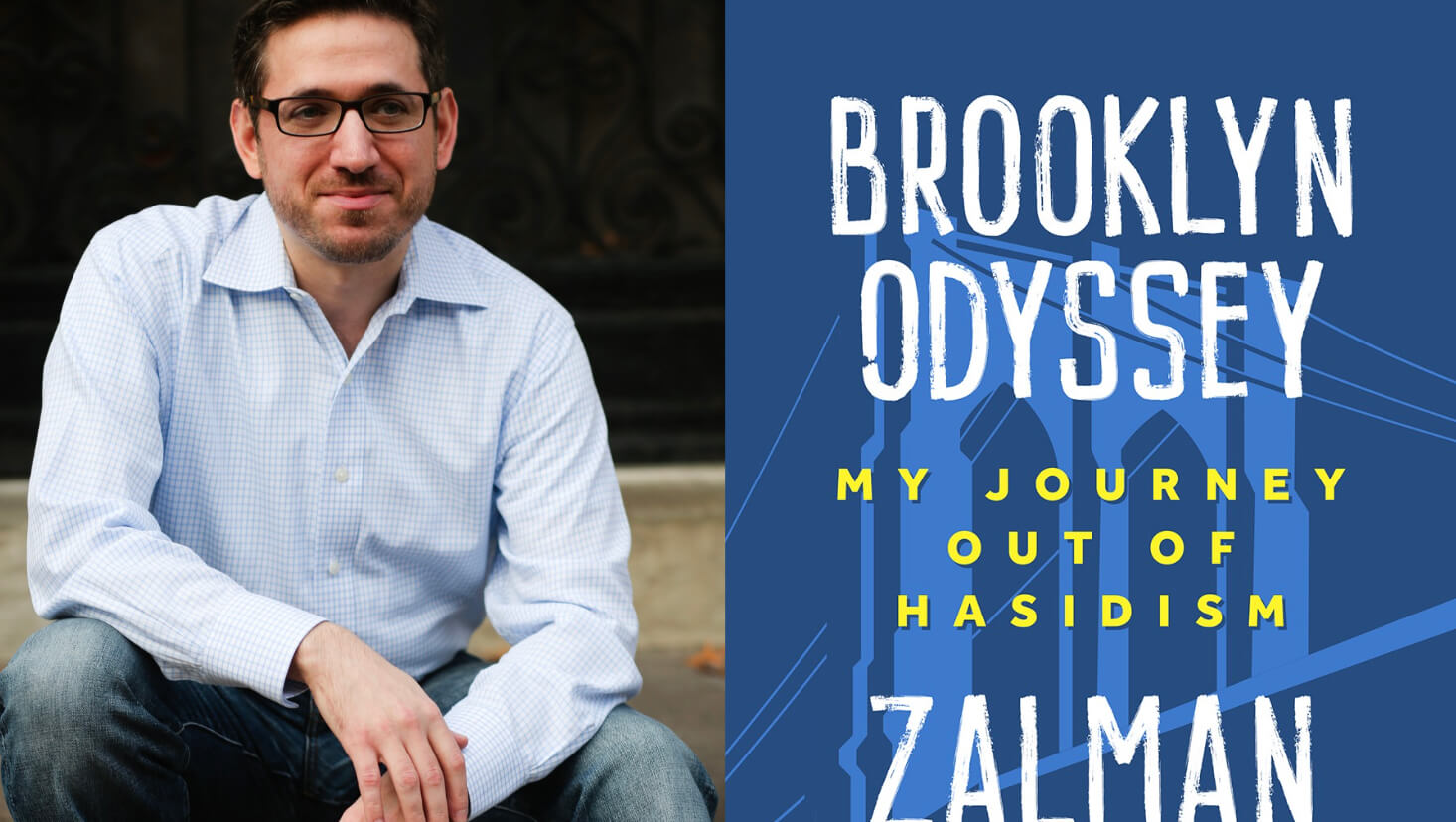
Schneuer Zalman Newfield charts his ‘Brooklyn Odyssey’ out of his Hasidic upbringing. Courtesy of Temple University Press
Schneur Zalman Newfield knows as well as anyone what it takes to leave Orthodoxy. In his new memoir, Brooklyn Odyssey, he likens his transformation from Hasidic to secular to a butterfly’s metamorphosis. “At one stage it is clearly a caterpillar; at another it is a butterfly. But when exactly did it shift from one organism to the other?” he asks. When exactly does a Hasidic Jew become someone who prays with egalitarian minyans and protests with Jews for Racial and Economic Justice?
Newfield, a 44-year-old sociology professor at Hunter College, has been asking that very question for years. For his first book, Degrees of Separation: Identity Formation While Leaving Ultra-Orthodox Judaism, Newfield interviewed 74 ex-Lubavitch and ex-Satmar Hasidic Jews to analyze what it means to leave Orthodoxy. Brooklyn Odyssey brings that sociological scrutiny to Newfield’s own life.
But the memoir is much more readable than the academic book that preceded it. Newfield renders vividly what it’s like to be an 11-year-old boy running amok in Crown Heights, the nerve center of the Lubavitch Hasidic universe, while rebbe Menachem Mendel Schneerson, the lionized leader of that community, was still alive. He also captures the feelings of a twentysomething ex-Hasidic virgin at Brooklyn College. After his mom reacts coldly to the news that he has shaved his beard, Newfield writes that he “felt like a Lubavitch mitzvah tank, one of those converted Winnebagos, had just rolled over my chest.”
I spoke with Newfield to see how he views the risk factors for leaving Orthodoxy, and how the Haredi world’s treatment of these people might be changing. The following conversation has been edited for length and clarity.
Lauren Hakimi: There are already so many memoirs out there about people’s journeys off the derech [out of Orthodoxy]. What did you think was missing from the OTD genre?
Schneur Zalman Newfield: None of the memoirs that are out there really captured the experience of growing up in the Lubavitch community, especially the Lubavitch boys’ environment.
Also, OTD memoirs tend to describe growing up in a very geographically constrained area. My experience is very different from that. A big part of my experience in Lubavitch was traveling around the world doing outreach work. Being exposed to the world and grappling with an awareness of other people was a big part of my process of leaving the community. There’s whole chapters in the book on my experiences visiting Russia, living in Singapore, living in China, living in Argentina.
Most of the OTD memoirs describe very stark breaks with people’s families once people left the community. In my last book, Degrees of Separation, I found that many people who grew up Lubavitch and Satmar who left the Hasidic community still maintained ties with their family. Sometimes those are very painful ties, but still, they are ties. That’s very much my own experience. A big part of my process of deciding to leave the community was complicated by the fact that I had a very loving and warm relationship with my family.
Lubavitch is as strict as other ultra-Orthodox sects, but its emphasis on kiruv [missionary work to encourage non-Orthodox Jews to become Orthodox] exposes Hasidim to secular Jews at young ages. How did your international travels affect your exit journey?
I was profoundly influenced by the people that I encountered. Especially in my late teens, my early 20s, once I was already reading a lot of secular books secretly on my own, I was very interested to learn more about the outside world. I think that really opened up new vistas for me that had I stayed in Crown Heights would have been much more difficult, if not impossible, for me to access.
In the very beginning of the book, there’s a photo of you and your family at your daughter’s bat mitzvah. Why was it important for you to include that?
A part of what I’m trying to convey is the fact that there is life after people leave the community. The narrative within the ultra-Orthodox community is that ‘we have such a great life, and we know the truth, and if anyone is crazy enough to leave the community, their life is doomed, and they’ll all become drug addicts.’
This is a propaganda message that the community employs in order to scare people and prevent them from even thinking of trying to leave. Many people who leave the community, yes, they face challenges, but many, if not most of the people who decide to leave the community eventually find their way in the broader society and are able to establish healthy and meaningful lives on the outside.
I wanted to highlight that about my own experience. Yes, there were real challenges, and that’s certainly part of what I talk about: the mental health issues I struggled with, the challenges related to maintaining a loving relationship with my family. At the same time, I was able to establish a healthy and meaningful life on the outside.
In Degrees of Separation, you draw a distinction between intellectual and emotional reasons for leaving Orthodoxy, but in your memoir, the intellectual and emotional seem to come together, like when your sadness over your younger brother Shimmy’s death makes you question God. I’m wondering how you view those two factors in the context of your own path.
To be clear, even in Degrees of Separation, I argue that everyone who leaves the community has both intellectual and social-emotional reasons for doing so. It’s simply a question of which of these aspects of their experience they tend to focus on. Most people tended to focus on one versus the other. This is not the full picture. The people who were talking about their intellectual disagreements with the community also experienced some kind of disenchantment or social-emotional issues related to their community. Same thing for people who talked about their social-emotional reasons for leaving.
When I thought about leaving, and then even after I left, when I thought about my experience of leaving, I did tend to describe it in intellectualist terms. In fact, early on when we were dating, my now wife asked me if Shimmy’s death played a role in my experience of leaving. I said, ‘No, I don’t think that that had anything to do with it.’
Only years later, after I was doing my academic work and thinking much more rigorously about all of these issues, did I realize that Shimmy’s death had a profound influence on my religious evolution. That, and the death of the Lubavitcher rebbe, who we were taught to believe was the messiah.
After you shave your beard, your mom sends you and your brother to a rabbi who tries to convince you to become more religious again. As someone who researches journeys out of Orthodoxy, what do you make of that intervention?
It is very common for parents, relatives, neighbors, to try to connect the person who’s thinking of leaving with some rabbi whose mission is to quote-unquote straighten the person out. In a sense, it’s kind of remarkable that there was only one intervention in my case.
Sometimes, these interventions are carried out under the guise of mental health. There’s a therapist, a psychologist, a social worker, or someone who doesn’t have any mental health training but purports to be a mental health professional. They often basically argue that for your own mental health, it would be best if you would come back to Orthodoxy.
The rabbi I was sent to had been my teacher for several years. When I had him as a teacher, I thought that he was this brilliant guy, charming and charismatic. But when it came to this interaction, where he was basically trying to convince me to remain Orthodox, he was very plebeian in terms of the arguments that he was making, and his general attitude of disdain for me, for non-Orthodox forms of Judaism, and for secular knowledge in general.
Do you think that if you were going OTD today, as opposed to 20 years ago, the Orthodox net might have done a better job trying to catch you?
I think the ultra-Orthodox community has become more aware of the fact that large numbers of their members are leaving and that they need to do a better job of trying to respond to it.
Each individual religious community responds in a somewhat different way. So it’s hard to make generalizations, but it definitely seems that the ultra-Orthodox community is trying to respond to this issue in a more sensitive and thoughtful and humane way than they were doing, let’s say, 20 or 30 years ago.
Me and other scholars have also noted a rise of quote-unquote ‘modern’ ultra-Orthodox people.
I sometimes stay in Crown Heights for Shabbos with my family and go to shul with one of my brothers in law. I go to this one particular shul, and there’s a bunch of people who have trim beards, or something’s going on with their beards, not quite the way nature intended. They’re going to shul every Shabbos, they send their children to Lubavitch schools. In a lot of significant ways, they’re enmeshed in the community, and they’re recognized as being full-fledged members of the community, yet they’re living a kind of Lubavitch lite.
So yes, I think if I was leaving today, or if I was living in the community today, it’s hard to say exactly how things would end up. But I didn’t grow up in the community today. I grew up in the community 30 years ago, and my story is my story.
This is a moment of great uncertainty. Here’s what you can do about it.
We hope you appreciated this article. Before you go, we’d like to ask you to please support the Forward’s independent Jewish news this Passover. All donations are being matched by the Forward Board - up to $100,000.
This is a moment of great uncertainty for the news media, for the Jewish people, and for our sacred democracy. It is a time of confusion and declining trust in public institutions. An era in which we need humans to report facts, conduct investigations that hold power to account, tell stories that matter and share honest discourse on all that divides us.
With no paywall or subscriptions, the Forward is entirely supported by readers like you. Every dollar you give this Passover is invested in the future of the Forward — and telling the American Jewish story fully and fairly.
The Forward doesn’t rely on funding from institutions like governments or your local Jewish federation. There are thousands of readers like you who give us $18 or $36 or $100 each month or year.
Support our mission to tell the Jewish story fully and fairly.