How a deeply religious Christian artist captured the spirit of the Jewish holy land
In the early 19th century, David Roberts took a dangerous and unprecedented trip from England to travel the same route that Jews took during the Exodus
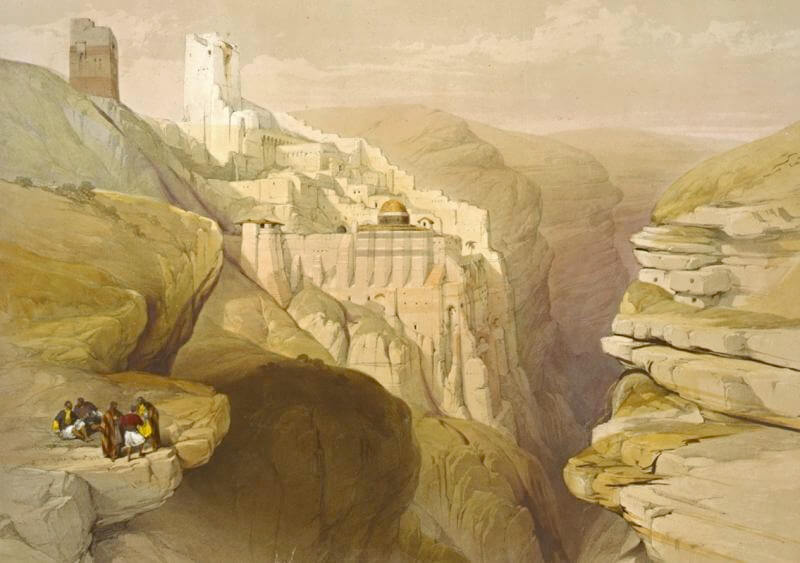
‘Mar Saba,’ by David Roberts. Courtesy of Jim Sable
I was briskly walking down the main drag of a swanky neighborhood in Seattle when I saw a faded, old-timey lithograph in the window of an art store. It was a landscape with a fortress built into the cascading side of a massive, dry and desolate canyon. The location was as far from green and leafy western Washington on that drippy spring day as one could imagine. In the foreground, a group of men wearing exotic clothes were standing and sitting outside the fortress.
I did a doubletake — I knew that place; it was Mar Saba, an ancient monastery in the middle of nowhere.
I went into the store and talked with the owners who told me the artist’s name was David Roberts. He was a contemporary of a couple of men named Charles: Dickens and Darwin. David Roberts started his career by painting sets for the London theater. After that, he developed an interest in landscapes and toured western Europe drawing historic churches and later found his way to southern Spain where he drew the famous sites of Moorish architecture.
Then, he did something truly extraordinary, especially for someone living in London at that time. In 1838, he sailed from England all the way to Egypt. Almost no one in Europe had traveled there since Napoleon and his army invaded in 1798. He toured Cairo and sailed up the Nile to the temples, tombs and relics of the pharaohs, detailing them in his sketches.
After returning to Cairo, Roberts embarked upon another excursion even more daring than his Egyptian adventure. A deeply religious Christian, he succumbed to the urge to see the Holy Land. The easiest way to do that would have been to sail down the Nile to the Mediterranean and follow the coast to the east. Or, he could have gone by horse or camel along the Via Maris, the ancient road that follows the coast. Both routes would have taken him only a few days to complete.
Instead, Roberts made a totally radical and potentially dangerous choice. He hired Bedouin tribal guides to take him by camel across the eastern desert of Egypt and through the length and breadth of the Sinai Desert, following the route the Hebrews took during their 40-year journey we now refer to as the Exodus. In the Torah, the book of Numbers is called BaMidbar, which means “In the Wilderness,” which is exactly what the forbidding Sinai is like. Life can easily be lost if one is not careful due to lack of water or the threat of bandits.
Once Roberts finally reached Israel, he toured almost all the places mentioned in the Bible and continued on to Lebanon, drawing everything he saw. Upon his return to England, Roberts made lithographs of his drawings and collected them into three jam-packed volumes. Being a shrewd businessman, the artist sold his collection to subscribers. It was an instant hit. His first subscription was purchased by Queen Victoria.
A refuge from the outside world
Years ago, when my wife and I were visiting Israel, we took a bus from Jerusalem to Bethlehem. After visiting the popular sites in that city, we hired a taxi which took us down a one-lane, dusty, rutty, partially paved “road” atop a narrow, steep ridge to its literal end. This road led us deep into the Judean Desert where Jesus spent time and where King David hid from his rebellious son, Absalom, who almost succeeded in having his father assassinated.
Mar Saba sits precariously on the shoulder of the canyon, called a wadi by the locals, in the hills above the nearby Dead Sea. Even though it was mid-October, the air was so hot that a local shepherd and his goats were sheltering in the shade of one of the high walls of the fortress.
We approached the main gate and knocked. A low voice inside answered. It was one of the monks. We were lucky he spoke English. However, we were not so lucky with what he said. He told us my wife could not enter because she was the wrong gender and would have to wait outside. However, he let me in.
Inside the main gate, the compound was crowded with ancient sand-colored stone structures. The monk first showed me the chapel, which was cool and dark in striking contrast to the veritable furnace outside. What it lacked in size, it made up for in ornamentation. The floor had a complex pattern of symmetrical pieces of colored marble. The altar had an elaborate filigree of gold. Most impressive were the walls up to the domed ceiling which were completely covered with icons of various saints, all of which appeared to have been made a very long time ago. Even the inside of the dome was covered with painted images of saints.
I followed my guide to a nearby stone building and was dumbfounded by what I saw. This was the monastery’s sepulcher room. On display on wooden tables under glass were dozens of skulls and bones. The monk explained that when a monk dies, he is buried in the monastery’s cemetery and remains there for several years. After that, the bones and skull are removed and placed on display in this room. He said that many of the remains belonged to martyred monks who were murdered when the Persians invaded in 614 CE.
In what I supposed to be the dining hall, the monk gave me a drink and proceeded to tell me he was from Greece. He seemed to feel free enough to unload his feelings because he went on to elaborate about the corruption and iniquity of the outside world and how his community of believers cherish their refuge from all of that behind the high walls of their little world.
Once I exited the main gate, I found my wife sitting on a rock in the shade waiting for me. Her only company was an old Arab man who was likewise escaping the withering glare of the sun. Her only consolation was that I had taken so many photos of the interior of Mar Saba that I had made a visual record of everything I saw inside the walls.
An island at the end of the world
When I was in the art store in Seattle two years later, the experience of Mar Saba came flooding back and I wound up purchasing the lithograph. I can tell you it is a pretty accurate depiction of what we saw. The place has not changed at all in more than 175 years since the artist was there. I doubt the place has changed much at all since its founding in the fifth century CE.
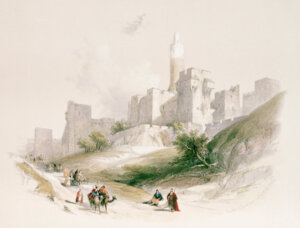
After learning more about Roberts, where he traveled and what he did, I began collecting more of his lithographs, including a drawing of the Tower of David, which I saw regularly when I was a college student in Jerusalem.
The Tower of David, next to the Jaffa Gate in the Old City of Jerusalem, functioned in ancient times as the citadel of the city. It was originally built during the Hasmonean dynasty who descended from the Jewish Maccabees of Hanukkah fame. I should mention that the Tower had nothing to do with King David as it was constructed by the Romans after their conquest hundreds of years later. When Roberts made his drawing, the road outside the Tower was just a narrow, dusty, dirt path. Now, it is a busy, well-paved, four-lane highway leading from Jerusalem to Bethlehem and Hebron.
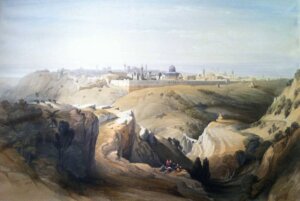
Roberts also drew a panorama of the Old City viewed from high atop the Mount of Olives. After my wife and I climbed the steep road up the Mount, past the old Jewish cemetery, which is where legend says the Messiah will appear and raise the dead on Judgment Day, we saw the same precise view that Roberts recorded for posterity. I believe Roberts took some artistic license with his work since he sketched a bridge over the Kidron Valley, even though there never was one.
Roberts drew the Isle of Graia where I traveled with a friend, Andy, when we were on spring break and took a trip to Eilat. At that time, Eilat was extremely remote, and it took hours to get there. The only other passengers on our bus from Jerusalem were workers headed to construction jobs building new hotels. As we got close to our destination, the other passengers pulled knives and guns out of their luggage.
Eilat, located where the Negev desert ends and the Sinai begins, was not much of a town back then. Surrounded by high hills, it is not a pretty landscape of undulating sand dunes; the terrain is rocky and almost completely devoid of any living thing. While Andy and I were there, we heard about an island further down the coast. We hitched a ride with some soldiers in a jeep who were headed down the coast. After about two dozen kilometers, they dropped us off at a place called Hof Almogim, or Coral Beach in English.
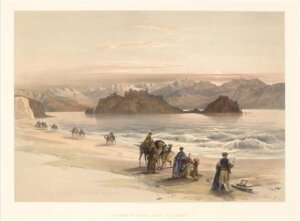
It was a beautiful beach without a soul there. It seemed as if we had reached the end of the world. The only thing on the beach was a small shack where the lone proprietor sold Cokes and rented snorkeling gear. Off in the distance was the island. On the opposite coast were the mountains of biblical Edom, in today’s kingdom of Jordan.
When Roberts was there, he was heading north with his local Bedouin guides in a caravan. I believe he included himself, dressed in Ottoman style-clothes, in the lower right corner of his picture drawing the scene; you can see him holding some kind of paper and his writing kit and an umbrella are on the ground in front of him.
When we showed up many, many years later, the weather was scorching, so we did what anyone else would do— we rented masks, pipes and fins and waded into the water. It didn’t matter that I had never gone snorkeling before. It took me a little time to get the hang of it, but I figured it out. The Red Sea’s temperature was like bath water, so we plunged right in and crossed into another world.
Not far from shore, we encountered a multi-colored coral reef that, from the shore, looks distinctly red, which is where the Red Sea gets its name. In stark contrast to the aridity of the land, the sea was alive. The reef was covered by lots of sponges that looked like colorful human brains. It was surrounded by swarms of shimmering, iridescent, palm-sized fish in different hues. As we maneuvered through them, they darted here and there, moving in unison liked flocks of birds.
The coral was razor sharp, so I was careful to keep my distance as we passed over it, at which point the sea floor dropped to 60 feet below us. Suddenly, it was devoid of life and it was hard to see the bottom.
It took almost an hour to reach the island. It has an impressive stone castle which was originally built by the invading Crusaders who wanted to protect the pilgrimage routes in the area and defend their kingdoms centered in Jerusalem. Later, during the Crusades, the Christians lost control of the fortress to Muslim forces. When we were there, Israel controlled the area, having conquered it in the Six-Day war. The Sinai now belongs to Egypt as a result of the 1979 Camp David peace agreement.
When Andy and I reached the beach, the weather was blistering. We could not explore the castle since our only footgear consisted of the fins we had on our feet. So, we did not stay long. On our return, the sun was sinking on the horizon. It was becoming noticeably colder. Sea creatures were emerging from their hiding places; a pink bubble the size of my fist floated directly toward me. It had tentacles that hung down from the body. Instinctively, I turned to avoid it. I later learned it was a Portuguese man o’ war, a type of jellyfish, which carries an evil sting.
Upon reaching the mainland, darkness smothered us, and Andy and I camped on the beach. The next morning, we checked our belongings for scorpions and caught a ride back to Eilat. Today, luxury resort hotels have sprouted on that once-lonely beach. The commercialization of that former paradise is heartbreaking.
Epilogue
Quite a few years have passed since those travels and David Roberts’ lithographs now hang in honored places in our home. Once in a while, I pause in front of one of them and marvel at the precision with which the artist captured the mood of his subject. Some of these locations, such as the ones in Jerusalem, I have been intimately familiar with. Others I merely passed through as a tourist just as Roberts did, albeit under far more primitive and dangerous circumstances. I almost wish I was able to go back in time and travel with him in that caravan.
Correction: A previous version of this article misstated that Exodus was called “BaMidbar” in Hebrew. It is the Book of Numbers that has that title.
This is a moment of great uncertainty. Here’s what you can do about it.
We hope you appreciated this article. Before you go, we’d like to ask you to please support the Forward’s independent Jewish news this Passover. All donations are being matched by the Forward Board - up to $100,000.
This is a moment of great uncertainty for the news media, for the Jewish people, and for our sacred democracy. It is a time of confusion and declining trust in public institutions. An era in which we need humans to report facts, conduct investigations that hold power to account, tell stories that matter and share honest discourse on all that divides us.
With no paywall or subscriptions, the Forward is entirely supported by readers like you. Every dollar you give this Passover is invested in the future of the Forward — and telling the American Jewish story fully and fairly.
The Forward doesn’t rely on funding from institutions like governments or your local Jewish federation. There are thousands of readers like you who give us $18 or $36 or $100 each month or year.
Support our mission to tell the Jewish story fully and fairly.