The minotaur-slaying, dragon-battling hero of this video game is an old Jewish guy with back problems and an attitude
The upcoming ‘The Eternal Life of Goldman’ is a gorgeous, 2D fantasy-adventure centered on the exploits of the kippah-wearing Mr. Goldman
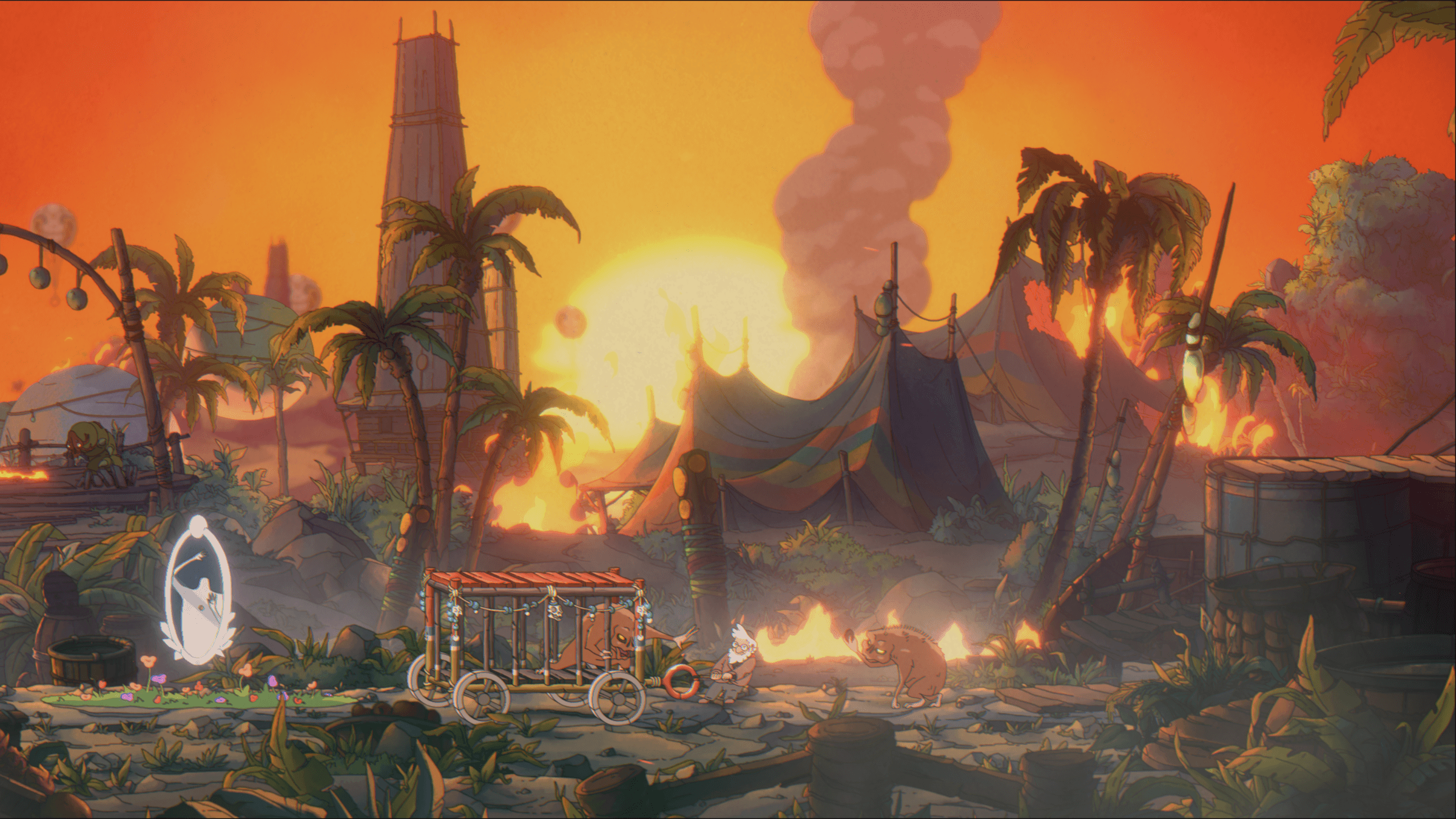
A suitably fiery screenshot from the game Courtesy of Weappy Studios

By Noah Hirsch-Rechter March 5, 2026
For a long time, Jews looking for representation in video games had to make do with the possible Jewishness of William Joseph Blazkowicz, the Nazi-hunting protagonist of the popular ‘90s video game series Wolfenstein.
A white, muscular, machine-gun-toting GI, with a lantern jaw and blue eyes, Blazkowicz didn’t exactly look the part. But his Polish ancestry, together with his enthusiasm for vanquishing Wehrmacht soldiers, left many Jews convinced. (Eventually, in 2017, Wolfenstein creator Tom Hall confirmed that the character’s mother was indeed a Polish Jew.)
Depictions of Jews in video games have, mercifully, improved in recent years, not least as the gaming industry has sought to reflect a wider range of identities and perspectives. The Shivah, published in 2006, told the story of a Manhattan rabbi caught up in a murder mystery. In 2020, The Last of Us, Part II introduced Dina, a Sephardi Jew with a fondness for apples and honey, while 2022’s Perfect Tides was an excellent coming-of-age story about a bashful 15-year-old New Yorker named Mara Whitefish. (Author and critic Josh Lambert described Perfect Tides as “the most compelling Jewish video game ever created.”)
To this growing roster of Jewish video games we can now add The Eternal Life of Goldman, the latest effort from independent game studio Weappy. Set to be released in full later this year, a demo version published last week received considerable praise online — and not just for its dazzling artwork and intuitive gameplay.
Rather, much of the intrigue and acclaim was because of the game’s improbable hero: a Jewish octogenarian with a yarmulke and a cane, the titular Mr. Goldman.
Although the demo is just the first 90 minutes of gameplay, it took me the better part of a day to get through. The game takes place on a vast archipelago populated by an array of menacing creatures — brilliantly brought to life by hand-drawn, 2D animations — and so death is ever present. For example, no sooner had I, as Goldman, arrived on the first of the game’s islands, than was I set upon by some kind of dragon-dinosaur hybrid. Goldman was promptly killed; he died with an arresting squeal. (The game’s sound effects are immense.)
It’s not clear why Goldman has opted to spend his presumably hard-earned retirement among volcanic ruins and thick underbrush. Palm Beach, this ain’t. Perhaps understandably, he isn’t so keen on the task at hand, which appears to be a rescue mission of sorts to retrieve a group of children known as “The Lost Ones,” though the demo ends before this is properly explained.
Still, Goldman is remarkably agile, with impressive powers of resurrection. The cane isn’t for walking, it turns out, so much as bouncing, thwacking and stabbing. It’s Goldman’s only companion as he faces down the beasts and monsters, most of which are lifted from a fable or myth. Besting the Minotaur, for instance, was the undoubted highpoint of a day’s gaming otherwise defined by my near-constant death.

Indeed, the game has a somewhat macabre feel. Even its framing device, a bedside conversation between a mother and daughter at a hospital, hints at a sinister plotline to come. (Ilya Yanovich, Weappy’s creative director, admitted as much in a recent interview.) In fact, the fairytales that the mother tells her ailing child seem to govern where Goldman ends up in the game. I was not the only reviewer for whom this called to mind the movie The Princess Bride — which, it’s worth noting, was written by one William Goldman.
This is just one among a host of Jewish, or Jewish-adjacent, references that cropped up in barely an hour-and-a-half of gameplay. There’s a faintly kabbalistic figure called Nissim Klein. Another character is named Hanoch. All three men — Goldman, Klein, Hanoch — periodically yell time-honored Yiddishisms like “Oy Vey!” and “Ach.” And at one point, we’re told about a group of giant clay statues “built by Nissim’s ancestors,” which feels more than a little Passover-coded.
Despite my difficulties progressing through the demo, then, the artwork, the Jewishness, the propulsive narrative energy, the main character’s cynicism, the simple left-to-right gameplay — it was all more than enough to sustain me.
Yet, at the risk of reading too much into a small slice of a much larger pie, it’s worth considering how Goldman communicates its Jewishness. For one thing, the game is, in at least one respect, the anti-Wolfenstein: While Blazkowicz’s Jewishness was merely gestured at, Goldman’s is unambiguous. And for another, Goldman places its Jewish protagonist in something other than a Jewish ceremony or ritual. (My apologies to the aforementioned The Shivah.) These are both salutary developments, the more so at a time of rising antisemitism, online and elsewhere.
But Goldman is a stereotype, too, albeit a largely inoffensive one. He’s a cantankerous older Jew with a hunch and a limp whose dialogue, in the demo at least, mostly consists of kvetching and confusion.
Now, is it amusing to see Goldman bouncing through the forest, battling mythical beasts and natural disasters, all while expectorating constantly? Certainly. Is the incongruity the point? Maybe. Still, it feels like a missed opportunity that Weappy selected a somewhat backward-facing protagonist as its vehicle for Jewishness — especially as Jewish identity becomes increasingly variegated with each passing generation.
The Eternal Life of Goldman is a valuable affirmation of a particular flavor of Jewishness, sure, and given the stir that the demo generated online, it doubtless will do very well. I can’t help but feel, however, that a less played-out protagonist might have compelled Yanovich — who is Jewish — to include some fresher, more interesting modes of Jewish cultural and ethnic expression.
After all, we’re more than yiddish and yarmulkes.
This is a moment of great uncertainty. Here’s what you can do about it.
We hope you appreciated this article. Before you go, we’d like to ask you to please support the Forward’s independent Jewish news this Passover.
This is a moment of great uncertainty for the news media, for the Jewish people, and for our sacred democracy. It is a time of confusion and declining trust in public institutions. An era in which we need humans to report facts, conduct investigations that hold power to account, tell stories that matter and share honest discourse on all that divides us.
With no paywall or subscriptions, the Forward is entirely supported by readers like you. Every dollar you give this Passover is invested in the future of the Forward — and telling the American Jewish story fully and fairly.
The Forward doesn’t rely on funding from institutions like governments or your local Jewish federation. There are thousands of readers like you who give us $18 or $36 or $100 each month or year.
Support our mission to tell the Jewish story fully and fairly.