An astonishing history of wartime Berlin that reads like a thriller
Ian Buruma’s ‘Stay Alive’ is at once panoramic and intimate, dispassionate and deeply moving
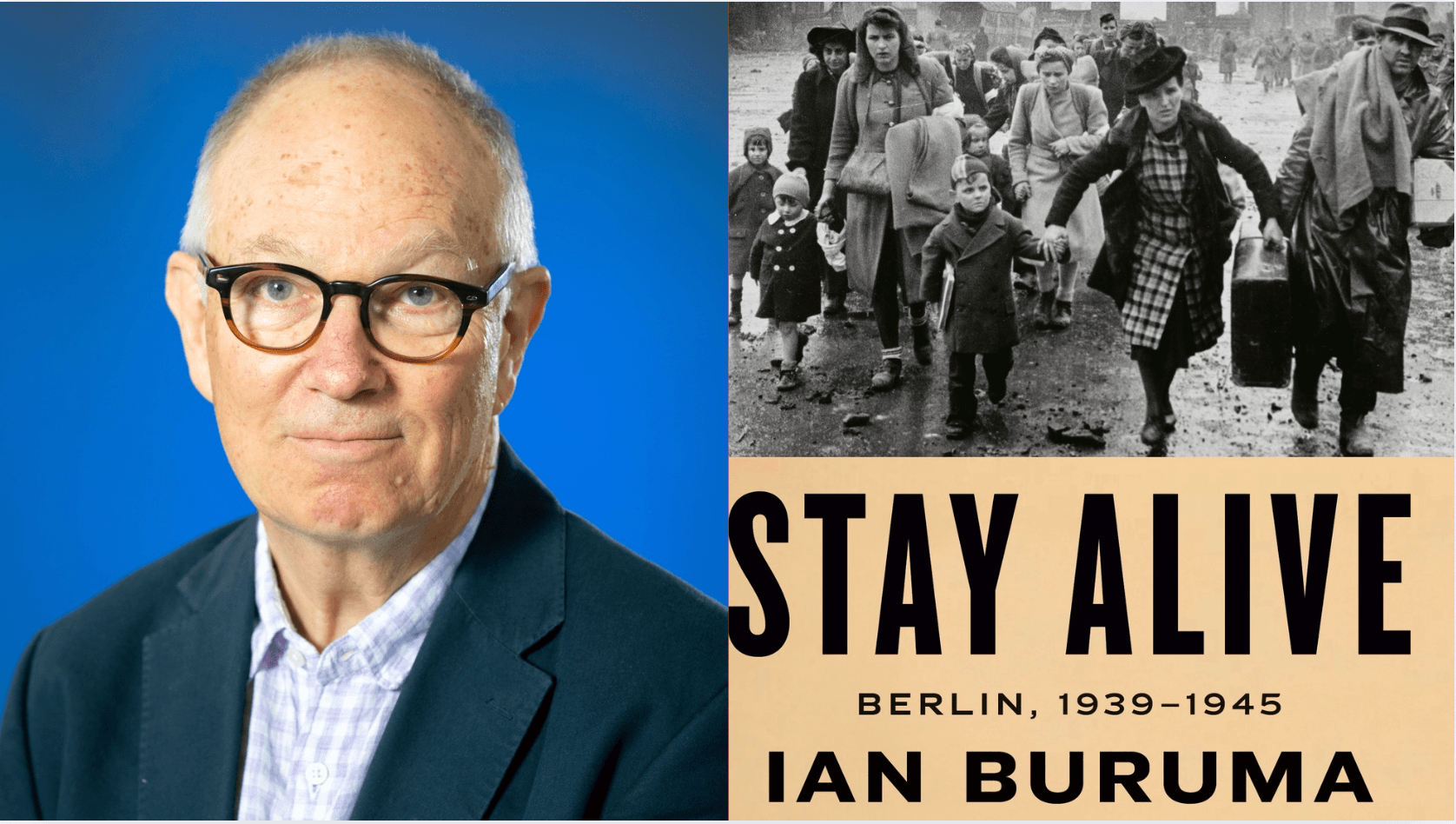
Ian Buruma’s latest book, ‘Stay Alive,’ is an impressionistic cultural and social history of Berlin during WWII. Photo by Getty Images/Penguin Random House

By Julia M. Klein March 17, 2026
Stay Alive: Berlin, 1939-1945
Ian Buruma
Penguin Press, 400 pages, $35
World War II Berlin had its share of fanatical Nazis, along with a handful of courageous resisters. But it is the people navigating between these two moral poles that seem to interest Ian Buruma the most — those trying, against the odds, to remain “decent in a criminal state.”
It’s an idea that surfaces repeatedly in this wonderful book, whose title, Stay Alive, embodies the era’s other imperative. By 1943, Berlin was suffering mightily under Allied bombardment. Food, fuel and housing were growing scarcer. Civilians were spending nights and eventually days, too, underground. Facing annihilation, the regime was executing its own citizens for desertion, dissent or “defeatism.” In lieu of Heil Hitler or simply auf Wiedersehen, Buruma writes, Berliners commonly greeted one another with the admonition Bleiben Sie übrig (stay alive).
This detail was new to me, one of many small revelations in this immersive chronological account of a capital city in the vise of both Nazi tyranny and wartime privations. Buruma’s impressionistic cultural and social history touches on government propaganda, escapist cinema, the dilemmas of Germany’s artistic class, the courtroom dignity of Hitler’s opponents, the rigors of life in the bunkers, the desperation of the city’s last remaining Jews, and more. Stay Alive manages to be at once panoramic and intimate, dispassionate and deeply moving. It reads much like a thriller, albeit one where the ending is never in doubt.
With short, punchy sentences, Buruma, a chaired professor of Human Rights and Journalism at Bard College and a prolific author, stitches together a variety of first-person sources to depict the city’s evolving routines and attitudes. Some, such as the journalist William Shirer’s Berlin Diary and the Berlin Diaries of the Russian aristocrat Marie “Missie” Vassiltchikov, are familiar. Others, including the recollections and correspondence of Buruma’s own father, Leo Buruma, a Dutch forced laborer in the city from 1943 to 1945, are unique or surprising.
It was his father’s wartime letters home, written cautiously to elude Nazi censorship and avoid causing his parents anxiety, that inspired the book, Buruma says. Leo, who had been a law student, worked at a brake and machine gun factory, enduring vile living conditions, limited food and, as the Third Reich’s fortunes turned, the threat of death from Allied bombs. But he was not entirely a prisoner. For a while, he was able to enjoy some of the city’s cultural life and even pursue a romance with a Ukrainian forced laborer. Seven years after the war, he would marry a Jewish woman, Ian Buruma’s mother.
Two themes play out in Stay Alive. The first is Buruma’s consideration of the range of reactions and moral choices, from the bravest to the most craven, provoked by an immoral regime. “Not everyone is cut out to be a hero; and even heroes are not always morally pure,” he writes. “Compromises come with a price, however, some of which are more acceptable than others.”
The German officers and others involved in coup attempts against Hitler had varying degrees of involvement in the Nazi regime. Some had led the war effort; others were conservative nationalists, abhorring the Third Reich but still loyal to Germany. When it came to Berlin’s Jews, a minority of Berliners protested their treatment or offered protection. Far more looked away, or worse, as their neighbors disappeared. Many German actors, musicians and others — including Berlin Philharmonic conductor Wilhelm Furtwängler — swallowed their ideological objections to keep performing.
Buruma’s second narrative thread traces the disintegration of the city, from a thriving cultural redoubt to a battered hellscape, and the responses of its resilient but ultimately despairing residents. Buruma makes the somewhat questionable claim that terror bombing in itself failed to shatter morale. But, certainly, morale collapsed as German defeat appeared inevitable, and Nazi images and insignia were consigned to the flames.
From 1941 up until the war’s end, most of Berlin’s Jewish population was deported to concentration camps and murdered. Some Jews chose a dangerous, peripatetic underground existence instead. Among these “U-boats” was Marie Jalowicz, a lawyer’s daughter, whose ordeals Buruma describes. In her case, as well as others, shelter sometimes required sexual transactions. When the lecherous husband of a woman offering refuge showed up at her bedside, Buruma recounts, Jalowicz pragmatically “let him have his way.”
Jewish spouses in “mixed” marriages to non-Jews and the Mischlinge, generally children of such marriages, mostly escaped deportation. Buruma interviewed one such Mischling, Horst Selbiger, detained in 1943 with other Mischlinge and Jewish spouses in a former welfare office for Jews on Rosenstrasse. The wives of the Jewish detainees (and some others) famously gathered in protest, called out for their husbands’ release and refused to leave. The prisoners were eventually freed – a rare instance of successful public protest in Nazi Germany (or of any public protest at all).
Buruma also tracked down other Germans, in their 80s and 90s, who recollect childhood under siege in Berlin. Jörg Sonnabend, an ex-engineer, remembers a semblance of normal life, succeeded by a fear of British bombers. He, like Buruma’s father and other survivors, was left with lifelong post-traumatic stress disorder.
In the end, neither Nazi triumphalism, willed ignorance nor moral scruples proved a match for Allied firepower. And surrender brought no immediate relief. As many as 100,000 Berlin women and girls were raped by Soviet soldiers, Buruma reports, including Marie Jalowicz. Widespread hunger was calamitous, but the postwar situation rapidly improved.
One of Buruma’s messages is about the dangers of conformity, “the temptation to look away.” But he also describes Stay Alive as a love letter to Berlin, which in recent decades has become a potent memorial landscape. “The city itself is a monument,” he writes, “not only to man’s blackest depravity, but to its capacity to be reborn and live again.”