A brilliant Jewish storyteller may be gone, but her characters are ‘still talking’
Lore Segal’s posthumous short story collection once again shows her mastery of the form
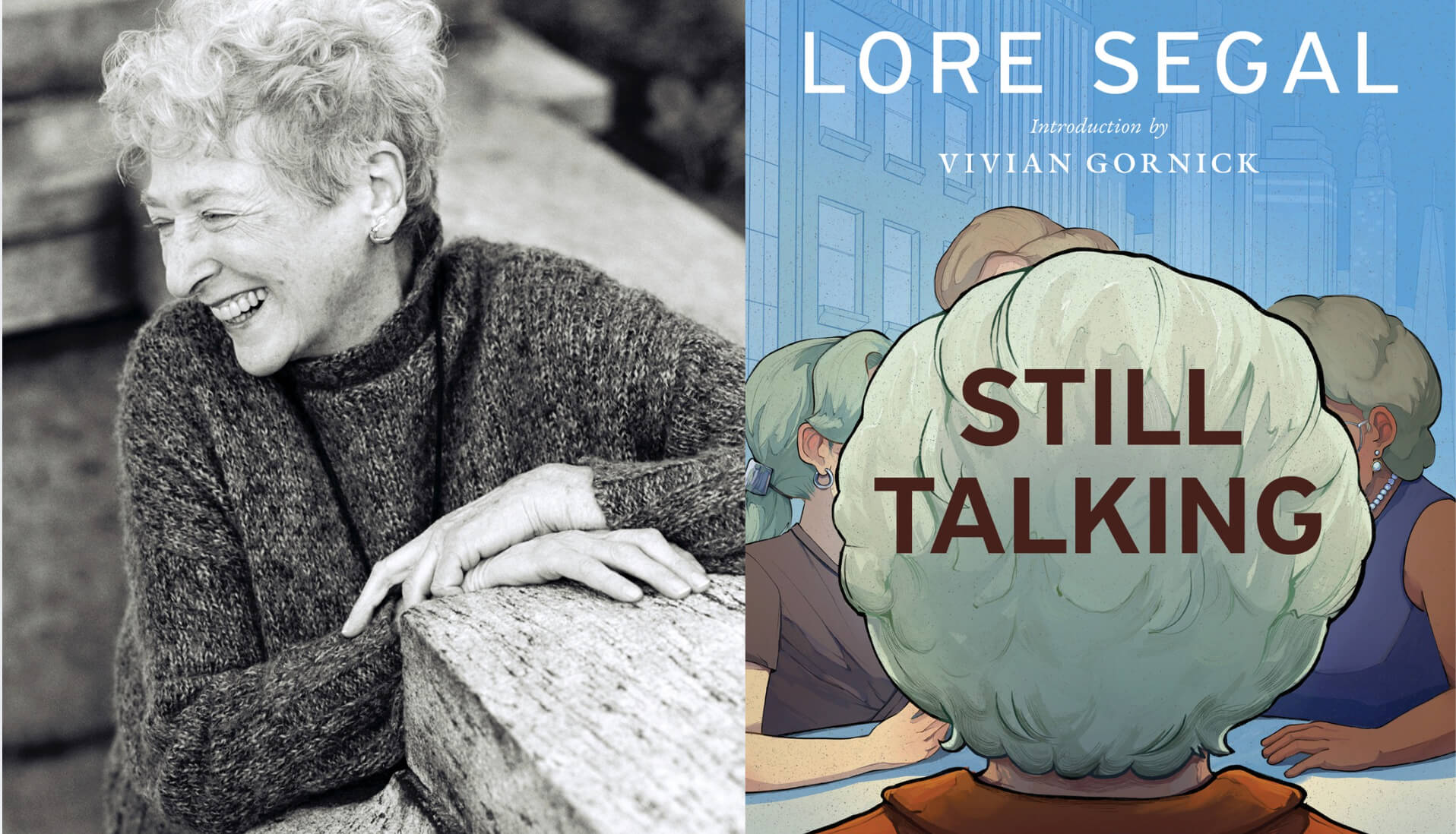
Lore Segal, who died in 2024 at age 96, was a master of the minimal. Photo by Ellen Dubin/Melville House

By Ann Levin March 18, 2026
Still Talking
By Lore Segal
Melville House, 128 pages, $19
In one of the stories in Lore Segal’s posthumous collection, Still Talking, a group of women in their 80s and 90s agree without the need for discussion “that they were not going to pass, pass away, and under no circumstances on. They were going to die.”
It is characteristic of these tough-minded women, who have graced the pages of the New Yorker and taken a star turn in Segal’s 2023 collection Ladies’ Lunch, to renounce one of the most annoying euphemisms of modern life.
Like the stories in the earlier collection, this book also features the “Ladies Lunch,” a literary device that Segal’s longtime friend Vivian Gornick describes as “a group of very intelligent Upper West Side women (Lore and her friends)” who get together regularly to talk.
“Aging is the condition at the heart of all their musings, a development that has not made them any less interesting than at any other stage of their lives,” Gornick says in a warm introduction, calling Segal’s writing “one of the small glories of American literature.”
At one such meeting, a character named Farah suggests a discussion topic: “forgetting as an Olympic sport” because names, dates, events — almost everything — won’t stick in their minds. At another get-together, Ruth, the “bona-fide retired activist” of the group, regrets not going to a dinner she was invited to, not because she missed the food or conversation, but because “it makes it easier to not go the next time.” And in “Left Shoulders,” a character wonders if she is losing the very capacity for speech. “There’s something I want to say, but my mouth doesn’t open to say it, or not in the moment when there is a gap in the conversation.”
Segal’s life and work are now the focus of a new exhibit at the Center for Jewish History’s Leo Baeck Institute, an archive and research library for the history and culture of German-speaking Jews. The show, which opened in January and closes April 15, features photographs, documents and artifacts that trace Segal’s personal and literary journey from prewar Vienna to New York.
Born into a Jewish family in Vienna in 1928, Segal escaped Nazi-occupied Austria on the Kindertransport when she was 10. She grew up in England in a series of foster homes, material that she mined for her first autobiographical novel, Other People’s Houses. Eventually she was reunited with her parents in Britain, then emigrated to New York with her mother in 1951. Her father died in the final days of the war.
Some of this historical trauma in reflected in the story “Ilka,” in which the eponymous character tells her friends that her daughter applied for and received her Austrian citizenship. When they ask whether she considered doing the same, she says, “I did not. I was remembering my parents’ desperation assembling the papers that were required for our emigration.”
At first, the story has a light-hearted tone as Ilka describes going back to Vienna for visits when she was younger, dropping her bags at the hotel and racing off in search of a remembered tower or palace. Then it takes a darker turn as she reports on her daughter’s efforts to find out what happened to relatives who didn’t manage to escape, including a beloved, “immensely overweight” aunt who was killed at Auschwitz.
“Ilka tries not to imagine Tante Mali, who needs help getting up from her chair, forced to run to the right, turn and run left. To imagine the men? Not Dante, not Milton, not Shakespeare has anatomized their human hearts, and about what she cannot imagine she cannot think and I cannot write,” Segal says in a metafictional twist at the end that shifts from the third to the first person, shedding light on Segal’s distinctive storytelling method.
Segal elaborates on that technique in another story, “In the Mail,” in which a writer character named Bridget compares the act of writing fiction to the transporter in “Star Trek,” a device that dematerializes people into energy so they can be reassembled elsewhere. “I turn us into the words that would allow [others] to imagine us,” she says.