The Nazis didn’t care that Paul Klee wasn’t Jewish
Sketches from the last decade of the lauded artist’s life, exhibited for the first time in the US at the Jewish Museum, change how we understand his work
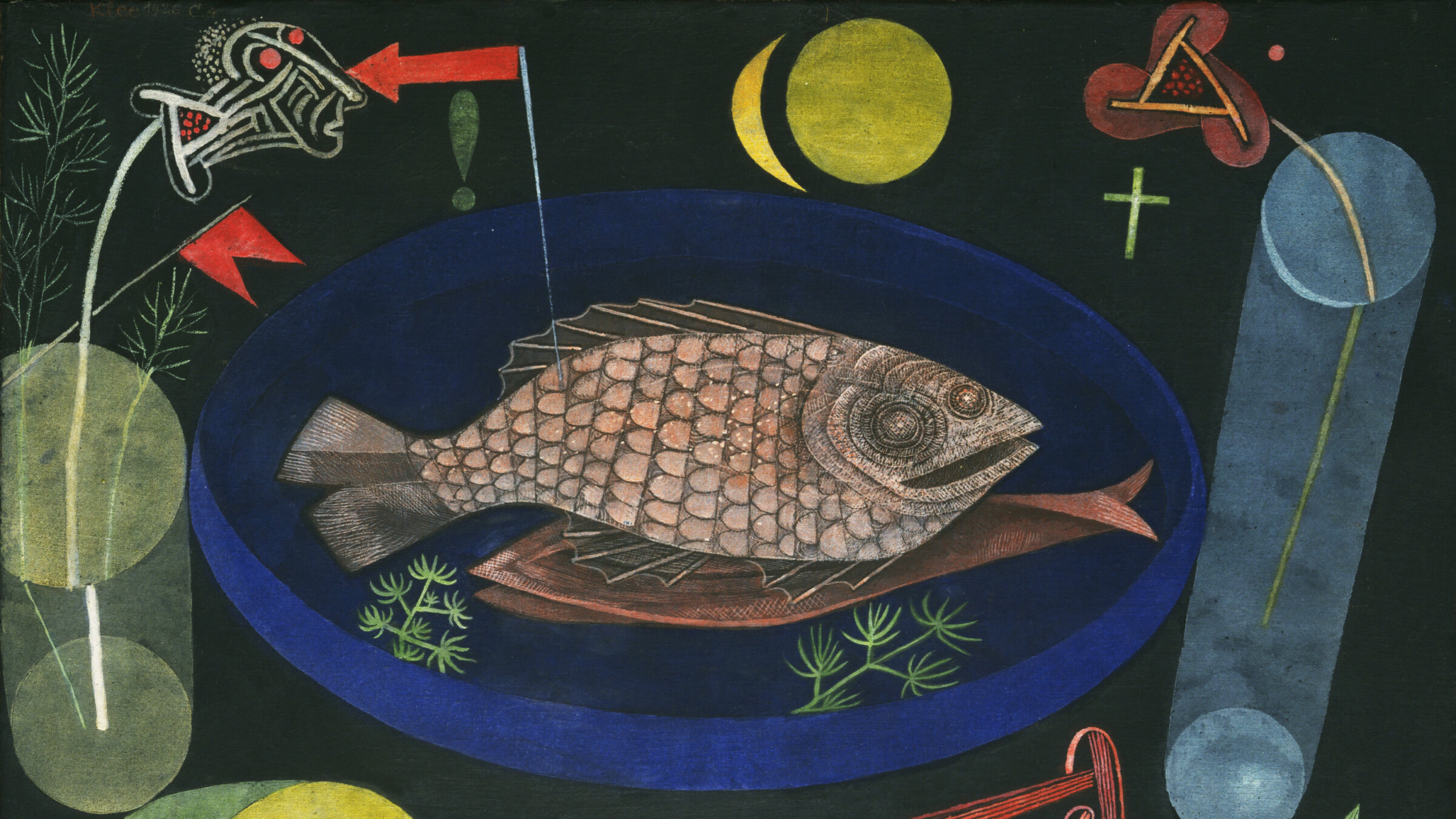
Around the Fish (Um den Fisch), 1926. Abby Aldrich Rockefeller Fund. Courtesy of The Jewish Museum

By Mira Fox March 19, 2026
Paul Klee is hard to describe. The German artist’s works, which he began creating in his childhood until 1940, when he died at age 60, vary widely; they often feature abstract forms, but just as often figures. They are known for strong colors, but some are monochrome. He taught at the Bauhaus school, is considered by some to be the father of abstract art, but he’s also foundational to surrealism and German expressionism. He uses cubism and pointillism.
What he is not particularly known for is his political statements. But a new exhibit, Paul Klee: Other Possible Worlds, opening this week at the Jewish Museum in New York, is looking to change that.
The exhibit, curated by Mason Klein in his final exhibit as senior curator at the museum, includes work from throughout Klee’s career, tracing a throughline of political commentary on fascism and authoritarianism that has gone little discussed. Its centerpiece is the first U.S. exhibit of a cycle of sketches the artist made in response to the Nazi assumption of power in 1933. It was an important year for Klee — it was the year he was removed from his teaching position at the Düsseldorf Academy of Art, in response to pressure from the new regime.
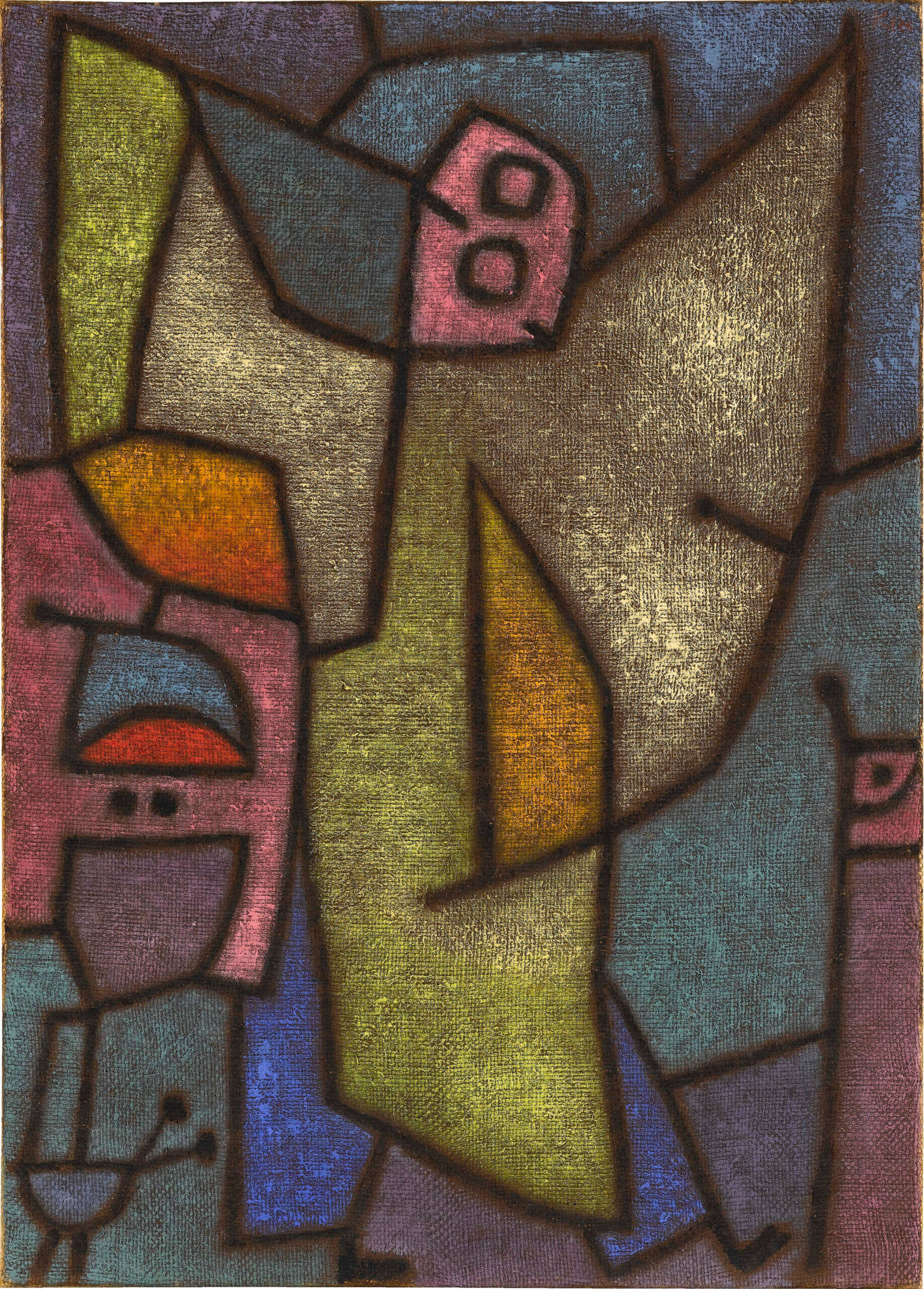
Klee was not Jewish. But Nazi press defamed him as Jewish anyway to justify his termination. “He tells everybody he has pure Arabian blood in his veins, but he is actually a typical Galician Jew,” read an article in Nazi outlet Die Rote Erde.
Klee was one of the first artists the Nazis declared “degenerate,” a descriptor applied to the abstract artists, often Jewish, who the regime sought to smear as sick, immoral and corrupting to the idea of German culture that Hitler promoted; 17 of his works were featured in the infamous Degenerate Art exhibition organized by Nazi leaders in 1937, which compared the artworks to the drawings of the insane. In another Nazi publication, Volksparole, he was accused of advancing “the Bolshevist ideals in art of communists and Jews.”
Klee, along with his wife Lily and son Felix, fled to Switzerland. But before he left, he drew hundreds of sketches satirizing Nazi ideology, full of chaotic lines, evoking the distress of the era. Klee’s concerns about the shifting culture are also seen in the pointed titles of each work, which he noted in a meticulous catalogue he maintained.
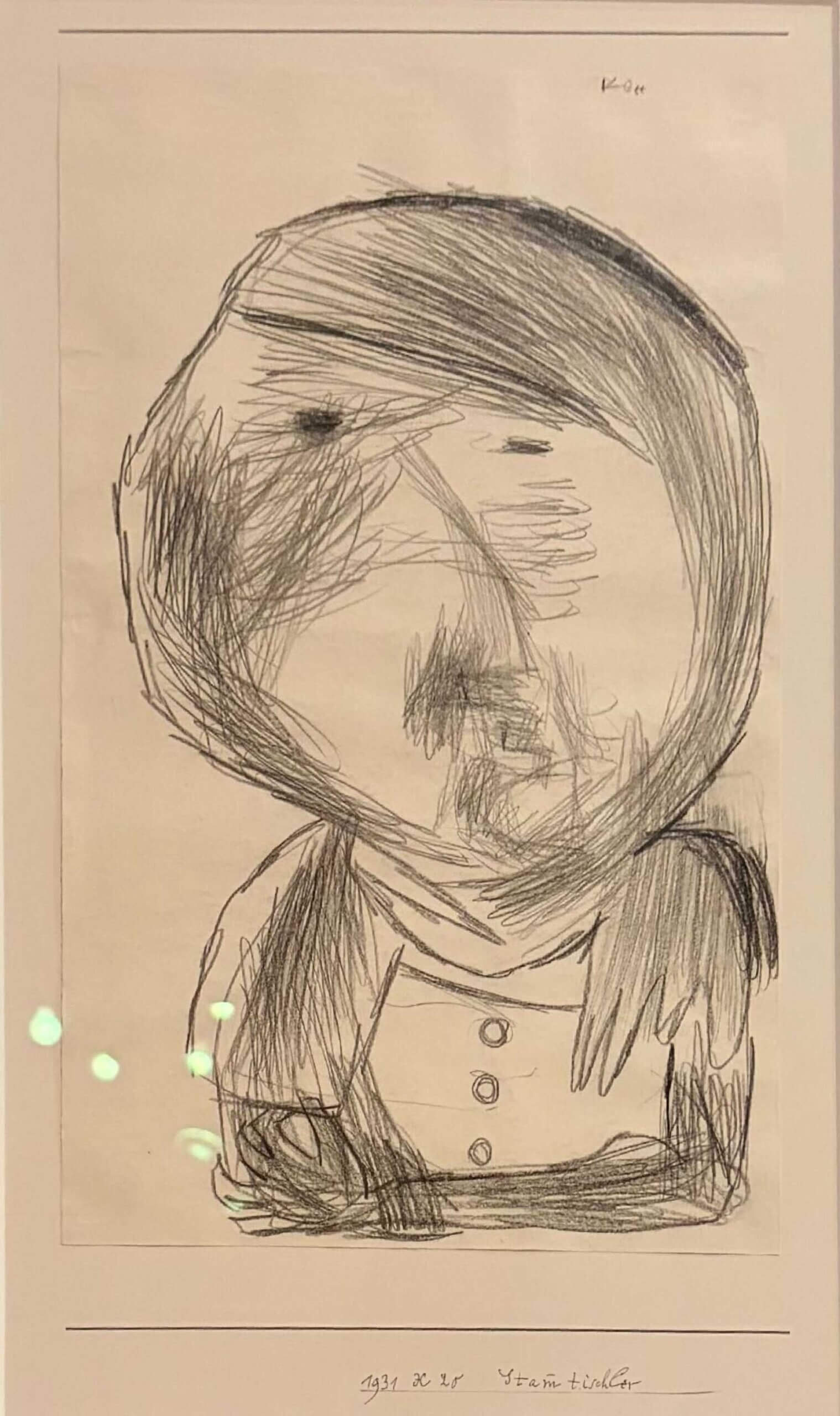
In Stammtischler, a clearly recognizable portrait of Adolf Hitler stares out from the page, with small, beady, scribbled eyes. In English, the title translates to “drinking companion,” a term with the positive-leaning connotation of an affable friend. But in German, writes curator and art-historian Pamela Kort, the term Klee uses suggests an oaf who voices loud, poorly informed opinions. Given that U.S. pundits often discuss which candidate the voters can imagine drinking a beer with, Stammtischler feels like a warning.
The museum’s director, James S. Snyder, noted the exhibit’s resonance to our current era in his remarks at the exhibit’s press preview. And it is hard not to think of our current political milieu when perusing Klee’s sketches.
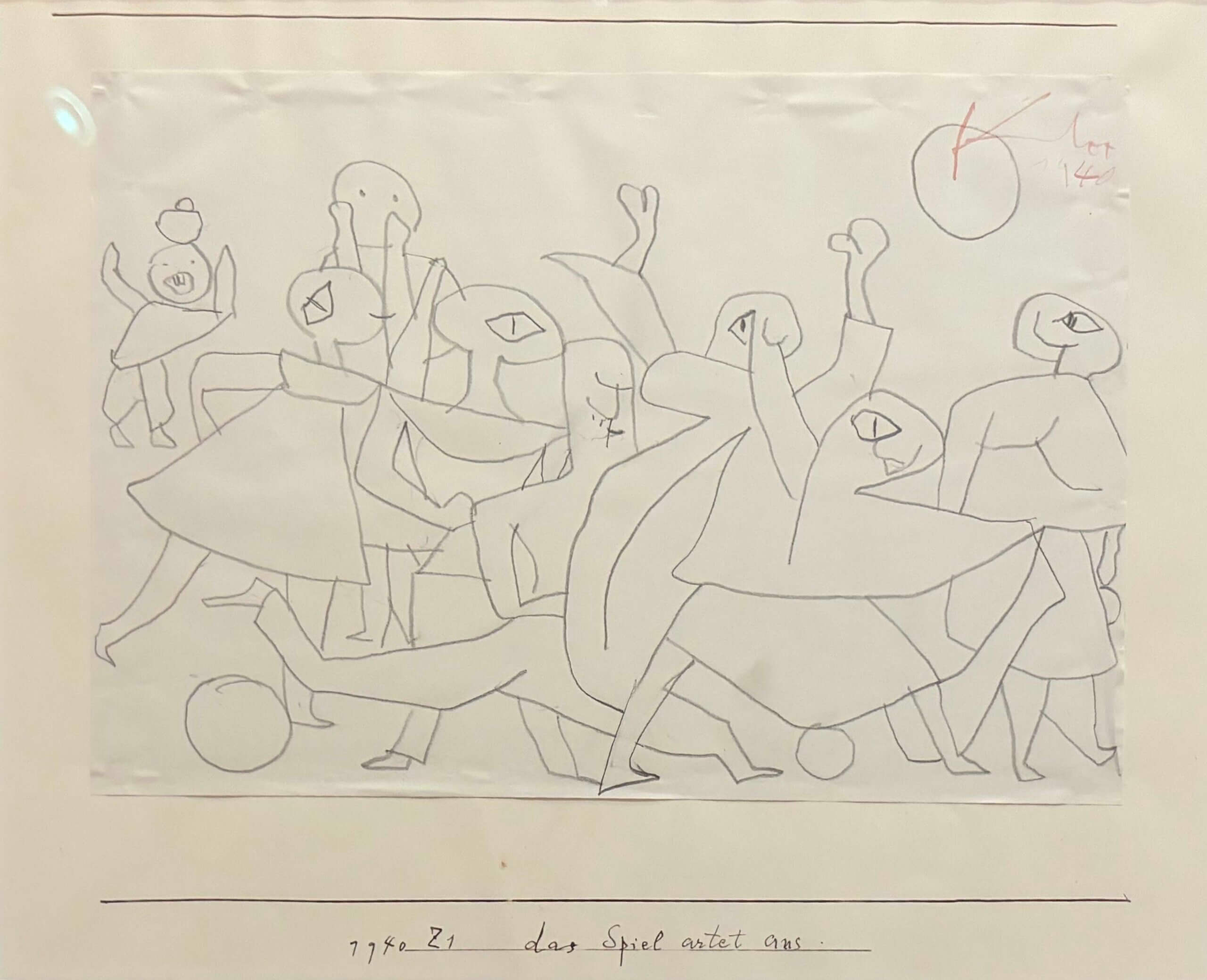
This Game is Getting Out of Hand, which shows a group of children with several balls in the air, depicts brawling as much as playing; Klee, the wall text elsewhere in the exhibit notes, was deeply concerned about the long-lasting effects of exposing children to Nazi ideology and violence. This evokes today’s extremist influencers — often young men who grew up immersed in the toxic soup of the internet — who use a trolling tone when espousing antisemitism or misogyny. It’s all a joke, supposedly, but the joke is getting less and less funny.
The political dimensions of Klee’s work are most obvious in the sketches. But they highlight the mockery of authoritarianism and fascism woven throughout his other work. Your Ancestor, a drawing of a monstrous, Gollum-like creature, pokes fun at the Nazi focus on eugenics. The wall text argues that his strangely colored paintings of fruit can be read as commentary on the pitfalls of selective breeding. Athlete’s Head, a portrait of a distorted face, is, according to the exhibit, “satirizing the Nazis’ superficial glorification of the heroic athlete” in light of a required five hours a day of athletics in schools.
Klee’s dismissal from his teaching position was not the first time Klee was slurred as a Jew. Over a decade earlier, when he was nominated as a professor at the Stuttgart Art Academy, critics who felt his art was too left-wing referred to him as “Paul Zion Klee.” (He did not get the position.)
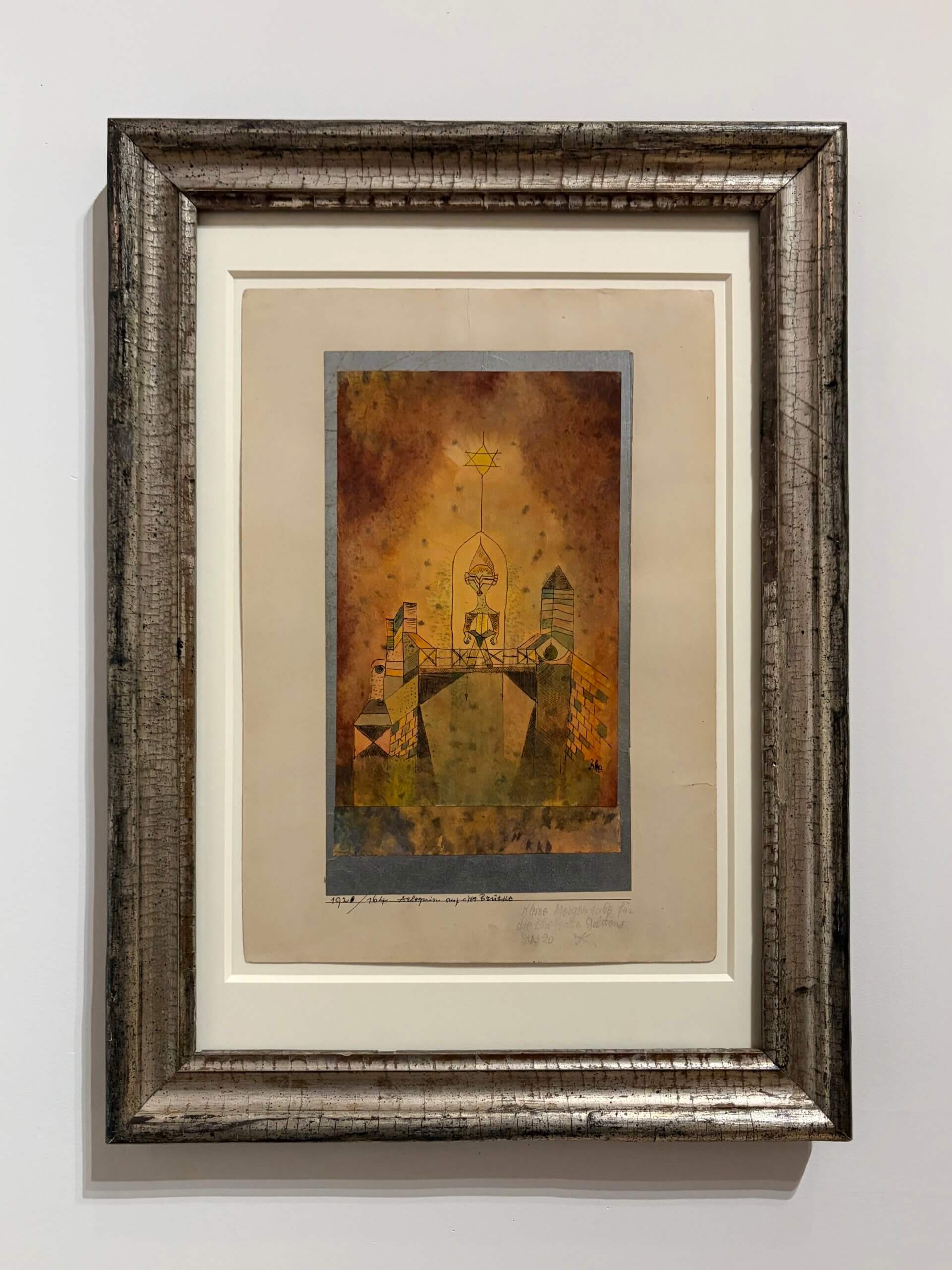
This inspired Klee to paint Harlequin on the Bridge, which deals openly with antisemitism. In it, a harlequin figure represents Klee himself, a Star of David hanging over his head, against an ethereal, unsettling background. The work wrestles with the idea of the perpetual outsider, whether jester or Jew, as the bridge between worlds, their positionality enabling them to access new ideas, combine categories and reach other worlds.
Klee’s politics are not always obvious. At times, it can feel hard to imagine that these abstract, modernist works are truly making a winking political commentary on antisemitism or Nazism, especially given that Klee did not speak publicly about his political views — though he wrote about them in personal letters to his wife and friends. Other Possible Worlds compellingly highlights the political valences in his work, but they remain open to a wide range of interpretations.
It all raises the question of why, if so much of his work had a political subtext, Klee did not take a louder, more pointed stand against the Nazis. Even his sketches, which criticize the new political regime, do so via caricature and irony. The titles, which give a trenchant context to each work, are still indirect. The power of Klee’s work lies in its ambiguity and ability to contain worlds, but it makes for poor activism.
In his writing, Klee appears to have decided that the best response to the vilification was to refuse to dignify it with any acknowledgment, however much he addressed the criticism in his art.
“It seems unworthy of me to undertake anything against such crude attacks,” he wrote in a letter to his wife. “For even if it were true that I am a Jew and came from Galicia that would not affect my values as a person or my achievement by an iota.”
The exhibit Paul Klee: Other Possible Worlds will be on display March 20-July 26 at The Jewish Museum in Manhattan.
This is a moment of great uncertainty. Here’s what you can do about it.
We hope you appreciated this article. Before you go, we’d like to ask you to please support the Forward’s independent Jewish news this Passover. All donations are being matched by the Forward Board - up to $100,000.
This is a moment of great uncertainty for the news media, for the Jewish people, and for our sacred democracy. It is a time of confusion and declining trust in public institutions. An era in which we need humans to report facts, conduct investigations that hold power to account, tell stories that matter and share honest discourse on all that divides us.
With no paywall or subscriptions, the Forward is entirely supported by readers like you. Every dollar you give this Passover is invested in the future of the Forward — and telling the American Jewish story fully and fairly.
The Forward doesn’t rely on funding from institutions like governments or your local Jewish federation. There are thousands of readers like you who give us $18 or $36 or $100 each month or year.

Support our mission to tell the Jewish story fully and fairly.