Ben Lerner’s tale of three hotels is a lyrical novel of loss and human potential
in ‘Transcription,’ the celebrated author writes Jewishly of what he finds himself unable to escape
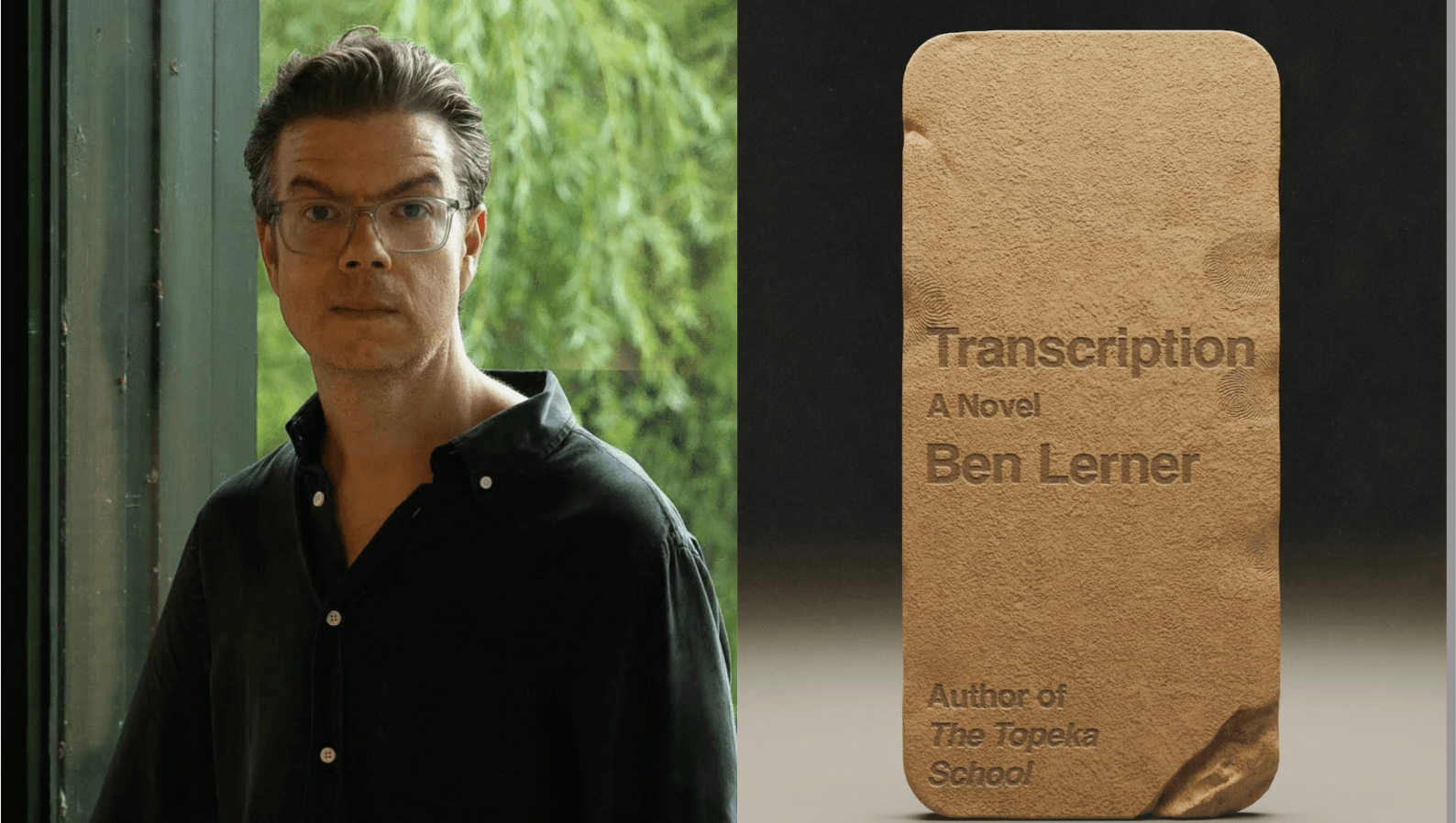
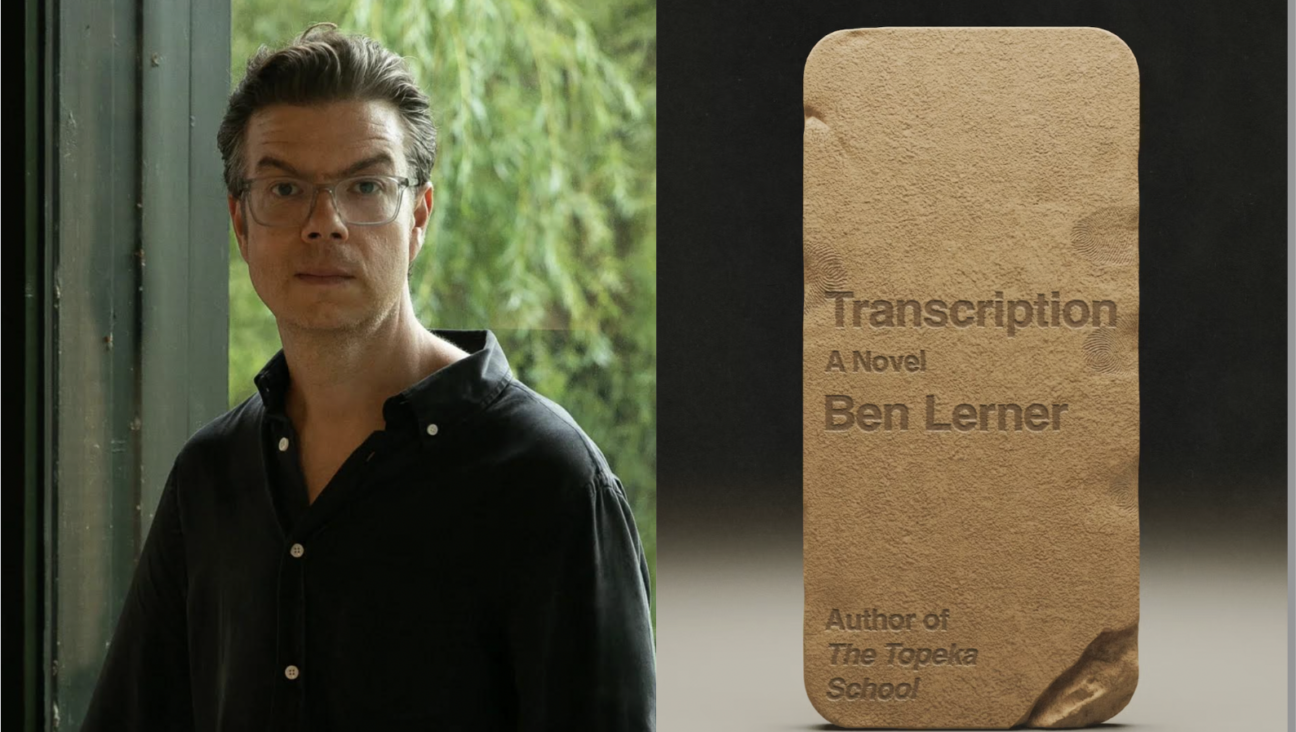
in “Transcription,’ as in his previous autofictional trilogy, Lerner uses a narrator — a writer who, like Lerner, went to Brown University — who hovers between being him and not. Photo by Farrar, Straus & Giroux

By Dan Friedman April 7, 2026
Transcription
By Ben Lerner
Farrar, Straus and Giroux. $25, 144 pages
As we scroll through the final portion of human history before it gets permanently revised by AI, Ben Lerner has written a lyrical novel of loss.
This three-part novel from the author of Leaving the Atocha Station, 10:04, and the Pulitzer finalist The Topeka School, presents loss in many forms: loss of recognition which leads to a confusion of identities; loss of memory which prompts whole new stories; or just, in a banal but usefully metaphorical way, the loss of the unnamed protagonist’s iPhone when he drops it in the sink near the start of the first section, “Hotel Providence.” This tech misadventure means that he will have to use an old landline to dial up his daughter before her bedtime and to rely on his frail human memory to remember the final interview he has with Thomas, his mentor and father figure.
As in his previous autofictional trilogy, Lerner uses a narrator — a writer who, like Lerner, went to Brown University — who hovers between being him and not. A writing assignment has brought him back to his alma mater, but the visit to his professor is more than just a work project. The initial piece and, as it turns out, later pieces about the trip, will be labors of love — with all the agita that accompanies those. The absent digital transcript of his interview at Brown seems to be what gives this book its name as well as what marks him as brave or foolhardy in the eyes of his peers at a later colloquium about Thomas. But the existence of the book as a “transcription” also avows the possibilities of human creativity in the face of transmission losses.
Transcription begins on a train journey and, just to prove that it is about moving away from the here and now, its first words also imply the start of a dream state: “I was falling asleep on a train.” Through the narrator, Lerner tells us as clearly as he can, that he is writing (script) in transit — and investigating how it is to rewrite from a place that is not your own. As the narrator along with Max — Thomas’ son who becomes a second narrator — recount their travels into adulthood, the book’s journey into the unknown is haunted by Freud’s dictum “where id was, there ego shall be.” Caught between fatherhood and filiation, they navigate a world that seems equal parts Escher and Kafka.
The book comprises three sections, each named for a hotel — a place to stay while dislocated: “Hotel Providence,” “[Hotel Villa Real],” and “Hotel Arbez.” The first is set punningly in Providence, the second is set in a hotel referred to in square brackets as if interposed later by editors, and the final one sits half in France and half Switzerland. Indeed, Max is named for the wartime owner of the hotel, since “during the German occupation, the Nazi soldiers could enter the French side of the hotel, but not ascend to the upper rooms, where Max Arbez helped shelter Jews and members of the Resistance. A kind of impossible staircase.”
Hotel Providence, which is located near Brown, is a name to conjure with, and Lerner — a decorated poet as well as a Fulbright, Guggenheim, and MacArthur fellow — conjures with it briefly as he takes his narrator to the interview. On the way, every landmark has either changed or been infused by memory, every person he sees is overlaid by his imagination. Without his phone he feels hypersensitive to his surroundings — “my body was able to convert the strangeness of being screenless into a kind of supersensitivity” — but unlike augmented reality, his senses overlay meaning, not information.
As the narrator walks through Providence, the ghosts of his time frame his vision — “the older woman in the long down coat leaving the List Art Center as I passed became Caroline Sharpe, a professor who told our class, after someone complimented her necklace, that she kept a cyanide capsule in its opal locket for use in case of nuclear war.” Generational perception, shaped by how his daughter Eva views the world, also changes how he sees the streets around him. Plus, he has to actually deal with the real world in the shape of a woman who hails him by name. She “approached me with the confidence of someone sure she’d be recognized” but when she is not recognized, “she discerned my confusion and offered, mercifully, Chloe.”
Reminded by Chloe of their mutual friend Anisa, the protagonist drifts off into one of his more significant digressions, detailing the web of lies she spun, that took him further away from his college girlfriend after a split. That girlfriend, Mia, is now his wife and mother of his child, yet we never hear how the rupture was mended. In a slender volume of scarce novella length, the story of Anisa’s lies takes up valuable real estate and hits us before we get to the ostensibly major characters. The “botanical models made by glass artists” that he and Anisa see at the Natural History Museum at Harvard become the underlying metaphor for how art is created. Their story is the story upon which this story is written.
Transcription works by exploring the specific and allowing it to stand in for the general. For example, almost no one understands the magic of technology but the narrator’s parenthetical aside about a text to his dead iPhone “(I don’t understand where a message lingers, or for how long, when there isn’t a device to receive it.)” has almost spiritual connotations for a novelist who is also an award-winning poet. When he asks Chloe about Anisa, social media is able to complete the specific web of acquaintance but at the same time we remain deeply unconnected: “We’re not in touch, Chloe said, but I know from Instagram that she’s in Atlanta.”
Thomas, the mentor who left post-War Europe for Rhode Island, is described by his son, Max, as “kind of a cross between Wonka and Bergman.” Max, who is the main narrator of the third section “Hotel Arbez,” is only a year older than the narrator and the two were friendly for a while at college. Thomas confuses them with one another as, increasingly, we do as readers. Their lives, their young daughters, their relationship with Thomas, merge. Max recounts the difficulty of looking after a distant elderly parent, while bringing up a child. He feels the distance from family, as many of us did, most keenly over the pandemic. The scenes of phone calls and visits that take place during and after the COVID period are intensely moving: what is done and what is said, despite what cannot be said.
The narrator’s relationships with Anisa and Mia, the near twinning of Max and the narrator, the fraught, heavy, insecure filiation of Max, narrator, Rosa and the others at the colloquium with Thomas, all of these spill over one another in ways that are endlessly reflective.
Many have written about the difficulties of conveying meaning from one person to another, from one generation to another, from one language to another. Translation, for example, is often viewed with distrust — “translation is treason” as the saying goes — but for Lerner, transcription is a new way of thinking about how we write meaning down or across or over. The concept becomes a way of thinking about translation, transmission and also, in the sense of over-writing, palimpsests — pages written over previous writing. Transcription is a function that our machines and AI can produce, but it is also the word that we use for expressing our genetic inheritance: DNA code expresses its nature through transcription into RNA.
In our age of Zoom, where we meet through machines and delegate our next steps to transcriptions and AI, it makes sense for Lerner to probe the nature of those pregnant gaps between humans that we all too often assume are filled with facts and decisions.
In the second part “[Hotel Villa Real],” the narrator continues to think about the Anisa episode about which Chloe reminded him. He googles Andrés, the Spaniard that Mia had had a fling with decades ago, an episode embroidered and extended by Anisa at the time. As if to compare the nature of testimony, he is made aware by his friend Rosa, a curator at the host institution, that his colleagues felt that he had “falsified” Thomas’ “testament” in the paper he had given, confessing that he had not recorded the final interview. Rosa says they feel his account of the night is a “deepfake.” The narrator finds it inconceivable that he is not trusted, but revisiting that evening, especially in the wake of the Anisa episode, makes it feel somehow suspect.
There is a convenient transactional conceit that a transcription will be complete or accurate but it is a convention intended for business, not for life. Everyone knows that even if Zoom transcriptions were not filled with errors, inconsistencies and nonsense, they would be woefully inadequate records of how humans experience one another. What we hear can have transactional value but, without context of the whole gestalt — the smells, the sounds, the body language of the person that we are interviewing — to claim that a recorded and transcribed interview is more accurate than a curated memory by a trusted author is to mistake the idea of veracity itself.
The closing epitaph from an artisan about how to “become a glass modeler of skill” is just the final example of how the glass touchscreens that enclose our lives are the least interesting of the ways of understanding our existence. We have no “secret apparatus” to form our worlds, but we increase our abilities by honing them from parent to child, “the touch increases in every generation.”
For Lerner, the Jewishness of his writing is in what he cannot escape: whether that is noticing the fringe cultists of Neturei Karta holding Free Palestine signs at a protest in the background of his daughter‘s FaceTime as he talks to her from abroad, the quirk of Hotel Arbez that gave Jews safe harbor from the Nazis, or the murky European history of his mentor with his Holocaust survivor wife. But in the end, what is more Jewish than a book written to study how we write and how we transmit wisdom, knowledge, information, behavior, and mistakes from generation to generation.
This is a moment of great uncertainty. Here’s what you can do about it.
We hope you appreciated this article. Before you go, we’d like to ask you to please support the Forward’s independent Jewish news this Passover. All donations are being matched by the Forward Board - up to $100,000.
This is a moment of great uncertainty for the news media, for the Jewish people, and for our sacred democracy. It is a time of confusion and declining trust in public institutions. An era in which we need humans to report facts, conduct investigations that hold power to account, tell stories that matter and share honest discourse on all that divides us.
With no paywall or subscriptions, the Forward is entirely supported by readers like you. Every dollar you give this Passover is invested in the future of the Forward — and telling the American Jewish story fully and fairly.
The Forward doesn’t rely on funding from institutions like governments or your local Jewish federation. There are thousands of readers like you who give us $18 or $36 or $100 each month or year.

Support our mission to tell the Jewish story fully and fairly.