The Pentagon fears the Vatican’s authority in a battle over Christianity’s power
Warmongers leery of the pope’s wartime peace-preaching confronted a cardinal — revealing weakness in the face of moral force
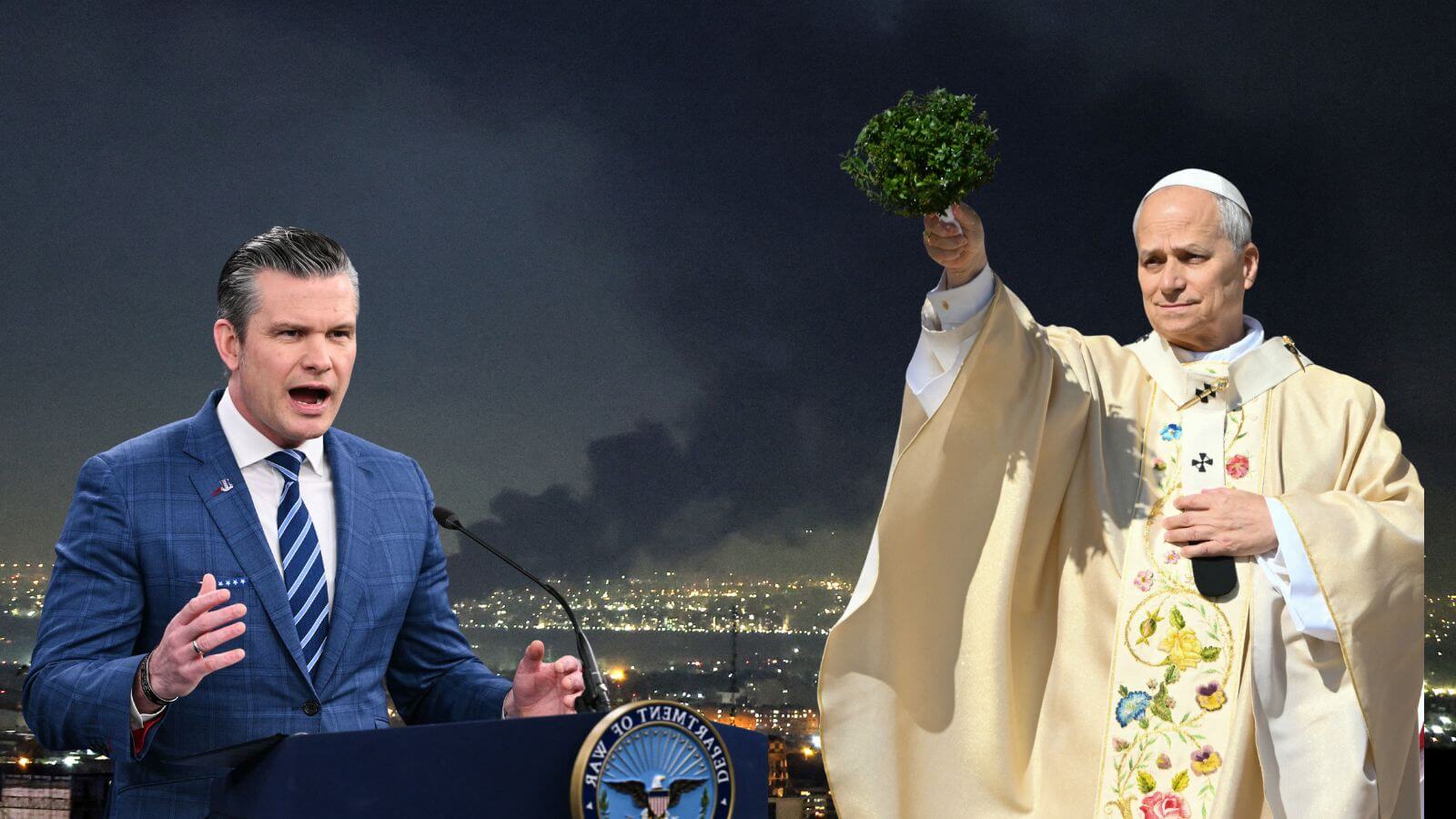
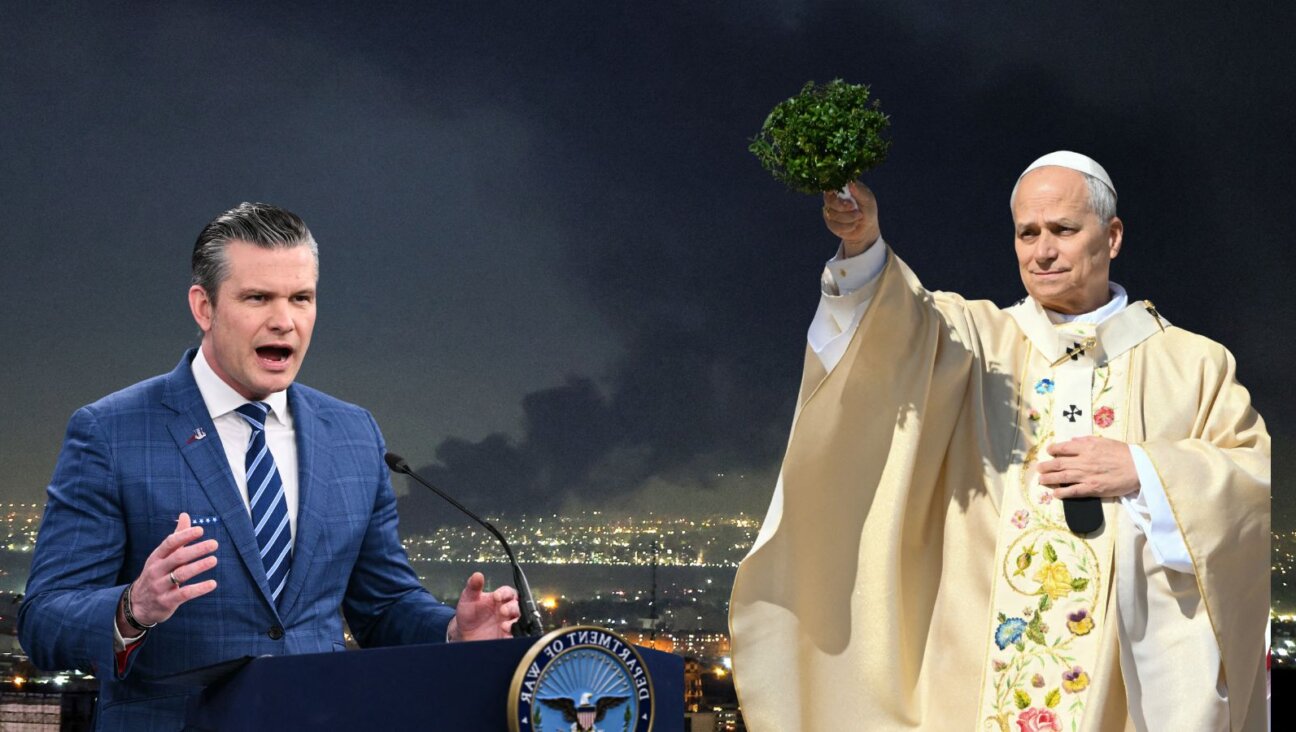
A meeting between the Pentagon and the Vatican shows moral authority is as central to today’s political sphere as military might. Graphic by Getty Images / Mira Fox

By Mira Fox April 10, 2026
The Vatican has not been a major player on the geopolitical stage in, well, at least a few centuries. The Catholic state is tiny, and has not had a real army or ruled land since, give or take a century, the days of Machiavelli.
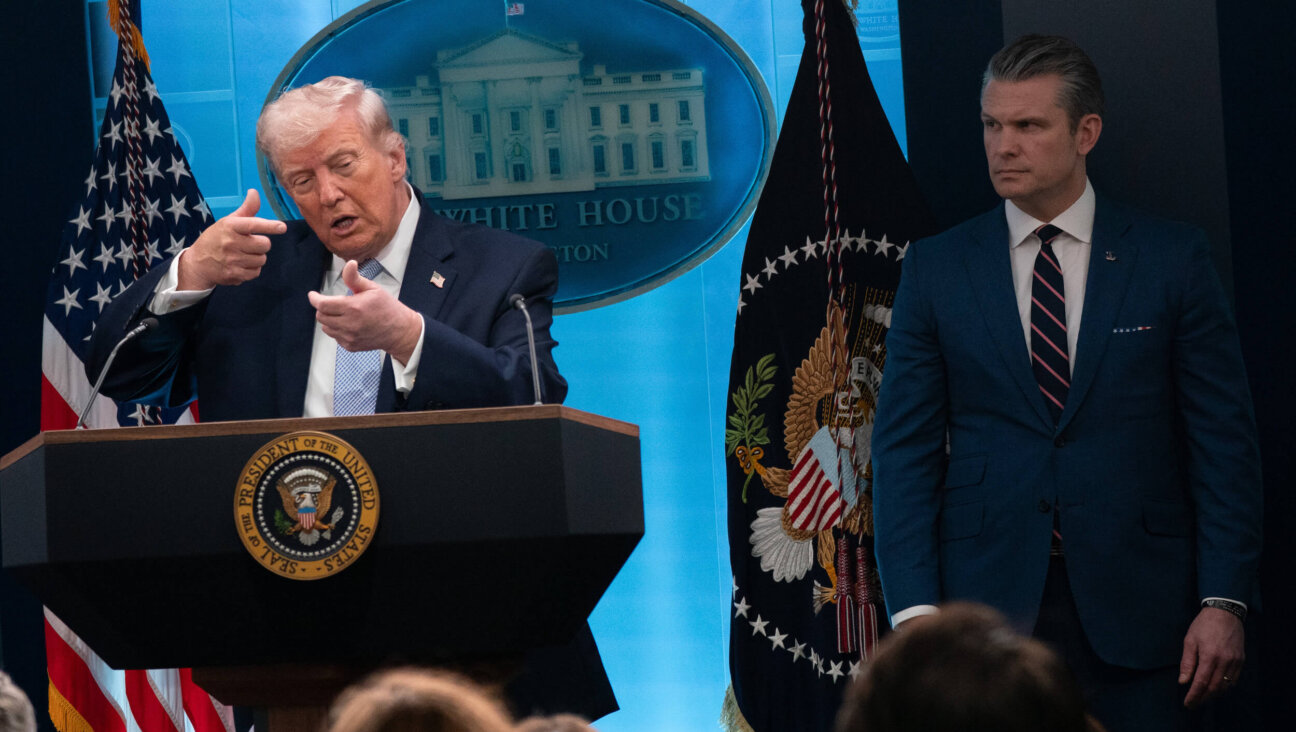
Nevertheless, in January the Pentagon summoned Cardinal Christophe Pierre, then the Vatican’s ambassador to the U.S., to a meeting, according to reporting from The Free Press. There, Elbridge Colby, the Undersecretary of Defense for Policy, sparred with the Catholic diplomat in light of Pope Leo XIV’s outspoken opposition to the war in Iran, and to wars in general.
According to the report, which cited anonymous sources, the Pentagon told the cardinal, has the military might to do “whatever it wants” and that the pope “better take its side.” NBC reported its own Vatican sources calling the meeting “most unpleasant and confrontational,” and Catholic outlet The Pillar reported a senior Vatican official describing the meeting as “tense” and “aggressive” though not overtly threatening.
Then, one of the Pentagon reps reportedly referenced the Avignon papacy, a niche bit of church history that the official transformed into a cudgel. During this period, from 1309 until 1376, the papacy moved to France, where seven different popes lived in the territory of Avignon, under the influence of the control and influence of the French crown.
Since the reporting broke, both Pierre and Pentagon representatives have rejected the framing of the meeting as a threatening one. Vatican representative Mateo Bruni said that the meeting “provided the opportunity for an exchange of views on matters of mutual interest.”
The Department of War’s X account posted that the meeting was a “substantive, respectful, and professional” one in which the participants discussed “morality in foreign policy, the logic of the U.S. National Security Strategy, Europe, Africa, Latin America, and other topics.” The department denied any mention of the Avignon papacy.
Still, the fact that the Pentagon met with the Vatican ambassador at all is a first, and notable for demonstrating the impact of the pope’s moral leadership and the importance of Christianity in driving and justifying U.S. military actions — in particular, the war with Iran. And the public’s engagement in the debate over the specifics of the meeting proves that the U.S. government is right to care what the church says about its wars; people take it seriously. Military might is not the only force for influence.
Pivotal to understanding what the meeting meant is the disputed reference to the Avignon papacy, a historical moment in which a country’s secular government clashed with the church over symbolic and moral authority. The fact that there is even uproar and debate over whether an esoteric piece of history was mentioned in the meeting is proof enough of the stakes of the meeting.
To understand why Avignon is so pivotal — and why a Jewish publication would even be covering a piece of Catholic ancient history — it’s important to understand that, during that time period, in the 1300s, Europe was Catholic. Martin Luther wouldn’t nail his 95 Theses to the door of the church for two more centuries, and Protestantism didn’t exist. That gave the Vatican massive influence as the leader of Christendom, which encompassed all of Europe, and arguably much more. Kings were seen as vassals of the Vatican, carrying out its orders.
When the French king, Philip IV, asked for the church to fund his war against Britain, the pope refused. In 1302, Pope Boniface VII drove the point home with a papal bull stating that submitting to the pope was required for eternal salvation, placing the Vatican’s authority over all royal power. And he threatened to excommunicate Philip.
In response, the king had Boniface VII beaten to a pulp, and he died shortly thereafter. His successor, not incidentally, forgave the king and restored his religious authority. France used its power at the time to stack the church with French-allied clerics, and the move to Avignon followed shortly thereafter, with the next seven popes all of French background.
Fundamentally, the Avignon papacy was a conflict over symbolic authority. Philip IV wanted his wars to be blessed, and righteous. The Pentagon, clearly, wants the same for the war on Iran, with historically freighted roles. Defense Secretary Pete Hegseth has declared the war a Christian mission for the U.S., fighting alongside Israel as the world’s Jewish state — together targeting the Islamic Republic.
The idea that the Pentagon might have summoned the ghosts of the Avignon papacy shows that the U.S. still cares about the moral authority of the peace-preaching Vatican as a rival to military might. And the debate over whether anyone referenced what sounds like a nerdy piece of history is really a debate over the influence of the U.S. as a world leader, and its bona fides as what the current government purports to be a Christian nation.
Catholicism is becoming increasingly high profile in the historically Protestant U.S. Six out of nine Supreme Court justices are Catholic. Vice President JD Vance is a Catholic convert. Unsubstantiated rumors are flying online that the pope is considering excommunicating Vance. There is clearly still power in the church, at least culturally.
And Leo XIV has leaned into that cultural authority. In numerous speeches, including his Easter address, the pope has appeared to directly respond to American government officials and decisions, expressing sympathy for migrants as Trump’s deportation efforts accelerated, and critiquing “imperialist” military might as he entered into war with Iran. Despite being the first American pope, he has refused multiple invitations to the White House, including one for July 4 this year to celebrate the country’s 250th birthday; instead, he is pointedly visiting migrants on the same day.
“The Pope may well never visit the United States under this administration,” a Vatican official told The Free Press.
The particular clash between the White House and the pope also centers in large part around Hegseth, who is a member of an extremist Reformed Christian church, not a Catholic. (Though he does have a tattoo reading “Deus Volt,” a rallying cry during the Crusades — which were certainly Catholic.) After Hegseth gave a speech declaring that God had blessed the war with Iran and asking troops to pray for military victory, the pope said that God “does not listen to the prayers of those who wage war, but rejects them.” Despite their different Christian movements, summoning a Vatican representative to the Pentagon, whatever was said, shows that Hegseth wants the pope on his side, and recognizes his speeches as a major factor in geopolitics.
The battle for Christian moral authority between the government and the pope also comes alongside a more internal Catholic clash in the U.S. The United States Conference of Catholic Bishops is fighting high-profile Catholic influencers such as Candace Owens and Nick Fuentes, who regularly justify their open antisemitism with Catholicism. Though the pope himself has yet to weigh in, it’s another face of an ongoing struggle to define what Christianity means.
In today’s world, it’s hard to imagine a speech from the pope or the threat of excommunication carrying real weight, among so many churches with many theologies about war, antisemitism and the Middle East. The Vatican is no longer the singular authority over the West, and the pope’s power is largely symbolic. Whether or not anyone in the Pentagon meeting said that the U.S. has the military force to do anything it wants, it’s true.
Yet the fact that the government is engaging so seriously with the Vatican is a sign of the increasing centrality of Christianity, both Catholic and otherwise, in the U.S. government, and in American society. As Christian nationalists in the Trump administration seek to go back to the imagined glory days of Western culture, when Christendom rules, it becomes increasingly difficult to ignore the oldest, largest and most public face of the religion, or to deny its moral authority.
In a world in which the Vatican has only soft power, the pope’s decrees carry only as much power as they are given. But however soft the pope’s power may be, that surreal Vatican visit to the Pentagon suggests that even the best-armed military in the world is afraid of it.
This is a moment of great uncertainty. Here’s what you can do about it.
We hope you appreciated this article. Before you go, we’d like to ask you to please support the Forward’s independent Jewish news. All donations are still being matched by the Forward Board - up to $100,000 until April 24.
This is a moment of great uncertainty for the news media, for the Jewish people, and for our sacred democracy. It is a time of confusion and declining trust in public institutions. An era in which we need humans to report facts, conduct investigations that hold power to account, tell stories that matter and share honest discourse on all that divides us.
With no paywall or subscriptions, the Forward is entirely supported by readers like you. Every dollar you give is invested in the future of the Forward — and telling the American Jewish story fully and fairly.
The Forward doesn’t rely on funding from institutions like governments or your local Jewish federation. There are thousands of readers like you who give us $18 or $36 or $100 each month or year.

Support our mission to tell the Jewish story fully and fairly.