In 3 centuries of Southern Jewish life in the Big Easy, no easy way to be Jewish
Nicholas Lemann’s ‘Returning’ is a sprawling family history of the limits of assimilation
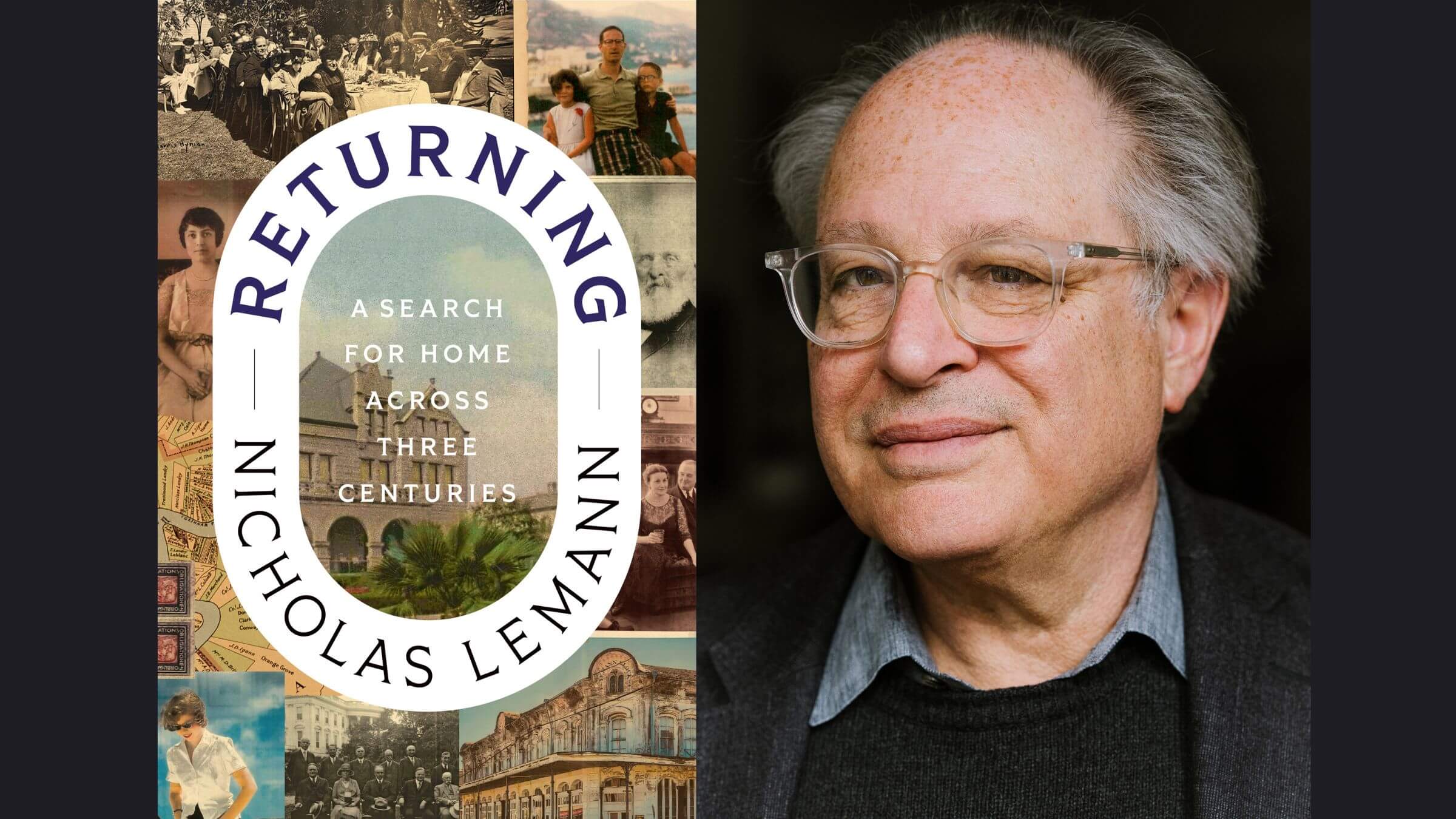
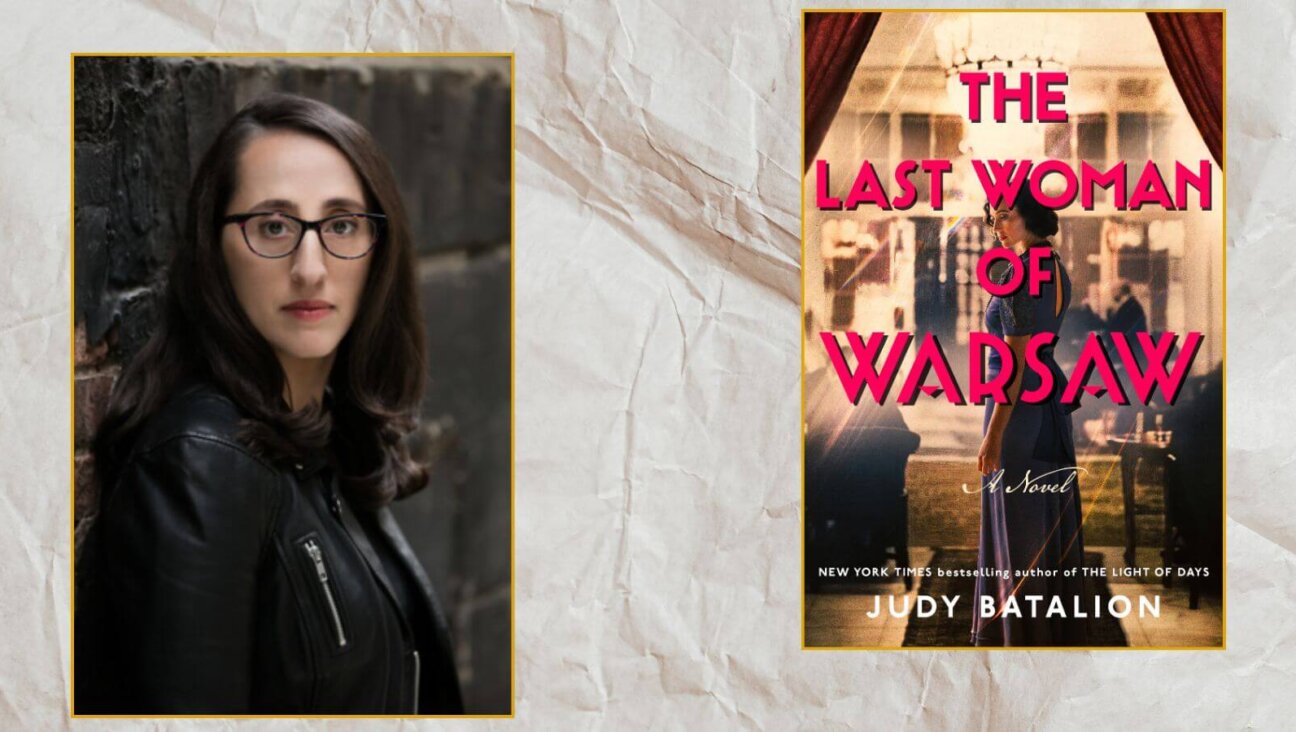
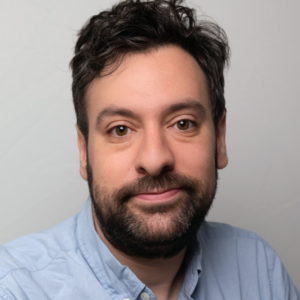
Nicholas Lemann’s Returning explores the family history he never knew. Photo by Liveright/headshot by Geordie Wood
By PJ Grisar March 24, 2026
Returning: A Search for Home Across Three Centuries
By Nicholas Lemann
Liveright, 416 pages, $35
Nicholas Lemann’s Jewish life was negligible. Great care was taken to make it so.
His family not only celebrated Christmas, they skipped Hanukkah, a fact that created a small scandal in their Reform congregation in New Orleans, a shul that had confirmations instead of bar mitzvahs. His father was known to hide baskets of kippot at family weddings — including his own. The topic of Israel was never raised at home, a plantation-style house with the lofty name of Quercus, and as far as Lemann can recall, neither was the Holocaust. (Robert E. Lee, however, was rhapsodized in an elementary school poem Nicholas composed, and that his father recorded on a reel-to-reel tape recorder.)
“I knew almost nothing about the Jewish aspect, as opposed to the Southern aspect, of my family’s history,” Lemann, a staff writer at the New Yorker and professor and dean emeritus at Columbia Journalism School, writes in Returning: A Search for Home Across Three Centuries. Jewish was more the way others thought of the family than how they viewed themselves. Or so he thought.
Lemann’s book is his fifth and his most personal, reaching back in time to uncover how his aristocratic, well-established life in Louisiana was a relatively modern development following decades of assimilation.
It is a family portrait in a unique milieu — Faulkner and Robert Penn Warren meets Irving Howe’s World of Our Fathers — that follows the rough contours of the Torah: the original sins of slavery, Exodus and the conflicted push towards a promised land with political Zionism and a codification of life as Lemann reclaims tradition. It’s a compelling read, all the more so for how its personal investigation brushes up against American history.
Lemann’s great-great grandfather, Jacob, who arrived in Louisiana from Essenheim, Germany, advanced in part from the sale of human beings. He left the country with his family during the Civil War, and by the time he returned and acquired plantations from owners who defaulted on loans, Zionism was the talk of Europe and a four-letter word in their Reform German world, as the newly-monied congregants strived to partake fully in American life and not arouse suspicion. By the turn of the 19th Century, the genteel way the Lemanns walked through life served as a contrast to a wave of more devout, poorer Jews from Eastern Europe.
But within the narrative is a force of particularism that Lemann was late to investigate. His great-grandfather, Bernard, the first American-born Lemann, was sent to New York for religious instruction and, while in Europe during the Civil War, lived like almost no Jews on the continent had before, absorbing high culture while observantly Jewish.
The platform of the American Reform movement sought to sand down all markers of difference, defining Judaism as a religion not a race, but Lemann’s Harvard Law-educated grandfather Montefiore (named for the great philanthropist Moses Montefiore) had a longstanding friendship with liberal Supreme Court Justice Felix Frankfurter and testified before Congress to bring German children to New York City after Kristallnacht. Though he came of age in Jim Crow on a plantation, his advocacy extended to Black people, urging other lawyers to sign on to a statement urging the South’s compliance to the Brown v. Board of Ed decision. His relatively progressive politics are hard to divorce from his own awareness of his minority status.
“We can never hope to eliminate all bigotry,” he wrote Frankfurter. “(Look at the experience of the Jews for 5,000 years.)”
Lemann’s largest reckoning is with his father, Thomas, whose resistance to Jewish life likely came from his experience at Harvard after World War II, in the age of quotas, and the false presumption that his difference could be fully expunged in favor of full acceptance. (An irony noted by Lemann is the fact that the family may not have converted because the old families already knew them to be Jews.)
Despite the mammoth efforts of Thomas and his wife, Barbara, who grew up in New Jersey but assimilated splendidly to her husband’s Louisiana roots, Nicholas began to feel a “distinct tug in the direction of Jewishness” as an undergrad at Harvard.
“The way I was brought up, supposedly so liberated, so carefree about what it meant to be Jewish, actually amounted to a heavy burden to bear,” he writes.
The titular return, to a more conventional Jewish life, is in some ways an acknowledgement of futility.
“It looks to me now as if, all these years later, under a profoundly different set of prevailing standards, Jewishness still isn’t universalizable,” Lemann writes, reflecting on the recent turmoil at Columbia, where he was cochair of an antisemitism task force.
He has a rather dim prognosis for the Jewish future.“The old dream that there might be a completely easy way of being Jewish (at least in the way I have chosen to be Jewish) in the wider world seems once again to have vanished.”
Gone with the wind, one could say. But then if Lemann’s chronicle proves anything, it’s that difficulty — and not the pursuit of ease — may be what gives Jews our foundation. We need to remember who we are, because the wider world won’t forget.
This is a moment of great uncertainty. Here’s what you can do about it.
We hope you appreciated this article. Before you go, we’d like to ask you to please support the Forward’s independent Jewish news. All donations are still being matched by the Forward Board - up to $100,000 until April 24.
This is a moment of great uncertainty for the news media, for the Jewish people, and for our sacred democracy. It is a time of confusion and declining trust in public institutions. An era in which we need humans to report facts, conduct investigations that hold power to account, tell stories that matter and share honest discourse on all that divides us.
With no paywall or subscriptions, the Forward is entirely supported by readers like you. Every dollar you give is invested in the future of the Forward — and telling the American Jewish story fully and fairly.
The Forward doesn’t rely on funding from institutions like governments or your local Jewish federation. There are thousands of readers like you who give us $18 or $36 or $100 each month or year.

Support our mission to tell the Jewish story fully and fairly.