‘Incitement’ isn’t about making Rabin’s murderer — it’s about making modern Israel

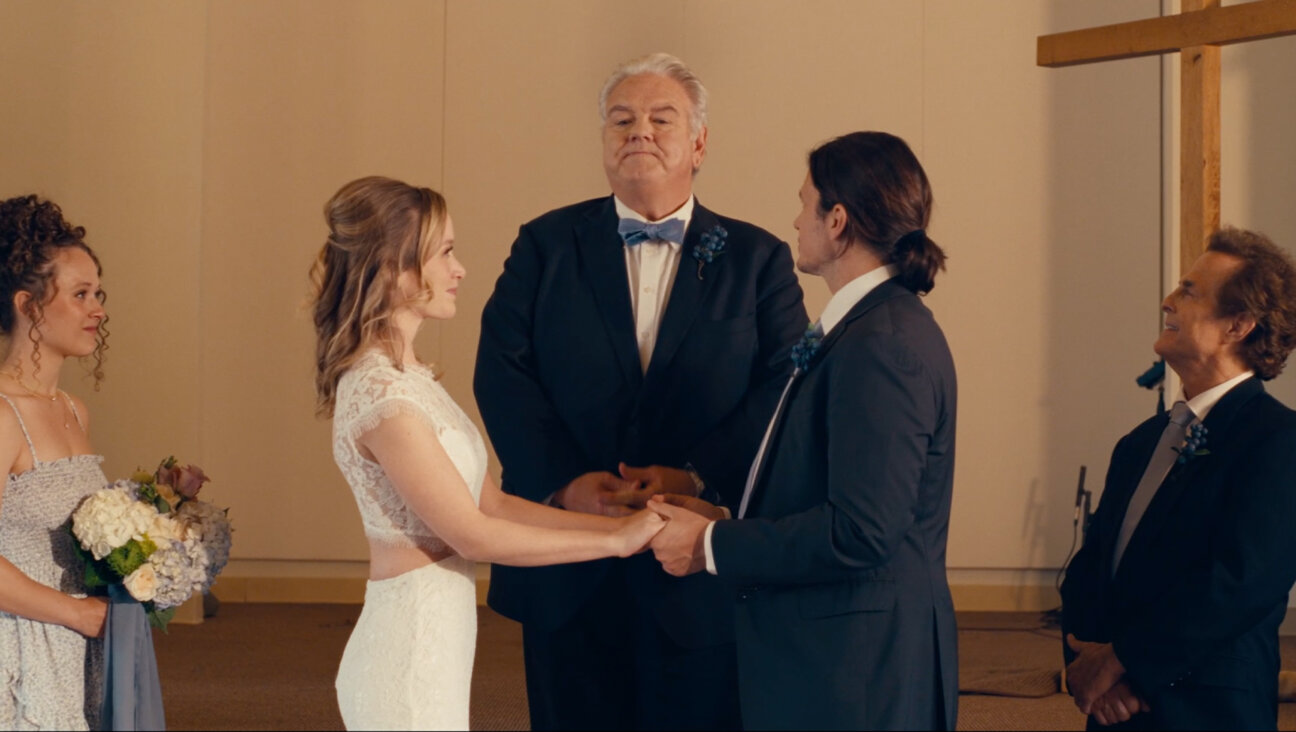
Yehuda Nahari Halev in Yaron Zilberman’s “Incitement.” Image by Courtesy PMKBNC ONLINE

By PJ Grisar February 6, 2020
We meet the killer as he’s cleaning tombstones.
While he scrapes and sponges, his radio broadcasts Prime Minister Yitzhak Rabin’s historic Rose Garden speech announcing the signing of the first Oslo Accord. When his work is done, he leaves to join protests against the peace plan in Tel Aviv. It’s 1993. In two years, this man, a law student named Yigal Amir (Yehuda Nahari Halevi) will assassinate Rabin, believing — as many others did — it was the righteous thing to do.
“Incitement,” directed by Yaron Zilberman, might have been just another addition to a crowded canon of recent films about disaffected, dangerous men. The winner of the 2019 Ophir Award — Israel’s Oscars — for Best Film, it shares certain features with Oscar nominees “Joker” and “The Irishman,” both of which build toward dogma-fueled murders. But Zilberman’s film, a gutting elegy for a time when peace seemed possible, is a broader character study — not just of a killer, but of a country.
Currently serving a life sentence in prison, Amir shot Rabin three times outside Tel Aviv City Hall on November 4, 1995. But he had been making plans for the prime minister’s murder for months before, and wasn’t cagey about communicating them. The film portrays him not as an innocent who becomes radicalized, but as someone who has long existed on the brink, and only needs a nudge to commit the unspeakable. More terrifying than a rogue agent, he’s a usual suspect, a man whose actions reflected a common sentiment in his religious, ultra-nationalist circle: that stopping Rabin’s peace plans would be acting on God’s behalf.
The point is clarified at a meeting at his university, when Amir listens as his elders discuss the Talmudic “Law of the Pursuer,” which theoretically allows for the extrajudicial killing of one posing an immediate threat to the lives of innocents — a precept that a number of nationalist rabbis applied to Rabin. Amir checks Maimonides and consults with three rabbis, all of whom offer the same opinion: Rabin can be considered subject to that law.
Amir, possessed of a messianic self-conception that stretches back to shortly after his birth, believes himself uniquely equipped to perform the deed. His mother, Geula (Anat Ravnitzki), tells his girlfriend, Nava (Daniella Kertesz), that his name was changed to Yigal, “He who will redeem,” at the last moment at his bris. “I’m like a laser pointer,” he says, “I mark a target and conquer them one by one no matter what.” When he fixes his target on the prime minister, he tells everyone who will listen about the imperative to “take Rabin out.” The conservative attitude to Rabin being what it was — the film shows him burned in effigy at protests, and alleyways lined with images of his face framed in a crosshairs — no one reports Amir.
In less capable hands, Amir’s crime might be rendered as the act of a single extremist. But Zilberman offers a bracing reminder that while Amir pulled the trigger, a not-insignificant faction of Israeli society was complicit. The director leverages news clips of thunderous crowds protesting the peace process — and, most horribly, the bloodied bodies of Muslim worshippers gunned down by Kahanist settler Baruch Goldstein — as evidence that Amir’s descent was more than one man’s journey to the fringe. By splicing Halevi into these demonstrations, Zilberman broadens his narrative from Amir’s intimate, individual story, making clear that the film is, more than anything, about the making of modern Israel. Some of the film’s most jarring moments are cutaways to footage of then-Likud Chairman Benjamin Netanyahu marching in front of a mock coffin labeled “Zionism” and claiming Rabin “illegally conspired” with the Palestinian Liberation Organization to “undermine democracy.” At a Tel Aviv rally prompted by the passing of the second Oslo accord in the Knesset, Netanyahu addresses a mob that responds by shouting “Bibi for prime minister,” and “death to Rabin.”
Rabin, also shown in archival footage, presents a thoughtful, deliberative counterpoint to Netanyahu. In the first words we hear from him — the first words of the film — he remarks that the signing of Oslo I is “not so easy, neither for myself, as a soldier in Israel’s wars, not for the people of Israel, not to the Jewish people in the Diaspora who are watching us now with great hope mixed with apprehension.” In the tumult and outrage following his efforts for improved relations, we hear him ask Israelis to decide, “Do we want separation between us and the Palestinians as a temporary closure just for a few days or as a way of life?”
In the aftermath of Rabin’s murder, Netanyahu did eventually become prime minister, first from 1996 to 1999, and then again beginning in 2009. In his first government, he reversed much of Rabin’s landmark achievements. News footage included in “Incitement” of Rabin at the White House podium, flanked by Yasser Arafat and Bill Clinton, proves a stark and dispiriting contrast to the latest proposition for peace, drafted by Netanyahu and President Trump without Palestinian input.
Zilberman and his co-writers, Ron Leshem and Yair Hizmi, end “Incitement” in 1995. They don’t explicitly connect it to the current moment, but they don’t have to. Their outlook is perhaps best expressed by Amir’s father Shlomo (Amitai Yaish), a Torah scribe, who tells his son that should someone murder the prime minister, “It’ll take generations to heal such a wound.”
PJ Grisar is the Forward’s culture fellow. He can be reached at [email protected]
This is a moment of great uncertainty. Here’s what you can do about it.
We hope you appreciated this article. Before you go, we’d like to ask you to please support the Forward’s independent Jewish news this Passover. All donations are being matched by the Forward Board - up to $100,000.
This is a moment of great uncertainty for the news media, for the Jewish people, and for our sacred democracy. It is a time of confusion and declining trust in public institutions. An era in which we need humans to report facts, conduct investigations that hold power to account, tell stories that matter and share honest discourse on all that divides us.
With no paywall or subscriptions, the Forward is entirely supported by readers like you. Every dollar you give this Passover is invested in the future of the Forward — and telling the American Jewish story fully and fairly.
The Forward doesn’t rely on funding from institutions like governments or your local Jewish federation. There are thousands of readers like you who give us $18 or $36 or $100 each month or year.

Support our mission to tell the Jewish story fully and fairly.