Why do people want ‘Zootopia 2’ to be about Israel?
Should we read anything into cartoon lynxes who control the government and the weather?
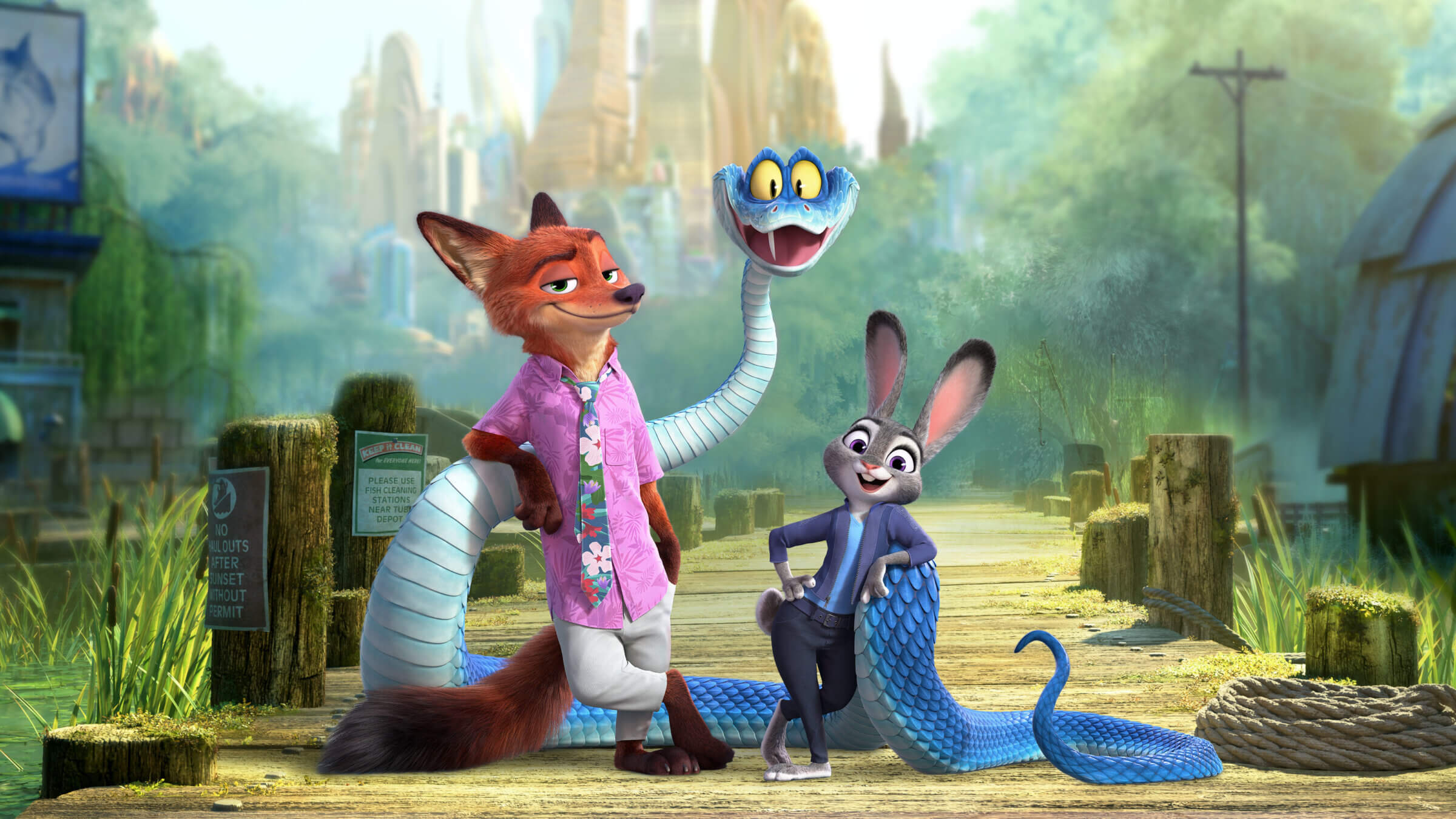
In Zootopia 2, Nick Wilde and Judy Hopps team up with Gary De’Snake to uncover a sinister plot. Courtesy of Disney UK

By Olivia Haynie December 2, 2025
This article contains spoilers for Zootopia 2.
Since Zootopia 2 takes place in a world of talking animals, it might be the last place one would expect to find commentary on the Israeli-Palestinian conflict. But several viewers have read the film’s plot — which concerns the division of Zootopia’s weather-controlled neighborhoods — as providing exactly that.
In this sequel to Disney’s 2016 animated hit, the sinister and wealthy Lynxley family plans to expand Tundratown, the part of the city where polar species reside, into Marsh Market. The Market is a home for already-ostracized animals, such as aquatic mammals, and a hideout for reptiles, who were banished from the city. Because each neighborhood has a specific climate controlled by “weather walls,” the merging of one section with another would necessitate the immigration of those unable to live in the new climate.
The more powerful animals use a lot of hierarchical language referring to the “lower” or “lesser” species who would lose their homes because of this plan. Reptiles are also stigmatized as being “dangerous” due to a fatal incident a century earlier that involved a snake and a turtle. For viewers of the first film, which took on racial profiling, the existence of speciesism in the Zootopia-verse won’t come as a surprise. But what has captured viewers’ attention is the film’s discussion of the stolen Reptile Ravine neighborhood.
“Did Disney get tricked into making a pro-Palestine movie?” one user of the movie review platform Letterboxd wrote with their five-star rating. “Yes they did 🫡.”
Commenters under the review had mixed opinions:
“Do you seriously think a Zionist company made a pro-Palestine movie?” someone responded.
“Finally saw someone thinks so too, the ethnic cleansing theme is indeed pretty strong on this one,” said another user.
Some reviewers have also likened the plot to settler-colonialism, which feels like a bit of a stretch given that none of the animals in charge of the expansion travelled from one place to another in order to conquer it and therefore don’t really qualify as settlers. All of the contested land is already within the constituted borders of Zootopia, so the plan involves expanding the qualities of one neighborhood into another, not completely redrawing territorial boundaries.
A more apt comparison might be gentrification in American cities and the way that has impacted racial minorities. The buried reptile neighborhood feels more reminiscent of communities such as the San Juan Hill neighborhood in Manhattan that was eliminated by Lincoln Center or the Hayti community in Durham, North Carolina, that was all but wiped out by a freeway and urban renewal. The accents, music and general appearance of Marsh Market are clearly inspired by the American South, specifically the bayous of New Orleans, which have always been an important landmark in Black American culture.
Of course, it wouldn’t be wrong to also think of Palestinian towns that have been renamed and replaced with Israeli neighborhoods. And to get into the nitty gritty of gentrification versus settler-colonialism might seem futile — many activists and social scientists would probably tell you that despite being different strategies, they have the same oppressive result.
But why focus on Israel? Clearly, there are numerous examples of subjugation from across the world and across time that Zootopia 2 could be mirroring. Israel’s government is not the only entity to ever be accused of ethnic cleansing.
The focus on comparing the Lynxleys to Israel feels especially problematic in this case since the Lynxleys also operate the weather walls and are shown to secretly determine Zootopia politics. This would make the Lynxleys wealthy Jews who control the government and the weather.
Maybe because Israel and Palestine have taken over headlines, there is a recency bias influencing the comparisons people are making. It could also be because the star of Zootopia 2 has found herself at the center of controversy related to the recent Israeli-Palestinian conflict: Last year, Ginnifer Goodwin, who voices the Zootopia protagonist Judy Hopps, was criticized for condemning the statement “globalize the intifada” as a threat to Jews and encouraging defunding UNRWA. Several months ago, that post was shared to a Boycott, Divestment, and Sanctions movement subreddit, where users called for the boycott of Zootopia 2.
The post-credits scene of Zootopia 2 hints that avians will be at the center of a future film. Who knows how viewers will interpret the birds’ role in the Israeli-Palestinian conflict.
This is a moment of great uncertainty. Here’s what you can do about it.
We hope you appreciated this article. Before you go, we’d like to ask you to please support the Forward’s independent Jewish news this Passover. All donations are being matched by the Forward Board - up to $100,000.
This is a moment of great uncertainty for the news media, for the Jewish people, and for our sacred democracy. It is a time of confusion and declining trust in public institutions. An era in which we need humans to report facts, conduct investigations that hold power to account, tell stories that matter and share honest discourse on all that divides us.
With no paywall or subscriptions, the Forward is entirely supported by readers like you. Every dollar you give this Passover is invested in the future of the Forward — and telling the American Jewish story fully and fairly.
The Forward doesn’t rely on funding from institutions like governments or your local Jewish federation. There are thousands of readers like you who give us $18 or $36 or $100 each month or year.
Support our mission to tell the Jewish story fully and fairly.