King David gets the kiddie treatment
The animated film ‘David’ flattens one of the Bible’s most vivid characters

David and his mother Nitzevet have a musical crash course on Exodus. Courtesy of Angel Studios

By PJ Grisar December 18, 2025
The figure of David is most often imagined nude, and for some people that’s a problem.
Michelangelo’s statue was once made to don a fig leaf in exhibition replicas. As recently as 2023, a school principal in Tallahassee, Florida, resigned after parents complained that an image of the marble used in a lesson on Renaissance art was pornographic. (Interestingly, no one is calling for a redacted edition of the Bible, where David is an unabashed adulterer who dances naked before the lord.)
David, like Odysseus, was a man of twists and turns, and that’s what makes him so compelling. Yet there has always been a temptation to contort him into a tidier package, PG and legible to youth. In Hebrew school — and, I imagine, Christian Sunday schools — we hear of his underdog exploits with Goliath. We rarely hear what happens next.
As novelist Geraldine Brooks observed in her book The Secret Chord, David was “the first man in literature whose story is told in detail from early childhood to extreme old age.” It is also a singularly strange story to adapt for children beyond that initial showdown with a Philistine with a pituitary disorder — the rest of David’s story is rife with sex and violence.
Even so, Angel Pictures, the up-and-coming, largely faith-based production house behind The Sound of Freedom (a fear-mongering pageant about human trafficking) and The King of Kings (about you know who) endeavored to put this narrative to film, following a “prequel” series called Young David. The resulting animated musical David punches above its weight in production value, with meticulous filaments of CGI hair and charismatic character design. If you’re looking for biblical fidelity, it mostly follows the text, but in making it family friendly — and perhaps to point in the direction of a certain legacy sequel — it slaps a narrative fig leaf over the interesting bits. Somehow, like so many neutered renditions of Leonard Cohen’s “Hallelujah,” it makes David boring.
Why target this one to kids? David is introduced as a shepherd boy with a sling, making him ripe for a young audience, at least if you skip the part where he decapitates Goliath and carries his head around as a trophy, which this film does. Most children’s media about him emphasizes those salad days heroics or his side hustle as a psalmist.
But the boy will go on, soon after he reaches his age of majority, to procure 200 Philistine foreskins in battle as a bride price. In exile from Saul, we’re told that, when he raided a region, “he would leave no man or woman alive.” At Hebron, he rewards the eager assassins of his rival by relieving them of their hands and feet.
What about this demands the Dreamworks treatment? The aforementioned prequel kiddie show, with its humble pastoral lessons, had to lead to something, I suppose, and here it’s a musical time jump with a new character model and older voice actor. The ads invite us to “watch how a boy becomes a man,” and, more saliently, to do the watching “this Christmas.”
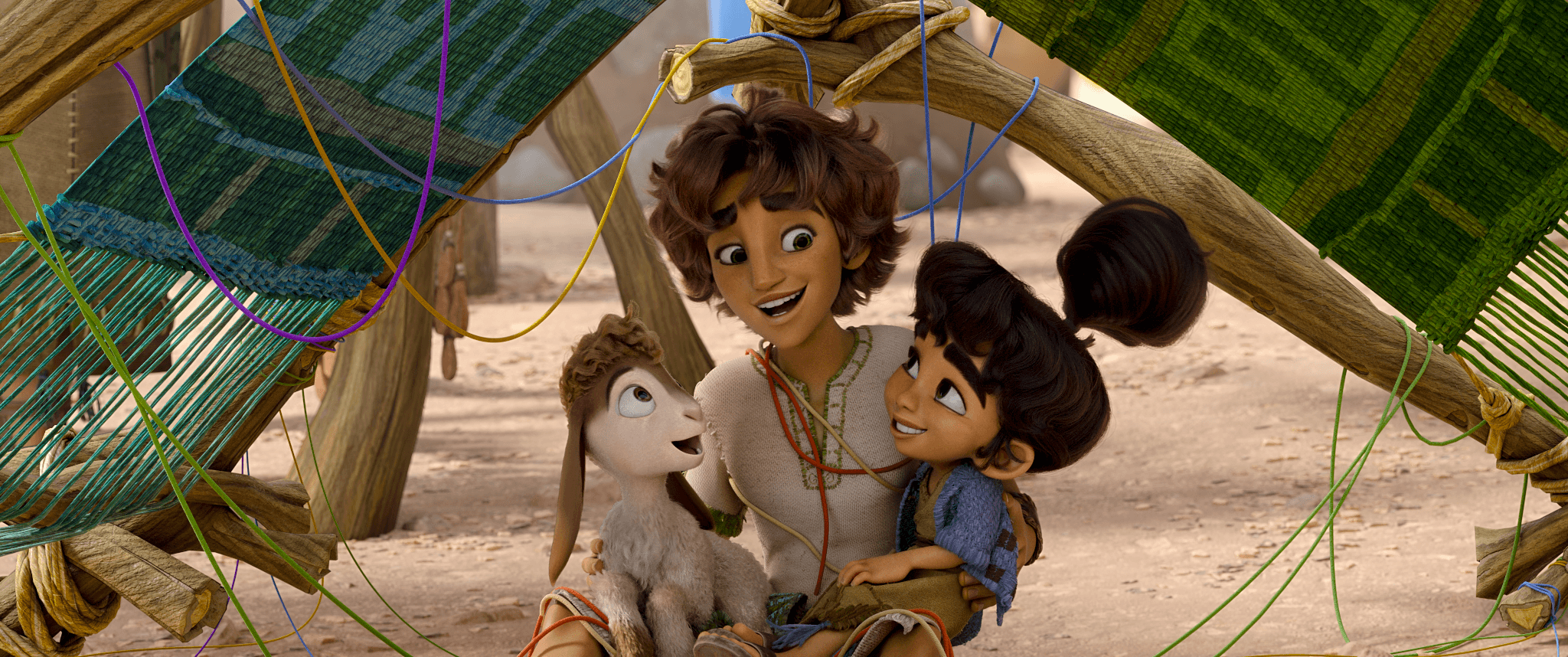
To Christians, David is a sort of Old Testament flashing arrow pointing to Christ. “Christ,” like the Hebrew “mashiach,” means “anointed one.” David, as we see in the film’s opening moments, after he saves a lambing ewe from a lion, had a horn of oil poured over him by Samuel. Jesus, a metaphorical shepherd, is sometimes called the Son of David.
As historians of Christianity like Elaine Pagels have noted, the genealogies laid out by Matthew and Luke have Jesus descend from David to fulfill the messianic prophecies in Jeremiah and Isaiah. This is then, a stealth Christmas story or almost a Jesus prequel, kind of a New Testament Phantom Menace with the added benefit of capturing a Jewish audience that — while still awaiting its own Mashiach ben David — goes out to the movies on Christmas and may be looking for family fare. Catholic comedian Kevin James has promoted it, as has Michael Rapaport.
The story, buoyed by boilerplate praise pop that sings of running towards adventure and “following the light,” tracks the moment David is selected as the future king up to his coronation, stopping before his uniting of the kingdoms in a new capital and his late vocation as a rooftop voyeur with major character flaws.
This David — auburn-haired and American-accented, while all other characters sound vaguely Israeli — is instantly likable, and unbearably insipid, “a man after God’s own heart.” The film had a rabbi adviser — one whose focus is on “ministering to Christians” — and that brings a veneer of Jewish authenticity. Samuel sings some of Psalm 118 in Hebrew as he anoints David (an odd choice given that David is the traditionally credited author). Production notes boast of paleo-Hebrew text appearing throughout and identify some of the songwriters as “Jewish believers in Jesus.” There are wolf motifs littering in the palace of Saul, whose tribe’s founder was likened to a ravenous wolf. Despite these trappings, the project feels derived from a familiar Christian impulse, and errs by taking David’s story beyond the Valley of Elah, where our hero still had a semblance of innocence.
The infancy narrative of Jesus may work for young people around Christmas time, sparing them the gory details of the crucifixion. But beyond a point, David’s early life can’t be so neatly detached from what follows, as the rest of the Bible, even the Christian parts, relies on it. It is hard to imagine this David — pure, faithful, a good shepherd who is reluctant to lead and ostensibly asexual — conquering Jerusalem. It’s harder still to imagine him having his way with Bathsheba (in what many now regard as rape), sending her husband to his death and losing several children as God’s punishment for these transgressions.
None of these events are the film’s concern, but without those pivotal plot points, we don’t have the Temple or the king — Solomon, born of Bathsheba — to build it. Without a temple in Jerusalem, there’s no backdrop for the Passion the film’s hinting at to play against.
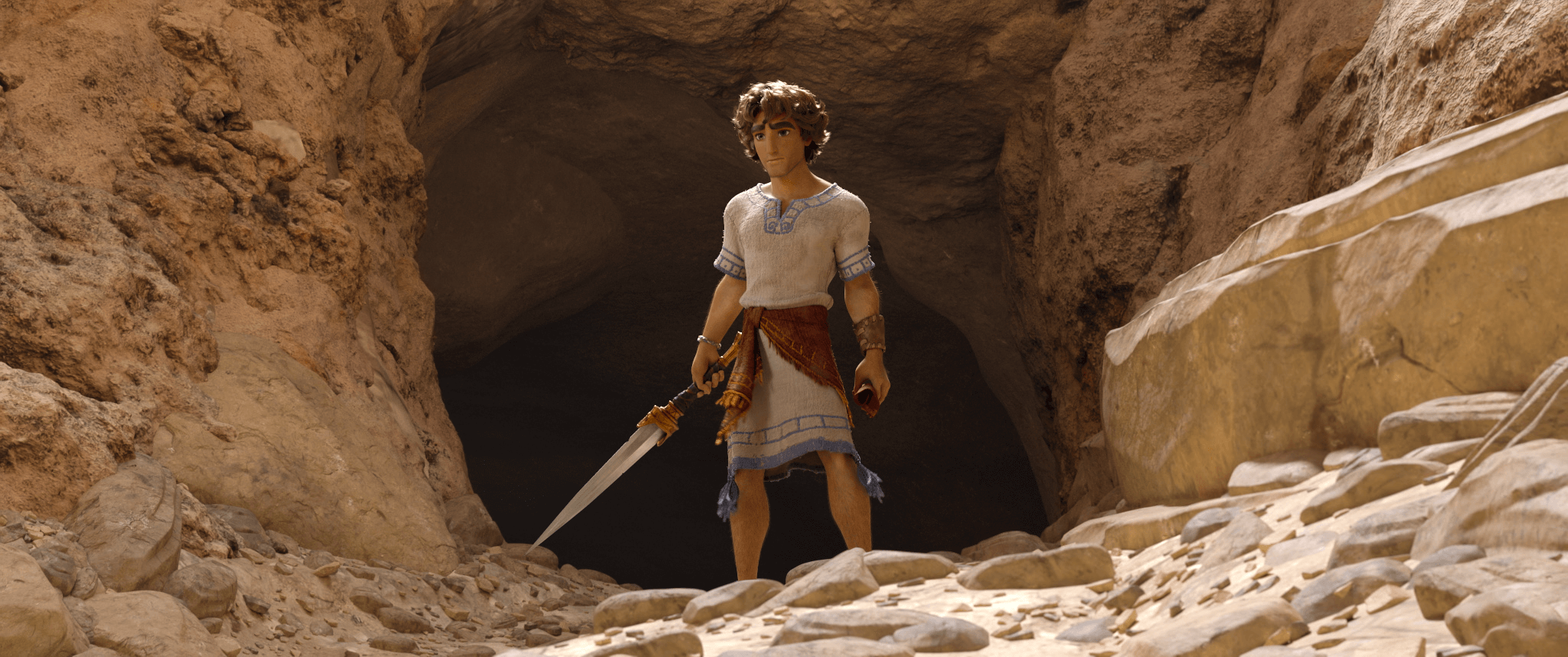
The screenplay, by directors Brent Dawes and Phil Cunningham, seems to be optimizing for action — Cunningham described David’s journey as “packed with adventure, with music, with fun” — while staying too squeamish to mount a proper battle scene. There’s the intrigue of Saul’s court, and the thread of dramatic irony, as the old king confides in David about his fear of God’s appointed successor, not knowing it’s him. We see David dash into exile in the wilderness, but we don’t witness his raids or any other mischief, only a crisis of faith. We get a glimpse of the mincing Philistine king Achish (we know he’s evil because of his eyeshadow and earrings) and the skull-laden Amalekites who raze David’s outpost at Ziklag and take his followers captive. (Saul’s failure with the Amalekites is appropriately sanitized — he fell short by letting them escape, not in sparing Agag’s life and keeping his best livestock. If God ordered their genocide, as he does in the source material, we don’t hear about it.)
In case there was any doubt, after David’s mom — here a speaking character — praises God as “the way and the light,” there’s a specific endgame in mind that necessitates our hero be presented as older and on his way to kingship.
To drive the point home, in an invention of the film, the Amalekites hoist David onto a tree to kill him while his mother weeps at his feet. This isn’t some first chapter of David’s rule but the foreshadowing of Jesus’ reign, and you can’t exactly crucify the little shepherd boy with the lyre. (Spoiler: He lives.)
While not to my taste, this would be forgivable if the film, however handsomely animated, didn’t fall into the same old timeworn tropes that even kids are surely bored of now: the precocious younger sister, the fat brother gorging on dates, the upstart Israelite army with vases for helmets who gulp, “Yup, we’re dead” upon seeing the well-equipped Philistines and their six-cubit champion.
Worse still, the film calls to mind other, better ones, appropriate for children but nowhere near as condescending.
A standout number has David’s mother singing about the world as a tapestry (Carole King she ain’t) and “the view that heaven sees,” essentially a rip-off of Prince of Egypt’s “Through Heaven’s Eyes.” You may also cringe at the line “like the way we work the loom, he knit you from inside the womb,” seemingly a play on Jeremiah 1:5, often used by Christians to justify pro-life positions.
David deserves better, but the good news is there’s competition. Amazon’s House of David, now in its second season, goes deep on the dynamics of Judah and Israel, often employing midrash to add texture to the intrigue, and it was reported in 2022 that Leviathan Productions, an outfit focused on Jewish stories, had optioned Brooks’ excellent The Secret Chord.
That shepherd boy from Bethlehem became a giant himself — and we will never stop singing his psalms or wrestling with his complicated, at times cancel-worthy, story. Angel Studios’ David may still challenge Goliath, just not the audience.
It’s our birthday and we’re still celebrating!
We hope you appreciated this article. Before you go, we’d like to ask you to please support the Forward’s independent Jewish news.
This week we celebrate 129 years of the Forward. We’re proud of our origins as a Yiddish print publication serving Jewish immigrants. And we’re just as proud of what we’ve become today: A trusted source of Jewish news and opinion, available digitally to anyone in the world without paywalls or subscriptions.
We’ve helped five generations of American Jews make sense of the news and the world around them — and we aren’t slowing down any time soon.
As a nonprofit newsroom, reader donations make it possible for us to do this work. Support independent, agenda-free Jewish journalism and our board will match your gift in honor of our birthday!
Support our mission to tell the Jewish story fully and fairly.