An Israeli dissident filmmaker finds tainted love amid the Gaza rubble
Nadav Lapid’s ‘Yes’ takes on the war, art and the soul of a nation

The raucous world of Yes! is unsparing in its satire of a country partying near the abyss. Courtesy of Kino Lorber

By PJ Grisar March 26, 2026
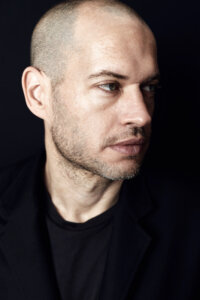
Nadav Lapid started writing his Oct. 7 movie in summer 2021 — before the events that shaped it took place. He says it hasn’t changed much, and that it’s not really about Oct. 7.
“It’s the same bitter reflection about the place of the artist,” Lapid told me on a Zoom call, a day after arriving in New York for the American debut of Yes, his withering satire of Israeli complacency.
“In a way, in the first version, you could notice the shadow of a catastrophe, the shadow of a disaster and a society on the edge of the abyss,” he said. “With the second version, this society made another few steps and went and fell down from the hill to the valley of hell”
As the title might suggest, Yes — which is sometimes styled with an exclamation mark — is about a kind of maximalist version of affirmative consent that ends in complicity. It follows Y (Ariel Bronz), a jazz pianist, who with his wife, Yasmin (Efrat Dor), serves as a willing entertainer and sex slave for the Israeli elite. The couple submit to almost anything, no questions asked. But when a Russian oligarch commissions Y to write an “anthem for the victory generation,” with bloodthirsty lyrics about annihilating Gaza, it’s (almost) too big of an ask.
What follows is a kind of Israeli Mephisto, alternating from orgiastic spectacle (fellated baguettes, geysers of cherry tomatoes, drugs) to biblical indictment (Y is pelted with stones from heaven for cravenly taking his hasbara assignment).
The film is well within Lapid’s oeuvre, which has skewered Israeli masculinity (Synonyms) and Israeli restrictions on free expression (Ahed’s Knee, which also featured a protagonist named Y, who contra our present hero is characterized by defiance). But the film has ratcheted up its critique along with its experimentation, seeming to say yes to its every outlandish idea.
Lapid was living in Paris on Oct. 7, 2023. He returned to Tel Aviv a couple of weeks later to see the aftermath with his own eyes, and later to begin filming.
“Almost immediately, when the airplane landed, I was taken by two, I think, contradictory feelings,” Lapid said the first was an “unfamiliar empathy” (he is famously conflicted about his home country) and a sense that the nation was partaking in a “collective shiva.”
At first there was a rare tenderness.
“It didn’t last long,” he said. “It was quickly replaced by what you see in the movie, by the kind of morbid vivacity, this ecstatic, dark party by a nation which, in a way, deeply knows that it’s giving up all its limits.”
Lapid saw his fellow artists throwing their weight behind the war and lending their talents to the government. He started production on Yes while drones were still bombarding Gaza. He filmed the smoke plumes from the border, guerilla style. It was an active military zone and he was only allowed to stay on thanks to the intercession of an interested officer, who peppered them with questions about the cameras. (When crew members learned the film was critical of the war, some walked off set — a career first for Lapid.)
In a film with extravagant, overstimulating set pieces, the sequence that takes place at the border stands out for its stillness.
During a road trip to find inspiration for his chest-thumping anthem, Y’s ex-girlfriend Leah (Naama Preis) explains to him the Hamas crimes she translates for the government on social media. It’s a gutting list of real-life murders and maimings. She interrupts the litany with the dismissive comments she sees daily, a signal of the world’s limited empathy.
Lapid chose to film this sequence simply in a static shot, emphasizing what he calls the “destabilizing power of the accumulation of facts.” Facts, he says, that many who he agrees with politically have difficulty acknowledging over a “childish lack of complexity, in the incapacity of looking at reality as it is.”
He sees the scene as a complement to the film’s main subject: the Israeli blindness to the humanitarian crisis in Gaza.
The director lets the weight of Leah’s words sink in, but doesn’t offer them as an excuse. Even these horrors are commoditized by our opportunistic hero. The next shot shows Y trudging up a hill overlooking Gaza, muttering the Hamas atrocities Leah recited. He’s using them to find the melody for a song that lauds how Israel will “exterminate our enemies.” (The camera then pans to Gaza, and we hear Leah and Y, unbothered, making out.)
The lyrics Y is tasked with working off are from an actual altered version of Haim Gouri’s poem “The Brotherhood” that emerged during the Gaza war. Asked if the song, in its original form from 1949, represented a purer vision of Israel, Lapid offered a kind of yes and.
“On one hand, of course, there’s a huge gap between a genocidal anthem and the song talking about, you know, brotherhood in battlefield,” Lapid said. At the same time, both versions refer in their chorus to a “love sanctified by blood,” what he thinks may be the “most important collective myth in Israel.”
“In the heart of Yes there is also this question whether it’s possible in such a society, in such a place, to love,” Lapid said of Israel, which he deems a failed experiment. “And the answer is ‘no.’ The answer is that at the very end, everything will be stained, will be polluted, will be contaminated.”
With a new war in Iran only a month old, Lapid thinks the film is only growing more relevant, reflecting a society mixing vulgarity and nationalism, communicating only in slogans.
But he’s a more even-handed critic of slogans than some seem to think. He was surprised that most reviews of the film overlook a moment critiquing performative activism in the west. The film isn’t just taking aim at the Israeli institutions and hardliners that have ended up condemning it.
“I haven’t done this movie in order to flatter or to polish the ego, or to give a kind of audiovisual demonstration of the theory of anyone,” he said. “I think the artist, filmmaker shouldn’t and doesn’t belong to any camp. His only real place and true place is in the contradiction.”
This is a moment of great uncertainty. Here’s what you can do about it.
We hope you appreciated this article. Before you go, we’d like to ask you to please support the Forward’s independent Jewish news this Passover.
This is a moment of great uncertainty for the news media, for the Jewish people, and for our sacred democracy. It is a time of confusion and declining trust in public institutions. An era in which we need humans to report facts, conduct investigations that hold power to account, tell stories that matter and share honest discourse on all that divides us.
With no paywall or subscriptions, the Forward is entirely supported by readers like you. Every dollar you give this Passover is invested in the future of the Forward — and telling the American Jewish story fully and fairly.
The Forward doesn’t rely on funding from institutions like governments or your local Jewish federation. There are thousands of readers like you who give us $18 or $36 or $100 each month or year.
Support our mission to tell the Jewish story fully and fairly.