Lawmakers and Activists Stage ‘Hunger Seder’
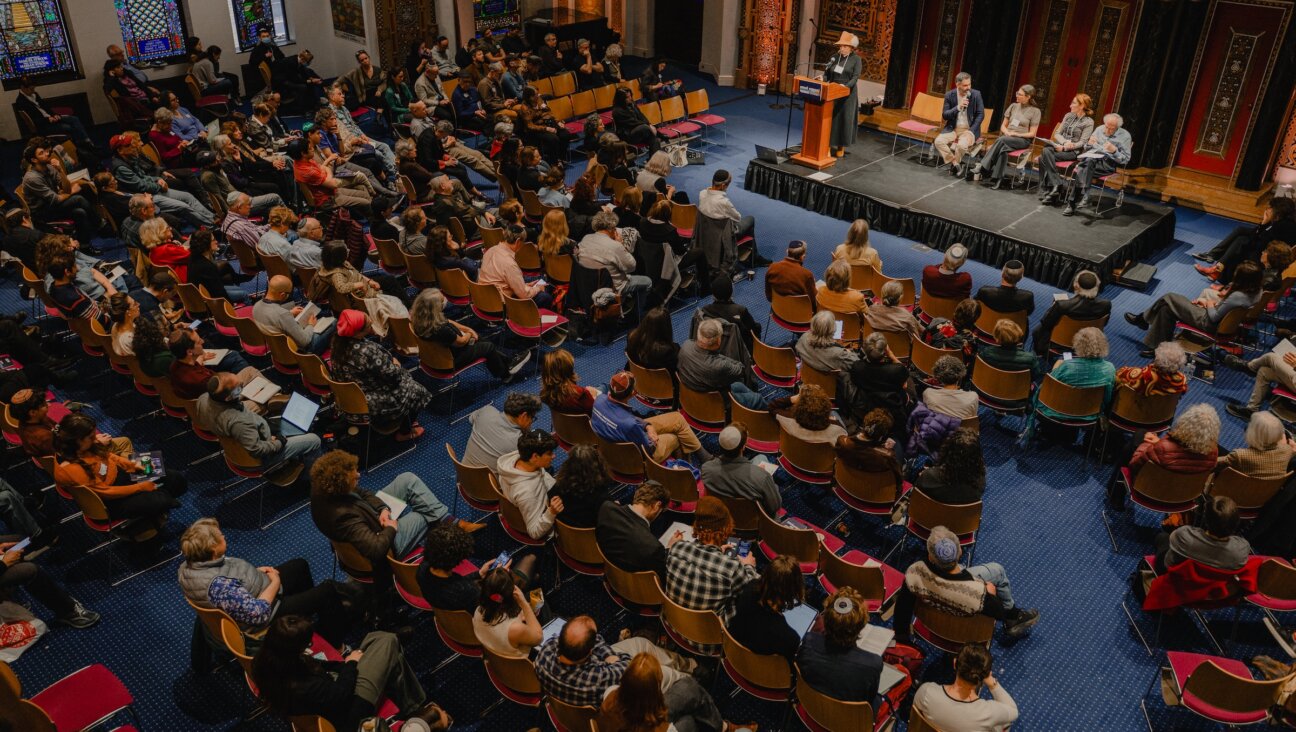
Congress members, White House delegates and representatives of Jewish social service agencies spoke out against hunger at the National Hunger Seder in Washington, D.C.
Wednesday’s seder, which was organized by the Jewish Council for Public Affairs and Mazon: A Jewish Response to Hunger, revolved around the traditional Passover seder message “Let all who are hungry, come and eat.”
The event at the Capitol building is among 27 hunger seders being held across the United States. It featured a Haggadah that included four questions on food insecurity, particularly among the elderly. The 10 “plagues we see today are not punishment from God, but ones of our own doing — the awful unintended results of our own actions and creations,” said JCPA President Rabbi Steve Gutow.
The plagues include “the grandmother who must choose between paying for medicine and paying for food” as well as “Apathy, the greatest plague of all — the failure to make ending senior hunger a national priority.”
Abby Leibman, the president and CEO of Mazon, said nearly 5 million American seniors struggle to put enough nutritious food on the table.
“And unfortunately, that number is only projected to grow as 10,000 baby boomers turn 65 each day between now and 2020,” she said.
Among the seder participants were Reps. Henry Waxman (D-Calif.), Jim McGovern, (D-Mass.), Jan Schakowsky (D-Ill.), Jerrold Nadler (D-N.Y.) and Brad Schneider (D-Ill.), as well as Matt Nosanchuk, associate director of the White House Office of Public Engagement for Jewish Outreach.
This is a moment of great uncertainty. Here’s what you can do about it.
We hope you appreciated this article. Before you go, we’d like to ask you to please support the Forward’s independent Jewish news this Passover.
This is a moment of great uncertainty for the news media, for the Jewish people, and for our sacred democracy. It is a time of confusion and declining trust in public institutions. An era in which we need humans to report facts, conduct investigations that hold power to account, tell stories that matter and share honest discourse on all that divides us.
With no paywall or subscriptions, the Forward is entirely supported by readers like you. Every dollar you give this Passover is invested in the future of the Forward — and telling the American Jewish story fully and fairly.
The Forward doesn’t rely on funding from institutions like governments or your local Jewish federation. There are thousands of readers like you who give us $18 or $36 or $100 each month or year.
Support our mission to tell the Jewish story fully and fairly.