‘Verbal sparring’ at a conference for religious Jews breaking from Israel orthodoxy? That’s not what I experienced
The Smol Emuni conference was marked by civil disagreements, not major ruptures
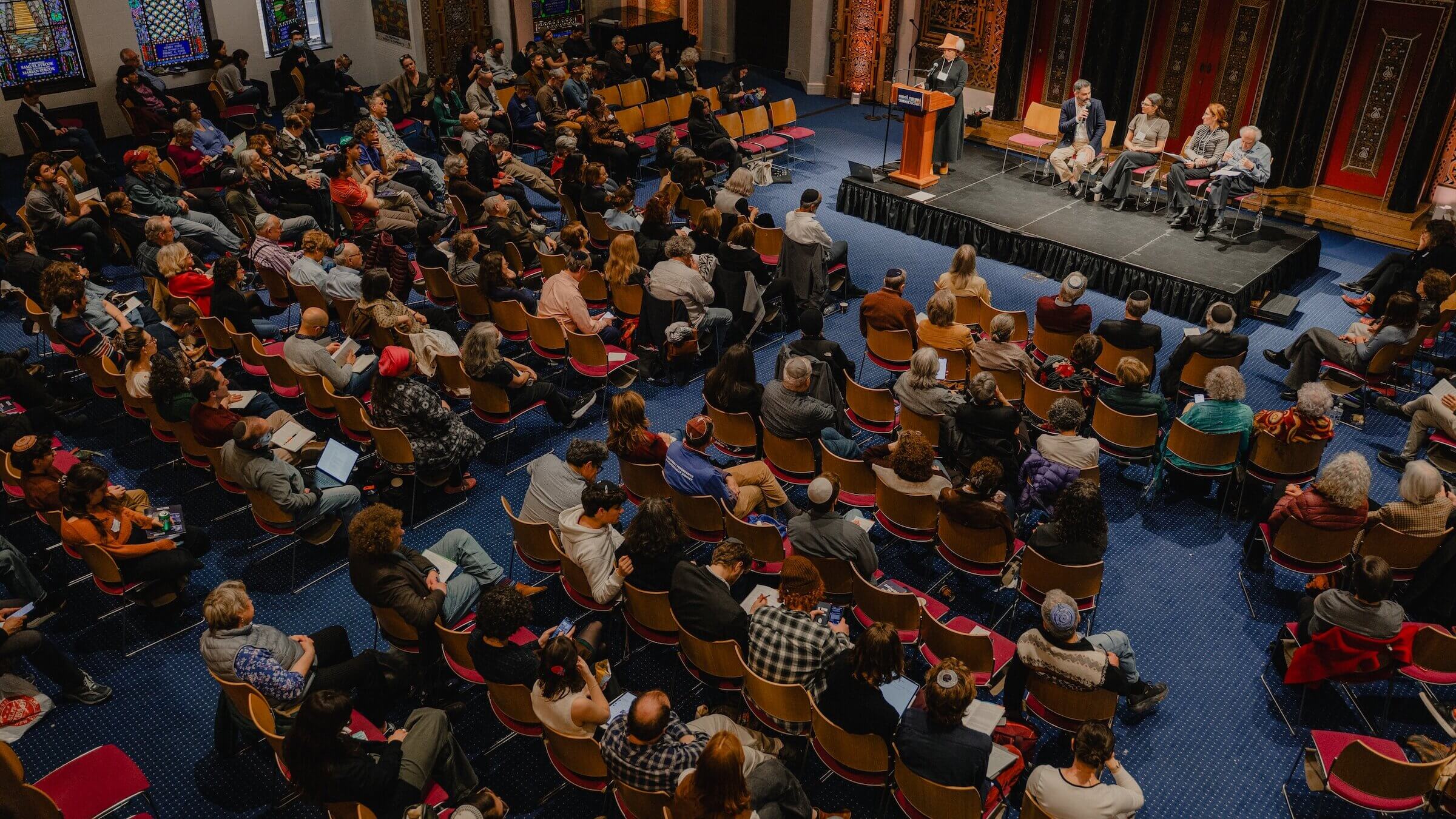
Smol Emuni’s second annual conference at B’nai Jeshurun in Manhattan. Courtesy of Liri Agami WIWA
In response to “When observant Jews gathered to challenge Israel orthodoxy, verbal sparring and walkouts ensued“
To the editors:
The Forward‘s article about the recent Smol Emuni conference seems to describe a different event than the one that I attended. There were certainly different viewpoints among the people assembled at the gathering for religious Jews who, per the organization’s mission, seek “justice, equality, and dignity for Jews and Palestinians.” And there were views and perspectives shared that felt challenging or even difficult to hear.
But to assert, as the Forward‘s article did, that the conference was riven by strife and anger is simply not true.
The basis of the article’s claim, and the focus of a flurry of subsequent op-eds and blog posts, was Rabbi Saul Berman’s address to open the afternoon session. Berman used his remarks to criticize the Palestinian activist who had spoken in the morning; in doing so, he invoked a broad, monochromatic description of Islamic theology that felt out of place to some of us, including me.
Berman argued that Islamic Law prohibits any territorial concession, suggesting that Islamic law, but not Jewish law, continues to make peace impossible. The implication that Jewish theology has not blocked work toward peace is quite problematic, given the central role of religious leaders and communities in building settlements and in right-wing politics in Israel.
It is precisely this line of argument that many came to this conference to escape. In too many Jewish communities, it feels impossible to acknowledge the ways in which Judaism has contributed to Palestinian suffering and injustice. Smol Emuni was created in part to end that silence. That is why Berman’s words felt jarring.
But reading the Forward‘s article, one might think that Berman spoke with anger or that the audience actively derided him.
In fact, Berman spoke for close to 20 minutes. As far as I could see, everyone listened to him attentively. Most of the audience applauded when he concluded; I heard no boos. While a few people came and went during his remarks, as is the case at any such event, I saw no evidence that anyone “walked out in protest.”
One of the organizers did feel the need to note, after Berman concluded, that the conference organizers specifically did not share all of his views. She did so gracefully, while thanking him warmly for speaking and affirming her deep respect for him. I do not know how Berman felt, but he was not visibly angered and he stayed for the remainder of the program.
It was an awkward moment, to be sure, but not one of rancor or disrespect. It certainly did not define the conference, which elevated a range of important voices and viewpoints that I found both thoughtful and thought-provoking.

Hello, fellow Forward reader! I’m Joel Brown, a Forward reader and supporter for more than 15 years, and currently the chair of the board of directors.
I’m an avid Forward reader because it ticks so many of my essential boxes: excellent journalism, Jewish focus and diverse viewpoints. In today’s political climate, what I most appreciate is the Forward’s independence — made possible by the generosity of its membership.
The Forward is committed to bringing you unbiased, nuanced Jewish news. From my position as board chair, I see an exciting future as we expand our position as the definitive independent voice of contemporary American Judaism.
That’s why I’m paying it Forward, by matching $36,000 of reader gifts. It’s an investment in the Forward’s newsroom, to continue telling the American Jewish story with truth and independence.
— Joel Brown, Forward board chair
Support our mission to tell the Jewish story fully and fairly.