The San Diego imam defended Oct. 7. His mosque still deserves our help
Muslims and Jews are the two most targeted religious communities in America. We can fight our common threats better together
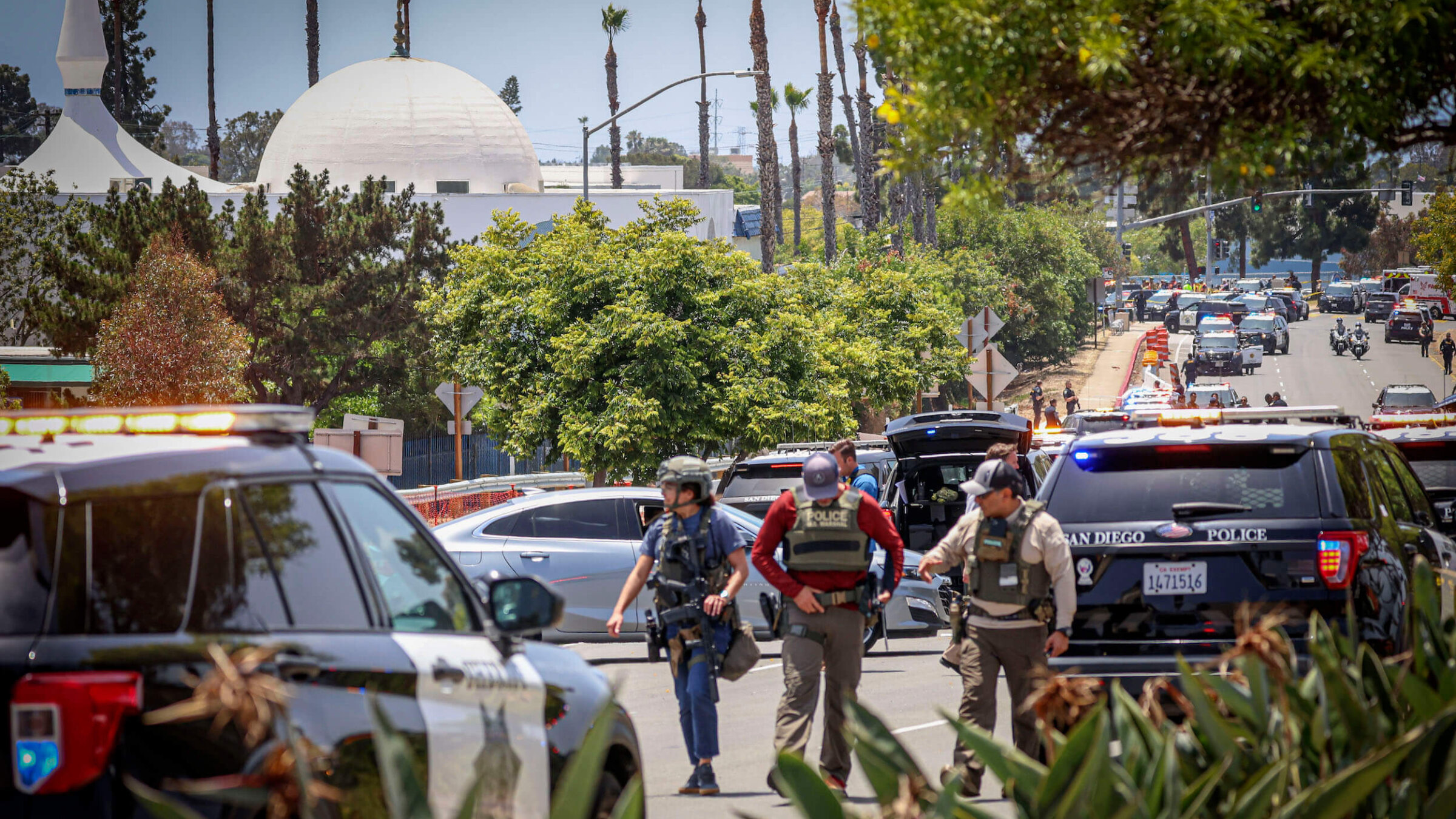
The scene after a shooting at the Islamic Center of San Diego on May 18. Photo by Sandy Huffaker / Los Angeles Times via Getty Images

Senior Columnist Rob Eshman May 19, 2026
Jewish leaders and institutions like the ADL correctly expressed sympathy and support after Monday’s fatal shooting at the Islamic Center of San Diego.
That really upset some people.
“Just remember the people who attend this mosque want us all to be killed,” Laura Loomer posted to X.
Loomer is an extremist, and it would be easy to dismiss her words as the fringe. But she does advise the president of the United States, and hundreds of social media posts echoed her opinion.
Many of them pointed out that 13 days after the Oct. 7, 2023 Hamas attack on Israel, Islamic Center Imam Taha Hassane gave a talk in which he told his congregation, “When people are occupied, then the resistance is justified — it becomes a human right.”
“We cannot accuse someone who is fighting for his life to be a terrorist,” he added. “The terrorist is the one who started the occupation, not the one who is defending himself.”
In the same sermon, Hassane said that American minds were poisoned by media influenced by “Zionist sources” to hate Islam, and that “the Zionist propaganda machine” bore some responsibility for the 2023 murder of an 8-year-old Muslim boy in Chicago at the hands of a mentally unstable, Islamophobic, non-Jewish man.
Some of them also noted that two months later, Hassane’s wife, Lallia Allali, was asked to resign from the community advisory board of The San Diego Union-Tribune and resigned from a teaching position at the University of San Diego after it came to light that she had posted an image on her Facebook account of a Star of David decapitating five babies, with the caption, “The devil is killing.”
All of this is bad. None of it justifies or excuses yesterday’s violence.
Too many of us, it seems, find it hard to understand that justifying acts of violence against those who disagree with you gives them ample reason to do the same to you.
‘We don’t need to agree’
“We do not need to agree on everything to stand firmly against violence,” Rabbi Jason Nevarez of Congregation Beth Israel of San Diego posted to Instagram following Monday’s attack. “The Jewish community knows all too well the vulnerability that comes when sacred space is violated. That experience should not harden our hearts, but deepen our capacity to stand with others.”
The fact is that Jewish and Muslim Americans, despite our political differences, both face the threat of political violence and hate crimes.
Jewish and Muslim houses of worship are both disproportionately targeted for violence. Jewish congregations make up just 3.2% of all congregations nationwide, but account for 22% of the attacks against houses of worship, according to a 2023 A-Mark Foundation study. (I was CEO of the A-Mark Foundation at the time of this research.) Just 0.6% of religious congregations nationwide are Muslim, yet attacks against mosques and Islamic centers account for 17% of the attacks.
Inside the vehicles of the two teenagers believed to have opened fire on the Islamic Center, killing three people before taking their own lives, authorities found gasoline cans decorated with Nazi insignia and hate literature. Muslims and Jews in this country face a common menace in the kind of hate that appears to have influenced these teens — and there are far more useful ways of fighting it than, as Loomer would have it, blaming each other.
Work to do together
First and foremost: Stop justifying violence, period. Stop glorifying terror. Stop demonizing groups other than your own. Whether from the pulpit or on social media accounts, religious leaders need to set an example.
I get the anger, fear and distrust over the imam’s statements following Oct. 7 — that’s human. But the Jewish leaders that condemned the shooting and offered support were right to do so in spite of his words — that’s humanity.
Part of me hopes that the connections made because of that solidarity, following this tragedy, will create a new opening for mutual respect. Maybe, maybe not. What should certainly come out of it is an awareness that we have a common enemy, and a common struggle.
Here’s where to start:
•Help the victims. Attacks on houses of worship are now terrifyingly common. The A-Mark report counted 59 attacks between 2012 and 2022 — and things have gotten worse since Hamas’ Oct. 7, 2023 attack on Israel, and the subsequent war in Gaza. Inevitably, society moves on. But even if there are no dead or wounded, the scars linger. “The aftermath is just devastating,” Rabbi Jen Lader of Temple Israel in West Bloomfield, Mich. — which recently weathered a ramming attack — told NPR. Muslims and Jews can work together to offer lasting support for victims of such violence: volunteering and donating to help rebuild damaged buildings and supporting congregants in their physical and emotional healing.
• Secure our institutions. As the attack was unfolding, leaders of Jewish Federations of North America were in Washington. D.C. seeking $1 billion in security funding for houses of worship of all faiths. This is lobbying Jews and Muslims can do together, including standing together against the administration’s conditioning of security funding on cooperation with Immigration and Custom Enforcement activities.
• Advocate for stronger gun laws. This may be the most Pollyanna-ish of all suggestions, but safe storage and gun lock laws are common in many countries, all of which have far fewer mass shootings than the U.S. It’s a cause Muslim and Jewish clergy can join in on pushing for.
• Finally, hold tech companies responsible for hate. More than half of all Americans have experienced harassment on social media, according to the ADL. Meta and TikTok’s own whistleblowers have said the companies promote hate to increase profits. Their algorithm “maximizes profits at the expense of their audience’s wellbeing,” they told the BBC. A Muslim-Jewish campaign to crack down on tech platforms that profit off hate groups and set their algorithms to push conflict could help make us all safer.
The teenagers who opened fire on the Islamic Center of San Diego didn’t care what the imam said about Gaza. They saw Muslims, and they wanted them dead — the same way the Pittsburgh and Poway shooters saw Jews. Our enemies are not making the distinctions we make about each other. Maybe it’s time we stopped making them too.
I’m personally matching all gifts to the Forward, up to $36,000. Can I match your gift now?

Hello, fellow Forward reader! I’m Joel Brown, a Forward reader and supporter for more than 15 years, and currently the chair of the board of directors.
I’m an avid Forward reader because it ticks so many of my essential boxes: excellent journalism, Jewish focus and diverse viewpoints. In today’s political climate, what I most appreciate is the Forward’s independence — made possible by the generosity of its membership.
The Forward is committed to bringing you unbiased, nuanced Jewish news. From my position as board chair, I see an exciting future as we expand our position as the definitive independent voice of contemporary American Judaism.
— Joel Brown, Forward board chair
Support our mission to tell the Jewish story fully and fairly.