‘This is sort of their normal’: Israelis confront yet another wartime flare after Iranian fire
Schools closed, hospitals underground — but for how long?
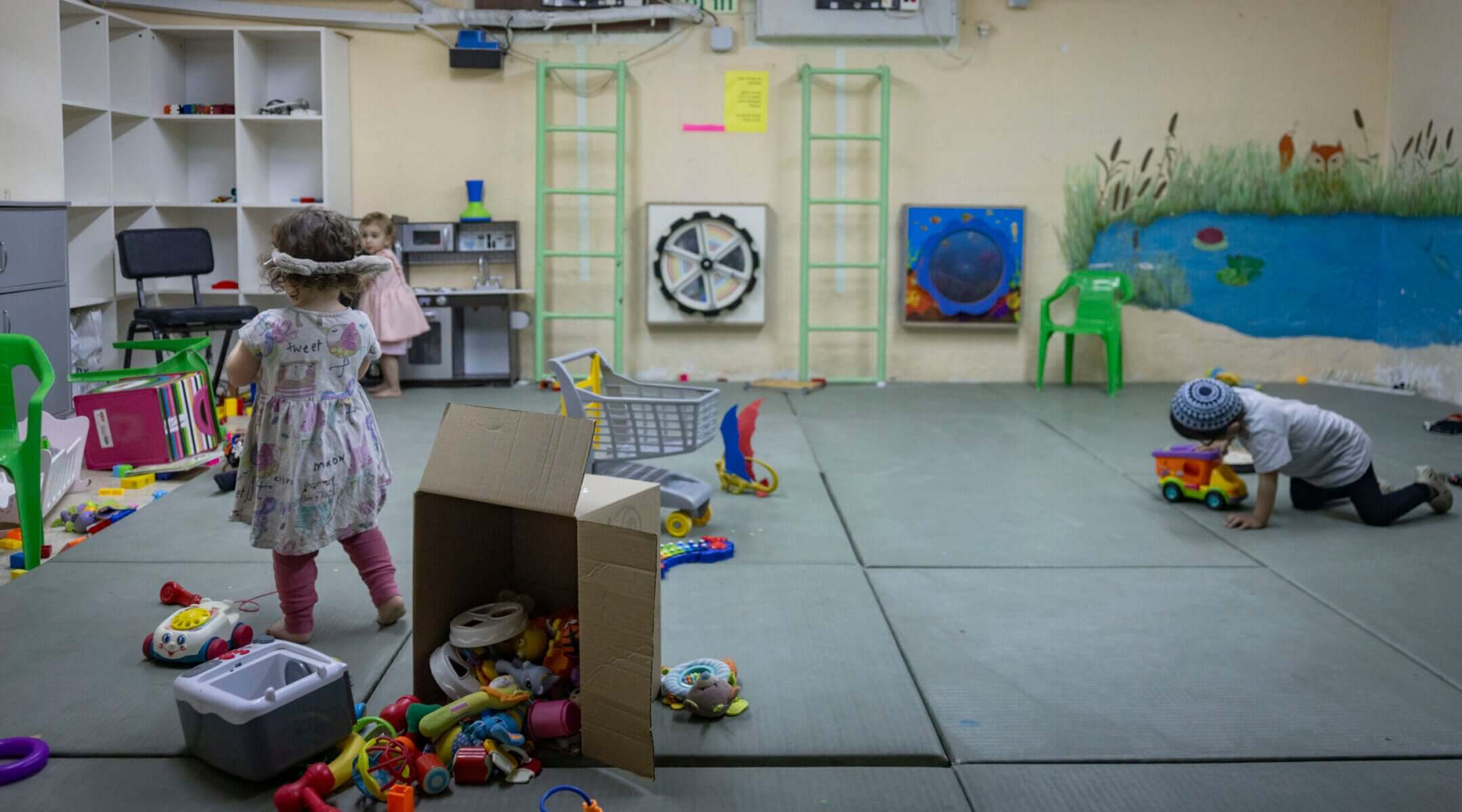
Children play in a public bomb shelter in the Nahlaot neighborhood of central Jerusalem, June 8, 2026. (Chaim Goldberg/Flash90)
(JTA) — TEL AVIV — As missiles flew toward Israel on Sunday night, beleaguered Israelis once again took to Facebook from their safe rooms.
“Whoever is in charge of naming wars over here, please do not give it a fierce animal name this time,” one Israeli wrote in an English-language group. “The last military operation was called ‘Roaring Lion,’ and the Twelve Day War in June 2025, ‘Rising Lion.’”
Another replied with a suggestion: “I hope it’s something like ‘The One Day War.’”
The idea may not have been far off. U.S. President Donald Trump said early Monday that he hoped both Iran and Israel would halt their fire. By mid-morning, Iran’s military announced the strikes were on pause, saying it had sufficiently retaliated for the Israeli strikes in Beirut, a tit-for-tat exchange. By Monday evening Israel time, Netanyahu, too, said the fighting was halted, but warned that Israel would respond “with force” to any future attacks.
Despite the tenuous pause — not quite a ceasefire — Home Front Command restrictions remained in place by Monday evening, touching every layer of daily life in Israel. Schools were closed through at least Wednesday. Or Erez, head spokesperson for Clalit, Israel’s largest health care network, told JTA, “We will continue to remain operating in shelters until the Home Front Command restrictions change.”
By 10 p.m. Sunday, NICU infants and those in critical care were already being moved to bunkers beneath Beilinson hospital, home to the largest emergency room in the Middle East.
“This is the third time within a year that we have carried out such a transition,” said Dr. Erez Barenboim, director of Beilinson and Hasharon Hospitals.
Hospital staff were visibly fatigued but resilient. Soroka University Medical Center was struck by an Iranian ballistic missile during the June 2025 conflict, and as is standard during attacks, health care staff canceled non-essential visits and moved operations to shelters.
Alexi Wirpel, a student at the University of Mary Washington in Virginia, was on a Birthright trip in the Galilee when the first sirens rang out. “We could hear the dome working, so we knew we were going to be relatively okay,” she said.
It was not Wirpel’s first trip to Israel, but it was her first time hearing sirens signaling incoming missiles. Others on the Birthright trip were more anxious and had to be consoled by staff, she said.
When word came of a tenuous pause, Wirpel said, she and others didn’t believe it would last long.
“All day today we’ve all kind of been just waiting for something to go off again,” she said. “It’s become a very real reality that this is something that my family has to go through instead of just hearing about it.”
Caroline Flannery manages an after-school program at a Tel Aviv middle school and has watched the cumulative toll of two and a half years of conflict reshape an entire generation of Israeli children. Added to the time lost during the pandemic, students in those grades have missed the equivalent of a year of school.
“We have kids in fifth and sixth grade that still don’t know the alphabet,” Flannery said.
Israel’s education system has been among the hardest hit since Oct. 7. Leaked results of a government aptitude test found that only 3% of Israeli ninth graders met the national benchmark for science, and just 22% met the benchmark for English, figures that prompted opposition leaders to call for a declaration of a “national educational emergency.”
The disruption extends to staff, who are just as rattled as students when a siren sounds and a week of lesson plans is suddenly worthless.
Flannery moved to Israel in 2019 and hadn’t planned to stay, but the impact she could make on Israeli children convinced her to commit to another year, and then another, until she was running the after-school program herself.
The conclusion she has come to in the wake of Oct. 7 is that many of her students, faced with constant disruption, will never fully catch up.
“It’s not just that they miss school, so now they have to work extra hard and catch up,” she said. “Their whole routine was disrupted and they come back. They’re not ready, not used to, not prepared to sit, to come into class, to sit in their seats, to learn. Their minds aren’t there.”
With Trump pressing Israel and Iran to return to the negotiating table, Flannery discussed contingency plans already on the table — such as Zoom classes, home visits — should the war return to its March tempo.
“This,” she said, “is sort of their normal.”
I’m personally matching all gifts to the Forward, up to $36,000. Can I match your gift now?

Hello, fellow Forward reader! I’m Joel Brown, a Forward reader and supporter for more than 15 years, and currently the chair of the board of directors.
I’m an avid Forward reader because it ticks so many of my essential boxes: excellent journalism, Jewish focus and diverse viewpoints. In today’s political climate, what I most appreciate is the Forward’s independence — made possible by the generosity of its membership.
The Forward is committed to bringing you unbiased, nuanced Jewish news. From my position as board chair, I see an exciting future as we expand our position as the definitive independent voice of contemporary American Judaism.
— Joel Brown, Forward board chair
Support our mission to tell the Jewish story fully and fairly.