This Jewish artist hadn’t painted in more than 5 decades. Then came Oct. 7.
Sid Klein wants to combat antisemitism, not with words or weapons but with his art
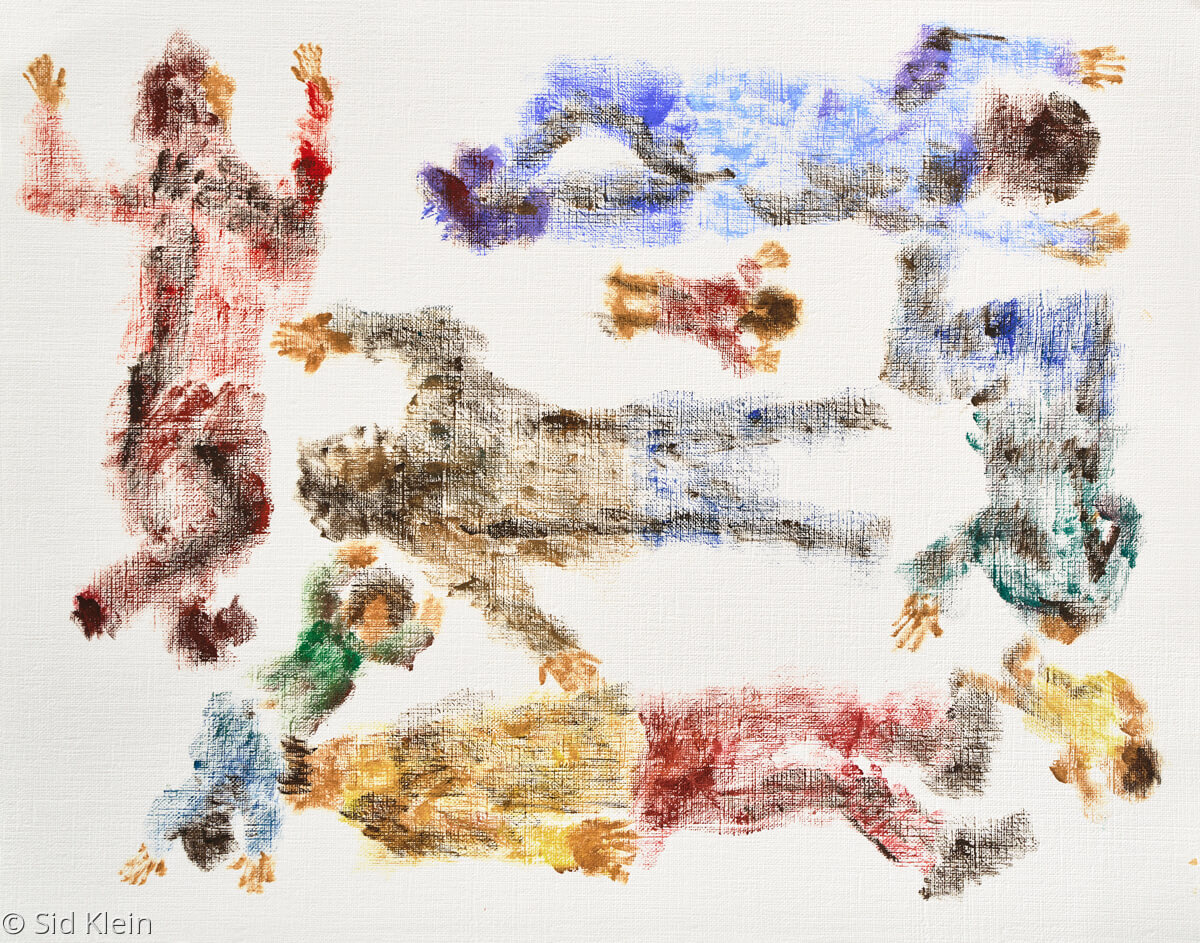
‘Nine More Dead’ — a Sid Klein painting inspired by Oct. 7. Graphic by Sid Klein
By Stav Ziv May 22, 2026
Sid Klein has finally found his subject. More than half a century after he scrambled to pick a topic for his senior art project at Brooklyn College—and settled on exploring the porcelain curves of a toilet bowl in a 20-painting series—he’s discovered a purpose.
Klein, 78, took a five-decade hiatus from art between college graduation and retirement. He picked his brushes back up just a few months before the events of Oct. 7.
Upon hearing of the Hamas attacks, Klein processed the news with acrylics. Soon, he began looking back to the Holocaust. He felt compelled to render contemporary and historical victims of hatred on paper and ultimately take on the mantle of combatting antisemitism, not with words or weapons but with images.
“For the first time in my life, I’m so motivated in my art,” Klein told me over Zoom from his home in South Florida. “All of a sudden I went from, ‘I don’t know what I want to paint,’ to, ‘I’ve got to make a record of this so people can look at these paintings and see what does antisemitism naturally lead to.’”
Living in this bubble
Born and raised in Brooklyn, Klein noticed at a young age that he could depict objects in three dimensions. “I started drawing with Crayola crayons with paper that my mom would pick up [at] the local five and dime,” he said.
But his mother died when he was seven, leaving his father to raise three children on his own. Though they weren’t particularly religious, Klein said, he attended yeshiva. The extra-long school day helped his working single father make sure he was safe. Klein continued dabbling in art through elementary and high school.
The Holocaust was not part of his education, as far as he remembers, not at the yeshiva and not later in college, where he flitted from pre-law to economics to philosophy before settling on fine art. “I’d never been exposed to it,” he said. “I’d never seen the photographs. I consciously avoided the photographs.”
“I was living in this bubble so I could pretend that antisemitism did not exist,” he said.
He remained in that bubble through business school and a long career in marketing. During that time, “painting didn’t even cross my mind,” Klein said. “For 55 years, I focused on the business and totally ignored the art.”
It wasn’t until his career drew to a close that he thought he might try again. “I wanted to give it a try and see what was left,” he said. But he wanted to keep painting only if he had a worthy subject, which he found in the wake of the Hamas attacks.
“That murder affected me in a profound way,” said Klein, who has two sons and five grandchildren living in Israel. “I started painting in my mind what these 1,200 people would have looked like. And that was my return to art.”
Filling the hole in his heart
The segue from the horrors of Oct. 7 to those of the Holocaust felt natural to Klein. “For me, all of those are one of the same. They’re all Jew hatred at different times in history,” he said. “The amount of evil in our world is just — I don’t know how to measure it.” There are endless tragedies, he said, “but I’m focusing on our people.”
Klein paints in a corner of the family room he’s designated as his studio. He regularly pores over hundreds of black-and-white photos taken in ghettos and camps, looking for his next subjects to call out to him.
In one photograph, he recalled, he saw lines upon lines of women and children, standing near cattle cars, waiting, exhausted. He distilled the scene to one row of imminent victims in “Innocents.” They’re “going to be taken to a gas chamber and they’re going to be dead in 20 minutes or a half hour, and they don’t know that,” he said. On the right, a boy tugs at his mother’s coat. The woman on the far left balances the small child in her arms alongside her pregnant belly. In the middle, another grasps a toddler’s hand. Their eyes implore the viewer to grapple with their fate.
Several of Klein’s Holocaust works were displayed earlier this year at the Gross-Rosen Museum in Rogoźnica in Poland, on the grounds of the concentration camp system of the same name, where an estimated 120,000 people were imprisoned and 40,000 died.
“As employees of a Memorial Site, we have constant access to disturbing historical photos and documents; these are undeniably important, but viewing the victims through the eyes of an artist is an entirely different, more intimate experience,” Bartosz Surman, who works for the museum’s education department, told me. Surman estimated that approximately 4,000 people saw Klein’s work there between January 27 and March 31. “For a Memorial Site located in a village of fewer than a thousand people, we consider it a significant success and a testament to the power of Mr. Klein’s work,” he said.
Four thousand miles away, “My Zaidy” hangs on the wall at the Dr. Bernard Heller Museum in downtown Manhattan as part of the exhibition “Proverbs, Adages, and Maxims.”
The man in the painting wears a star under his heart. The bright yellow patch and pearlescent and gold shimmer of his face contrast with the matte blue of his coat and hat. But turning the corner of the exhibition, it’s the eyes that catch you. “I left them blank, so you can put in his eyes, any eyes you want,” Klein said—his zaidy’s or yours or a stranger’s.
The eyes may be missing but the gaze is powerful, as though this old man, as he approaches his cruel end, is staring and saying, “Look at me. Do you see what’s happening? Why are you just standing there?”
“A lot of bubbes and zaides were exterminated,” Klein said, including his paternal grandfather. But the zaidy in the painting isn’t Klein’s, exactly, he said. He can’t recall ever seeing a photo of him. Instead, he painted another elderly man in a photo that struck him: This is what a zaidy selected for the gas chamber looks like. This is what Klein’s zaidy could have looked like.
“I decided I was going to do a painting, and fill that hole in my heart,” Klein said.
“There’s something very haunting about the hollowed, empty eyes,” museum director Jeanie Rosensaft told me over the phone. “We were very touched, because although [Klein] has not had a long resume of art production, we felt that the image that he provided was very compelling.”.
Klein is one of 58 artists in the exhibition, and his work will be included in a tour the museum is organizing following its New York run, which ends June 24. “We hope that he continues on this path,” Rosensaft said. “It’s really essential that art bear witness to the past and provide a bridge to the future.”
Seeing the pain
Klein’s next painting, he told me, was inspired by a photo of two small children, empty bowls in hand, begging for food.
“If I had more working space, I would make my paintings bigger,” said Klein, who says he hopes to one day create life-size portraits. “Right now you’ve got to get pretty close to see what the hell is going on,” he said. “I want size to be part of your experience seeing the pain.”
Spending his days sifting through Holocaust photos and painting its victims takes a toll. “When I paint, I become emotionally involved. But when it’s done, I listen to my music for a couple of hours, and that gives me the emotional strength to continue,” says Klein, who puts on Vivaldi, Mozart, or Brahms, for example. “After I do a painting, I need this music to settle my nerves.”
“Sometimes I say, ‘Klein, try something else!’” he said. But he can’t imagine abandoning his subject or newfound mission for any others. Which means he’ll need more of that music in the years to come, as might those viewing his paintings.
“A lot of my work is grotesque,” Klein said, and that’s intentional. “I want to shake you up.”

Hello, fellow Forward reader! I’m Joel Brown, a Forward reader and supporter for more than 15 years, and currently the chair of the board of directors.
I’m an avid Forward reader because it ticks so many of my essential boxes: excellent journalism, Jewish focus and diverse viewpoints. In today’s political climate, what I most appreciate is the Forward’s independence — made possible by the generosity of its membership.
The Forward is committed to bringing you unbiased, nuanced Jewish news. From my position as board chair, I see an exciting future as we expand our position as the definitive independent voice of contemporary American Judaism.
That’s why I’m paying it Forward, by matching $36,000 of reader gifts. It’s an investment in the Forward’s newsroom, to continue telling the American Jewish story with truth and independence.
— Joel Brown, Forward board chair
Support our mission to tell the Jewish story fully and fairly.