The bizarre antisemitic book that taught me to better understand Judaism
Hector Bolitho’s ‘Twelve Jews,’ published in 1934, tried to defend Jews — in one of the strangest ways possible
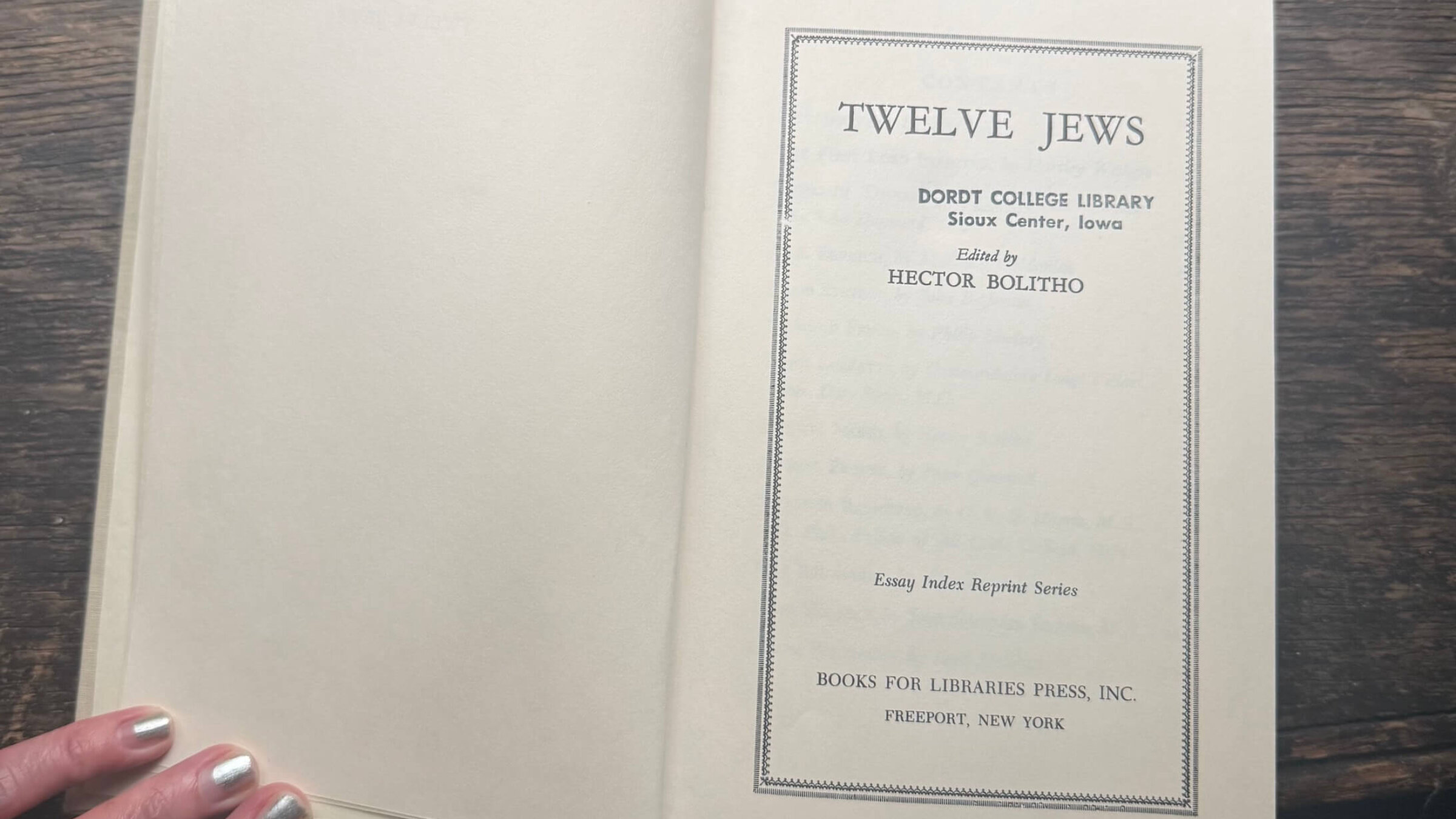
My used copies of Hector Bolitho’s ‘Twelve Jews’. Photo by Talya Zax

By Talya Zax May 22, 2026
The pub bookshelf in Painswick, England, was stocked with books bound in handsome jewel tones. It seemed charming and innocuous, until I spotted a 1934 hardback with the alarmingly simple title of Twelve Jews.
Curious, I opened it.
“The quarrel between the Jews and the rest of civilisation has been kept alive by two forces: one, the peculiar character of the Jews, and the other, the antipathy of Christian or non-Jewish society,” the introduction read. “The one has induced the other.”
Um, what?
As disturbing as that claim was — it’s such a pity that Jews are too weird for Christian society to tolerate! — I found it even more troubling that the author, Hector Bolitho, who conceived of and edited the essay collection, had obviously written with a profound wish to defend Jews against prejudice. He hoped the book would help ameliorate the long quarrel he identified, especially in light of the already unfolding “enforced exodus of the Jews from Germany.”
Less than a page in, I felt a profound need to take a shower. (“Centuries of estrangement from normal society and opportunity have undermined the qualities in Jewish character, so that Jews neither think nor act within the comprehension of other people” — ick.)
There was something in this strange, unconsciously bigoted book that felt painfully contemporary. I hated it, and needed to understand it. Since I first encountered Twelve Jews on vacation a year ago, I’ve been perturbed by its particular combination of animus and sympathy. How could anyone think that this book — a book in which one writer, a financial journalist named Hartley Withers, questions “whether Jews are unpopular because of their money, or money is unpopular because of its Jews” — was the right way to make a case against the impending genocide of the Jews?
Bolitho, a prolific New Zealand-born author who has faded into obscurity, had a simple idea: Have 12 writers profile 12 eminent Jews — including Sigmund Freud, Marcel Proust and former Italian Prime Minister Luigi Luzzatti — with the hope that doing so might “calm people to realize the conquests as well as the sorrows of the race.” Bolitho wanted, in effect, to humanize Jews at a time when he saw them being dangerously dehumanized.
His tragedy, and ours, is that the best he could achieve was a more earnest form of dehumanization. Call it falling prey to the allure of explaining the Jew.
The fallacy that hatred against Jews is an equation that can be solved — in part by parsing the bigoted instincts of broader society, but mostly by seeking to explicate what Bolitho called “the peculiar character of the Jews” — is age-old. Abbé Grégoire, who during the French Revolution prominently argued for Jews to have legal equality, also “believed that Jews should convert, so that they might intermix with the rest of the population and thus lose their ‘degenerate’ moral and physical characteristics,” Lawrence Grossman wrote in the Forward in 2011. The word “antisemitic” was coined in reference to the 19th-century scholar Ernest Renand, who undertook serious research into ancient Israel and the Hebrew Bible, and also helped popularize the idea of fundamental divisions between “Aryans” and Jews that reflect poorly on the latter. We know how that aged.
This is a phenomenon that broadly falls under the definition of “philosemitism.” As Grossman wrote, “not all expressions of love for Jews are necessarily benign.”
Spending time with Bolitho’s particularly enraging entry in this canon — he refers to one German Jew whom he met in the course of his research as “a cruel, dishonest business man,” who “was nasty with Christian pretensions” — has helped me understand just why the urge to solve antisemitism through anthropology is so seemingly eternal. And it’s helped me to understand why it never, ever works.
It’s simple, really. To take on the task of explaining a people to whom you don’t belong is to ground your work in the belief that that group is not just different from the norm, but somehow unknowable. From that point, there can be no true understanding; only observation, as of animals in a zoo.
Take this sentence from an entry by J. Hampden Jackson — a writer of history who, like Bolitho, has largely been forgotten — on one former writer for the Forward: “Leon Trotsky remains a Jew all through, from the cast of his countenance to the cast of his mind.” Think what you will of Trotsky — and Jackson was clear that many Jews, of many different affiliations, despised him — the lack of recognition of a fellow human being inherent in that statement stings. Jackson is trying to explain, but the only way he can do so is by further stereotyping.
To experience this in real life is to feel profoundly lonely. At the start of the Israel-Hamas war, I was dating someone I had been close friends with for nearly a decade, who I thought I knew well. Then he began to treat me as an avatar for everything wrong with Israel; when the IDF did something particularly inhumane in Gaza, like kill aid workers with the World Central Kitchen, I was, in his eyes, personally responsible. I felt as if he no longer saw me as myself; he just saw me as a Jew.
Which might be part of why I reached for Twelve Jews, despite the obvious fact that it is poisonous. It made me feel clearly understood, but not by its authors.
Instead, I feel understood by the Jews they wrote about. We are a diverse people; we cannot be made sense of as a single body. But most of us have experienced some version of othering in our lives — someone thinking they can know us by analyzing us, rather than engaging with us.
To be reminded we’re not alone in that experience is to feel some relief from it. The rest of the world might be observing us, but at least, in this one way, we understand each other.

Hello, fellow Forward reader! I’m Joel Brown, a Forward reader and supporter for more than 15 years, and currently the chair of the board of directors.
I’m an avid Forward reader because it ticks so many of my essential boxes: excellent journalism, Jewish focus and diverse viewpoints. In today’s political climate, what I most appreciate is the Forward’s independence — made possible by the generosity of its membership.
The Forward is committed to bringing you unbiased, nuanced Jewish news. From my position as board chair, I see an exciting future as we expand our position as the definitive independent voice of contemporary American Judaism.
That’s why I’m paying it Forward, by matching $36,000 of reader gifts. It’s an investment in the Forward’s newsroom, to continue telling the American Jewish story with truth and independence.
— Joel Brown, Forward board chair
Support our mission to tell the Jewish story fully and fairly.