The profound internal contradiction that could spell doom for Hillel
Students don’t want campus Jewish life to come with a strictly enforced political agenda
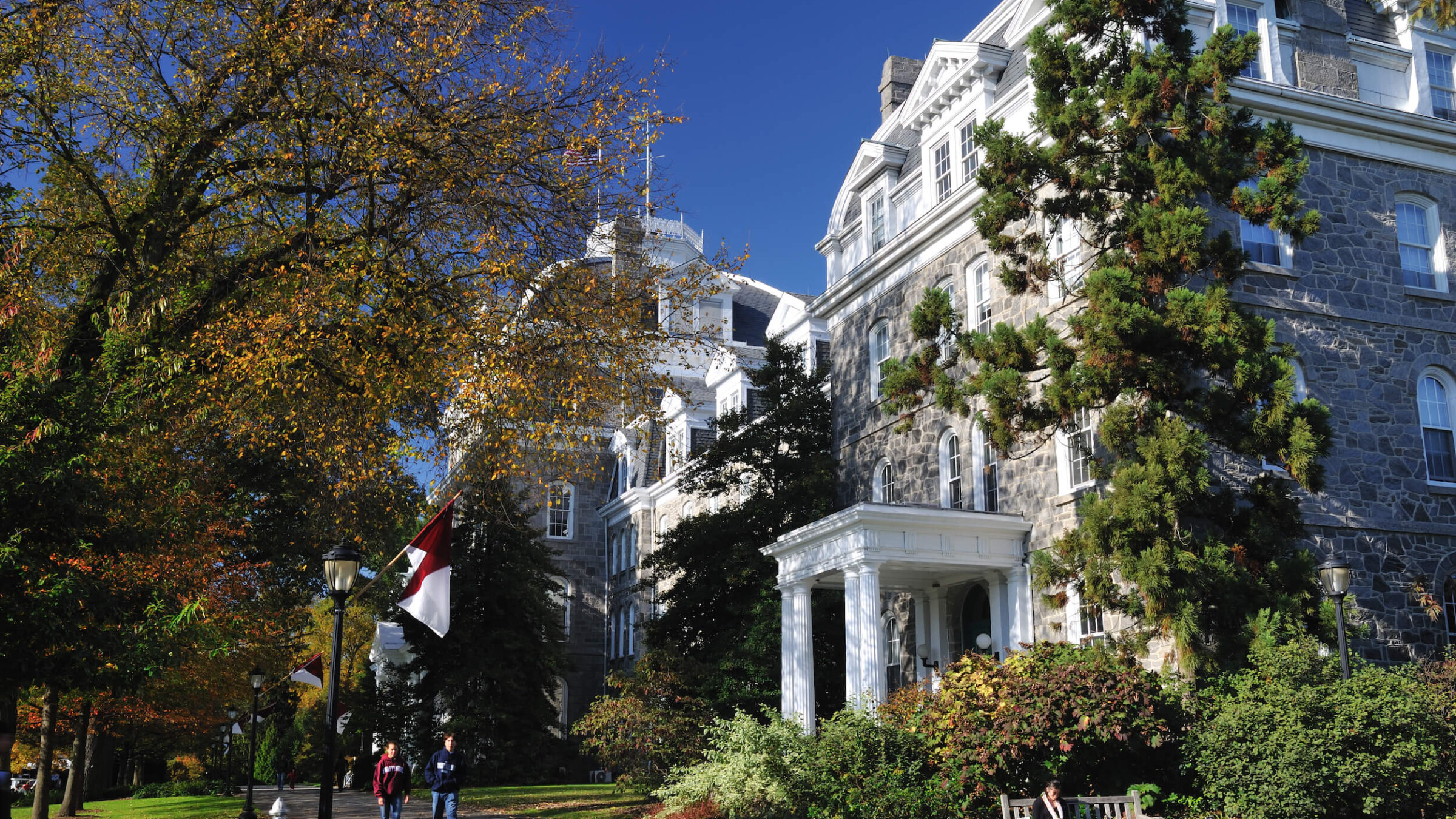
Students on the campus of Swarthmore College. Photo by aimintang/Getty Images
Joel Swanson May 15, 2026
Shortly after I graduated from Swarthmore College, it became the first campus to formally break with Hillel International. The campus Jewish organization began, instead, to call themselves an “Open Hillel,” then rebranded entirely after the parent organization threatened legal action over a civil rights panel it deemed too critical of Israel.
Swarthmore Jewish students lost the name, but they kept their integrity. Jewish students at Middlebury just faced the same question. They answered it the same way. And they were right to do so.
What happened in Vermont is not just a local story about one campus organization. It is a story about a deep contradiction at the heart of Hillel International — one that the organization may no longer be able to sustain.
Hillel presents itself, publicly and forcefully, as the Jewish student organization at colleges and universities across the United States. It’s the home of Jewish campus life, where Jewish students celebrate the High Holidays, eat kosher meals, light Hanukkah candles and gather for Shabbat. It describes itself as the world’s largest Jewish campus organization, serving nearly 200,000 students at more than 850 colleges and universities. It is, at many of those colleges, the only such institution that exists.
Precisely because of that monopoly position, Hillel and its allies have argued — with some justification — that protests targeting Hillel are a form of antisemitism. To make Jewish students feel unwelcome at the one place on campus where they can observe their religious obligations, they argue, is to attack Jewish students as Jews, not merely to criticize a political organization.
That argument has real force. Jewish students deserve to celebrate their holidays without running a political gauntlet. No one should have to defend their views on the West Bank occupation before they can get a bowl of matzo ball soup.
But the problem is that Hillel is also an explicitly political organization. And as such, it should be fair game for protesters.
Hillel International has a mandatory political line that all affiliated chapters must enforce: Its guidelines declare that Hillel is “steadfastly committed to the support of Israel as a Jewish and democratic state,” and campus chapters are prohibited from partnering with or hosting any group or individual that supports the Boycott, Divestment and Sanctions movement, “delegitimizes” Israel by Hillel’s own definition, or questions Israel’s right to exist as a Jewish state.
When the Middlebury Jewish students met with Hillel International representatives, they were told that board members must universally adopt the organization’s political values about Israel. Universally. There is no asterisk, no opt-out, no room for the challenging pluralism of Jewish life in 2026.
This, from an organization that recently used imagery showing the entire territory from the Jordan River to the Mediterranean Sea as part of Israel, without distinguishing the West Bank and Gaza.
This is not a neutral cultural position. It is a political one, and a fairly aggressive one at that. Hillel sends students on trips to Israel through Birthright and similar programs and received $22 million from a $66 million Israeli government initiative called Mosaic International to promote pro-Israel sentiment in the U.S. These are choices a political organization makes.
So which is it? Is Hillel a cultural and religious organization that provides communal Jewish life for all students, in which case it has no business enforcing political litmus tests? Or is it a politically committed advocacy organization with a defined ideological position — in which case it cannot claim special immunity from protest on the grounds that criticizing it means attacking Jewish students’ ability to celebrate Passover?
The answer, uncomfortable as it is, is that Hillel is both. For students like those at Middlebury, the tension between those two identities has become impossible to manage. I suspect more will soon follow their lead.
This contradiction matters now more than ever, because the American Jewish community is changing.
A major recent survey by the Jewish Federations of North America found that 14% of Jews ages 18 to 34 identify as anti-Zionist. Even among younger Jews who support Israel’s existence, the survey found, less than half agreed that Israel makes them feel proud to be Jewish. The Jewish Electorate Institute’s most recent survey found that only about a third of American Jews self-identify as Zionist. As the government of Israel moves further and further to the right, the divide between American Jews and the state of Israel is only likely to grow.
Under current Hillel rules, the meaningful and growing number of Jewish students who identify as non-Zionist or anti-Zionist are effectively excluded. If they choose to participate, they are required to keep their politics at the door — but the organization doesn’t require the same of itself.
The Middlebury case illustrates the absurdity with unusual clarity.
The students’ discomfort with Hillel International began, they explained, after a November 2023 challah sale raised $656 for World Central Kitchen, an organization that provides food relief in Israel, the West Bank and Gaza. That act of simple, universalist charity created friction with the chapter’s parent body. Co-president Caroline Jaffe put the stakes plainly: “How are we ever going to get to peace in Israel and Palestine if we can’t even have a Middlebury Jewish group and a Middlebury SJP” — Students for Justice in Palestine — “talk to each other in Vermont, pretty much as far removed as you could be?”
That should not be a radical question.
The solution is not to try to reform Hillel International from within; that project has been tried repeatedly, by the Open Hillel movement and others, and the structural incentives against change are too powerful. The solution is instead what the Middlebury students are pointing toward: decentralization.
Political pluralism within Jewish campus life is not a threat to Jewish students. It is a reflection of the actual diversity of Jewish opinion, which surveys consistently show to be far wider than Hillel International’s guidelines allow. An American Jewish community that can only cohere by suppressing internal dissent is far more fragile than one that has learned to argue openly and remain in relationship. The students at Middlebury, by renaming themselves the Jewish Association of Middlebury and insisting on a more pluralistic identity, are not abandoning Jewish community. They are building a community that is more honest about what it is and who it is for.
I remember the moment at Swarthmore when Jewish students stopped asking permission and started asking a different question: not “what will Hillel International allow?” but “what do our Jewish students actually need?” The answer turned out to be more interesting, more contested, and, in its way, more Jewish than anything the guidelines had room for.
Did you know that only 2% of Forward readers donate to support our nonprofit newsroom? That 2% make it possible for millions to read the Forward without a paywall or subscription — removing any barriers to the full and fair Jewish story.
But while the Forward is free to read, it isn’t free to produce. Big stories — like deep dives into the antisemitism data, political scoops or reporting trips to college campuses — take months of research and fact-checking. All while we keep you informed of what you need to know each day.
— Rachel Fishman Feddersen, Forward Publisher & CEO
Support our mission to tell the Jewish story fully and fairly.