Bamba blankets NYC after Park Slope Food Coop vote to boycott Israeli products. What’s next?
UJA-Federation of New York is considering holding Israeli food fairs at JCCs
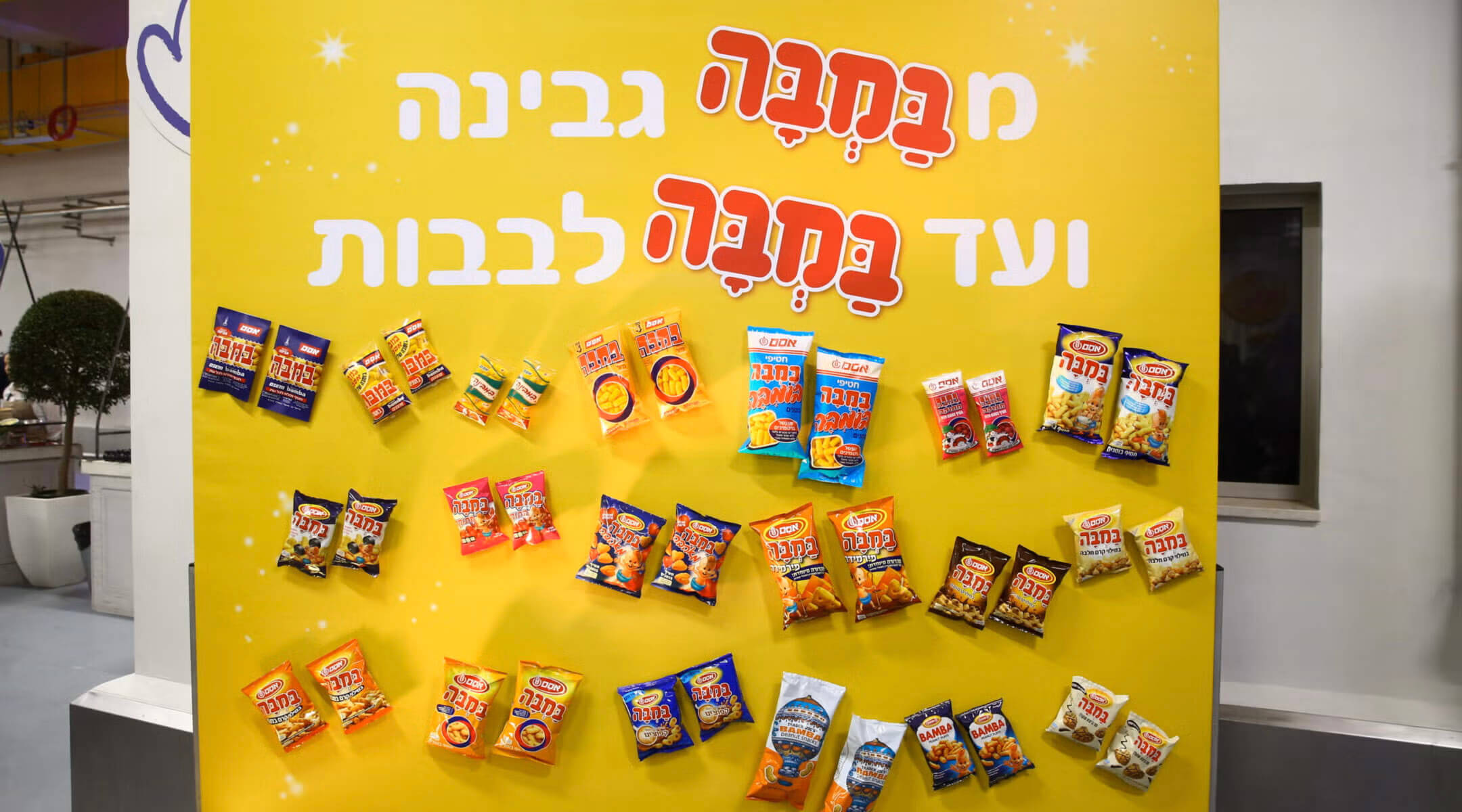
View of posters at the Bamba factory of the Osem corporation in Kiryat Gat, Israel, Feb. 19, 2019. Photo by Flash 90
(JTA) — Jewish institutions are responding to a boycott of Israeli products at a Brooklyn grocery store by buying up Bamba.
Four thousand free bags of the Israeli peanut butter-flavored snack made their way Sunday along the Celebrate Israel Day Parade route up Fifth Avenue, passed around by volunteers with UJA-Federation of New York.
It was the organization’s first response to a contentious election result at the Park Slope Food Coop, the members-only Brooklyn grocery store that last week voted to boycott Israeli products. Bamba is one of the products no longer sold at the coop as a result of the boycott and a symbol of the Israeli snack food industry.
The Bamba distribution was coordinated by UJA, which was a sponsor of the parade, and the nonprofit group Met Council, which will also be distributing bags across their network of food pantries. (An initial purchase of 20,000 bags was made by UJA in the wake of the coop vote last week.) The snacks were brought to UJA’s office by truck on Friday.
The Met Council will distribute the remaining Bamba to the hundreds of food pantries who receive its food deliveries, including the 14 it owns and operates, by next week, CEO David Greenfield told the Jewish Telegraphic Agency.
“They smartly decided to make lemonade out of lemons,” Greenfield said of the UJA initiative. (Some of the pantries, he noted, may decline the Bamba anticipating clients with peanut allergies.)
The Bamba will be added as an additional free snack item to pantry clients’ usual takeaways. Some of it will also be delivered directly to Holocaust survivors within the Met Council’s network.
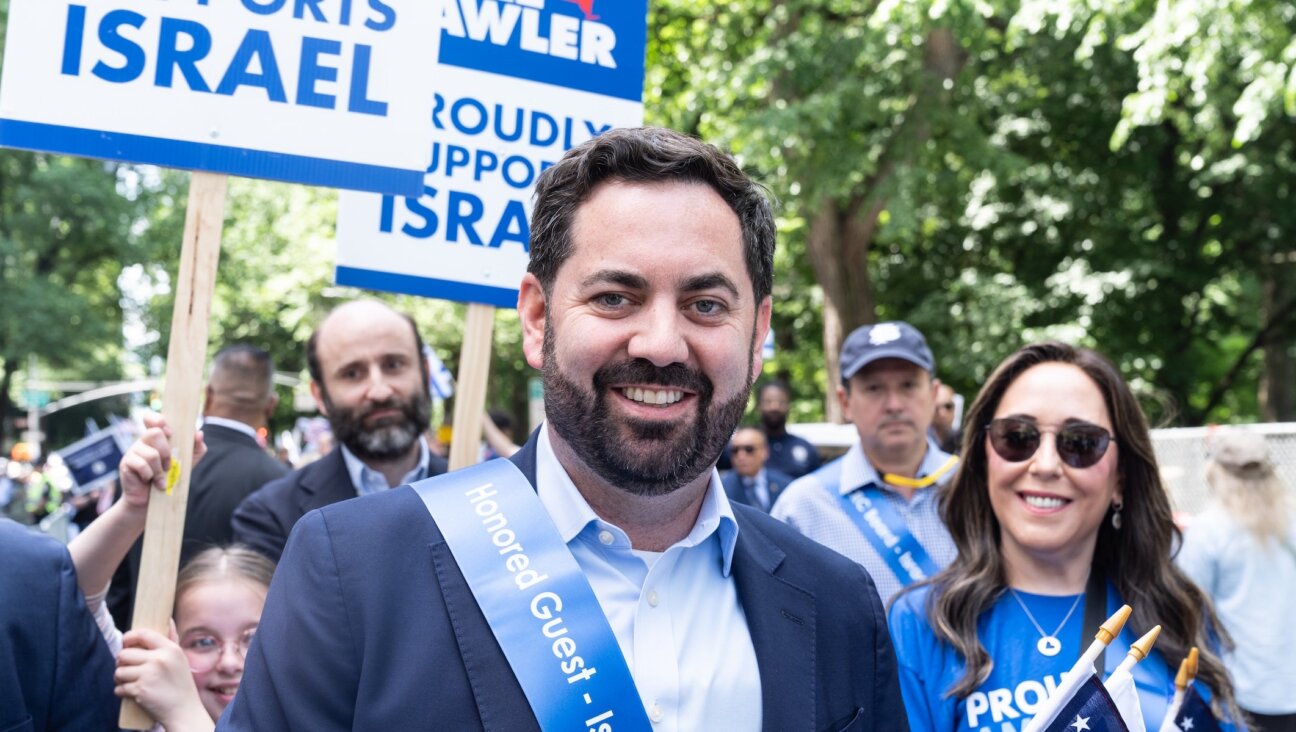
Sunday’s parade was a respite for members of the Jewish community who say they felt alienated in the wake of the coop vote Tuesday night. But it was also controversial due to New York City Mayor Zohran Mamdani’s decision not to attend — a mayoral first — and the surprise appearance of far-right Israeli Finance Minister Betzalel Smotrich.
But why purchase the popular Israeli snack in bulk, as opposed to encouraging local grocery stores to stock up on it and other Israeli items?
“There are a bunch of ideas on the table,” Hindy Poupko, senior vice president of the UJA-Federation told JTA. “We wanted to do something in the immediate aftermath of the boycott to demonstrate solidarity with the anti-boycott members of the coop, and all the work that they put into it. We wanted to immediately demonstrate to our community that we are able to respond quickly when these things happen, and also demonstrate that we will always be on the side of coops working together — not engaging in boycotts.”
One option UJA is floating, Poupko said, is an Israeli fair at a number of Jewish community centers where visitors can purchase Israeli goods.
Some advocates have even begun taking legal action against the coop, hoping to see the items restored to the shelves.
A group of pro-Israel activists filed a cease and desist motion in response to the boycott, alleging that the boycott itself is illegal and discriminatory.
CUNY law professor Jeffrey Lax announced in a post on X Wednesday that he had filed a New York State Division of Human Rights complaint on behalf of his Jewish advocacy group alleging that the boycott violates a state law that prevents the boycott or blacklist of products based on protected classes, including national origin.
“Instead of bringing neighbors together, this community institution chose to alienate many of its longtime Jewish members and their allies by banning a handful of Israeli products,” the ADL of New York/New Jersey said in a Thursday statement on X. “This move does nothing to advance peace in the Middle East; instead, the heinous rhetoric about Israel and Jews invoked in the process to ban these products contributes to the intense climate of antisemitism in NYC.”
The coop itself has not responded to JTA’s requests for comment. Activists aligned with the boycott, which passed with a 67% majority, referred JTA back to a press release distributed immediately following the vote last week.
“Tonight’s win is proof that cooperative movements are powerful models for exercising solidarity and participatory democracy,” coop board candidate Taylor Pate said in the May 26 statement.
In addition to Bamba, a variety of bell pepper sold only in the winter, persimmons, olive oil, sesame products, and Dorot frozen herb cubes are affected by the Park Slope Food Coop boycott. Two of the brands, Al Arz Tahini and Equal Exchange olive oil, are made at least in part by Arab-Israelis.
Asked for comment in regards to the coop vote results, Jewish Community Relations Council CEO Mark Treyger, through a spokesperson, referred JTA to a May 9 sermon by Congregation Beth Elohim senior Rabbi Rachel Timoner, in which she called it “the hyper local example of a proxy war.”
“If the boycott was designed to change Israel’s policies or to create a Palestinian state, or if it had the goal of safety, freedom, and equality for both Israelis and Palestinians, many of us would support it,” Timoner added. “But the BDS movement is not that.”
Timoner clarified her stance on the boycott at the coop in a sermon days after the vote.
“I do think that there is a lot of antisemitism threaded through the entire conversation about Israel,” Timoner said in the May 29 sermon. “But the vast majority of people who voted for that boycott were simply trying to say that what is happening to the Palestinians is wrong.”
A representative for Nestlé, the parent company of Osem, which manufactures Bamba, did not respond to a request for comment about the boycott.
The boycott means Brooklynites will have one fewer place to buy Bamba, the now ubiquitous snack that has been sold at Trader Joe’s for the last decade and is credited with reducing the prevalence of peanut allergies in Israel.
There’s at least one other place in New York City where Bamba was once available and no longer is. In March 2021, at the opening of baseball season, Bamba and the New York Mets announced a partnership in which the snack would be sold at the stadium in the main snack kiosks. The following year, the baseball team and the snack launched a sweepstakes for children to win free tickets to a game.
Since a March 2023 announcement that the brands would partner again for the season, Bamba has not publicly commented on their partnership. The Mets did not respond to a request for comment.
This article originally appeared on JTA.org.

Did you know that only 2% of Forward readers donate to support our nonprofit newsroom? That 2% make it possible for millions to read the Forward without a paywall or subscription — removing any barriers to the full and fair Jewish story.
But while the Forward is free to read, it isn’t free to produce. Big stories — like deep dives into the antisemitism data, political scoops or reporting trips to college campuses — take months of research and fact-checking. All while we keep you informed of what you need to know each day.
— Rachel Fishman Feddersen, Forward Publisher & CEO
Support our mission to tell the Jewish story fully and fairly.