Israel Slams Iran for Nuclear ‘Stall’ Tactics
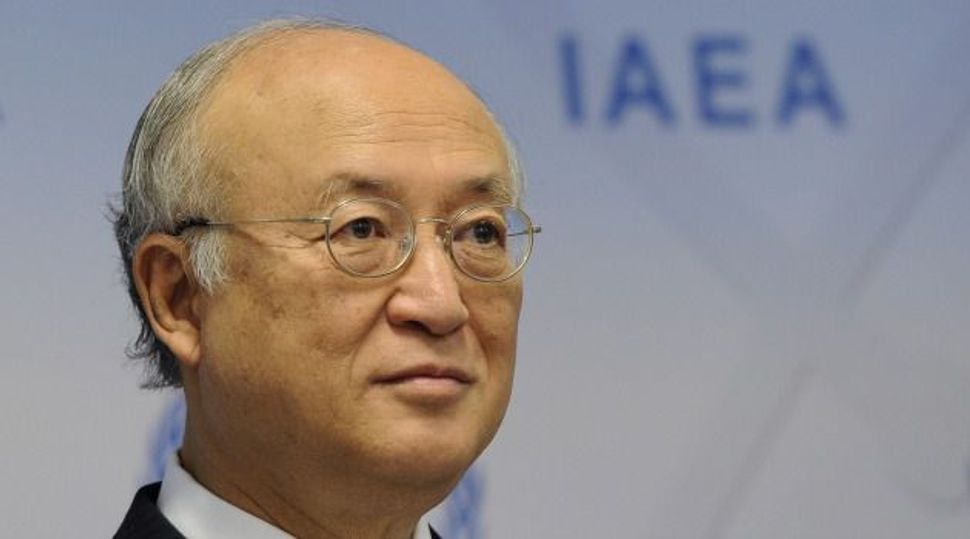
Open Up Iran: International Atomic Energy Agency Director General Yukiya Amano discusses Iran’s nuclear program. Image by getty images
Israel has condemned as unacceptably slow Iran’s cooperation with a U.N. watchdog inquiry into suspected atomic bomb research and accused Tehran of providing “false” explanations for its disputed activities.
At a weekly board meeting of the International Atomic Energy Agency, IAEA Director General Yukiya Amano said Iran had finally begun to engage with an investigation into allegations that it has worked on designing a nuclear warhead.
Western envoys to the IAEA cautiously welcomed the development, calling for Tehran to pick up the pace of its cooperation, but Israel’s ambassador suggested Iran was just trying to buy time while pressing on with its nuclear work.
Widely believed to be the Middle East’s only nuclear-armed power, Israel sees Iran’s atomic program as a direct threat and has in the past warned it could carry out unilateral strikes on Iran’s nuclear sites.
Iran, which rejects accusations that it has been trying to develop a nuclear bomb capability, says it is Israel’s presumed arsenal that endangers regional peace and security.
“Iran continues to abuse what is termed as a ‘step-by-step’ approach to the resolution of outstanding issues,” Israeli Ambassador Merav Zafary-Odiz said, referring to a phased cooperation pact agreed in November between Iran and the IAEA.
“This pace of investigation is unacceptable … Iran will continue to provide false explanations and to hide the true nature of its activities,” she said, without giving details.
Because of a Jewish holiday, Zafary-Odiz did not deliver her statement during Wednesday’s IAEA board debate on Iran, but it was posted later on the U.N. agency’s web site.
WEST WARY
Israel is also deeply skeptical of U.S.-led efforts to reach a final international accord to scale back a nuclear program which Iran says is peaceful but the West fears may be a covert bid to develop the means and expertise to build nuclear weapons.
U.S. officials say it is vital for Iran to resolve the IAEA’s concerns if the parallel negotiations between Tehran and the United States, France, Germany, Britain, China and Russia on the long-term agreement to settle the dispute are to succeed.
Those talks aim to set verifiable, civilian limits to Iran’s nuclear program and end punitive international sanctions imposed on Tehran.
Israeli Prime Minister Benjamin Netanyahu has complained that sanctions on the Islamic Republic are being eased prematurely.
The IAEA’s inquiry focuses specifically on what it calls the possible military dimensions of Iran’s atomic activities, notably whether it has carried out research and tests relevant for nuclear weapons.
Iran says the allegations of a nuclear weapon agenda are baseless but has offered to address them since pragmatist Hassan Rouhani took office as Iranian president last year, partly on a platform to end the Islamic state’s international isolation.
Last month, Iran gave the U.N. watchdog some information requested in the inquiry as to its purpose in developing Exploding Bridge Wire (EBW) detonators, which can be used to set off an atomic explosive device. Iran has said it needed them for civilian purposes.
In a meeting in Tehran on May 20, Iran also agreed to address two other areas of the investigation by Aug. 25.
Western governments regard Iran’s increased readiness to cooperate as positive but are likely to remain skeptical until it has cleared up all allegations of illicit atomic work.
“It is essential that Iran delivers substantive progress in the near future,” the 28-nation European Union said in a statement to the IAEA’s quarterly board of governors meeting.
This is a moment of great uncertainty. Here’s what you can do about it.
We hope you appreciated this article. Before you go, we’d like to ask you to please support the Forward’s independent Jewish news this Passover. All donations are being matched by the Forward Board - up to $100,000.
This is a moment of great uncertainty for the news media, for the Jewish people, and for our sacred democracy. It is a time of confusion and declining trust in public institutions. An era in which we need humans to report facts, conduct investigations that hold power to account, tell stories that matter and share honest discourse on all that divides us.
With no paywall or subscriptions, the Forward is entirely supported by readers like you. Every dollar you give this Passover is invested in the future of the Forward — and telling the American Jewish story fully and fairly.
The Forward doesn’t rely on funding from institutions like governments or your local Jewish federation. There are thousands of readers like you who give us $18 or $36 or $100 each month or year.
Support our mission to tell the Jewish story fully and fairly.