Benjamin Netanyahu Opposes Palestinian State, Cabinet Ally Concedes
Graphic by Angelie Zaslavsky
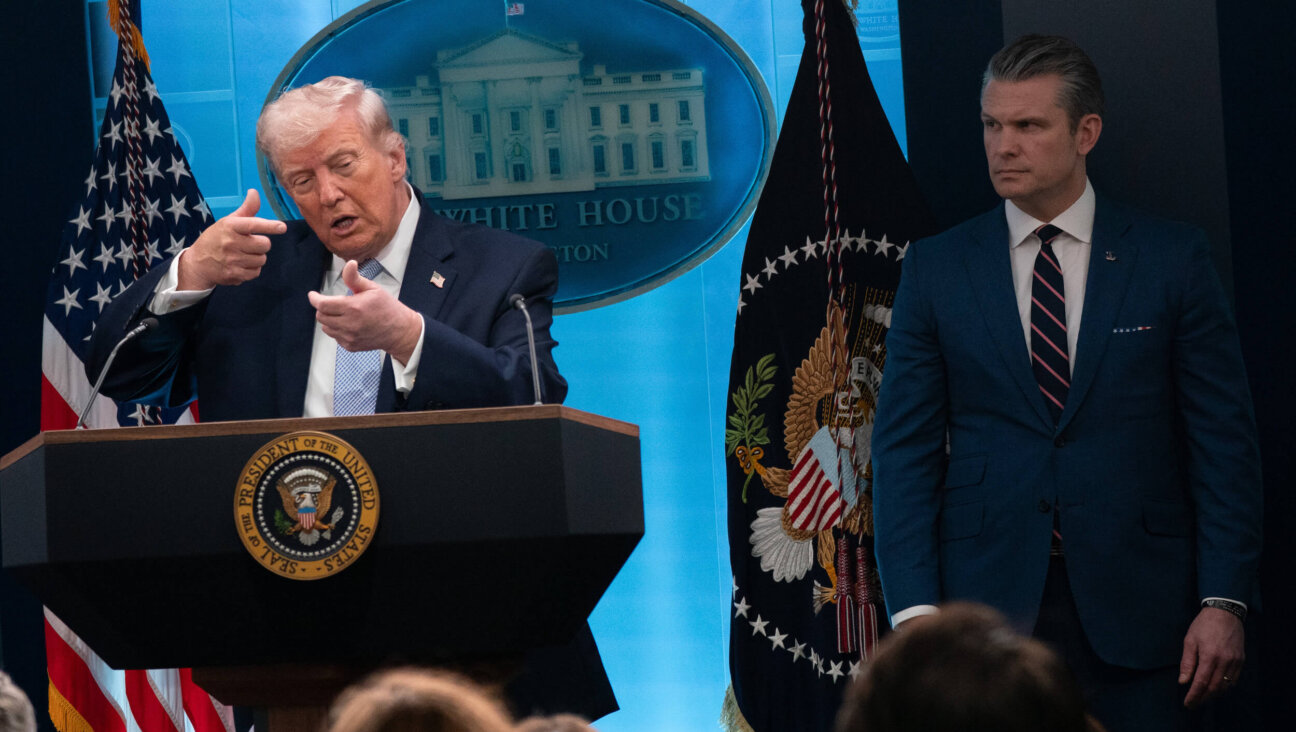
Benjamin Netanyahu opposes a Palestinian state, a senior Israeli cabinet member said on Monday, but left it unclear whether the prime minister would say that publicly in talks with U.S. President Donald Trump in Washington this week.
Netanyahu has never explicitly abandoned his conditional support for a future Palestine, and his spokesman did not respond immediately to a request to comment on Public Security Minister Gilad Erdan’s remarks.
Erdan belongs to Netanyahu’s right-wing Likud party, whose leading members have often espoused a harder line than the prime minister himself.
“I think all members of the security cabinet, and foremost the prime minister, oppose a Palestinian state,” Erdan told Army Radio after the forum met on Sunday on the eve of Netanyahu’s departure for Washington for talks with Trump on Wednesday.
“No one thinks in the next few years that a Palestinian state is something that, God forbid, might or should happen,” he said in the interview.
But asked if Netanyahu would voice opposition to statehood on camera when he meets Trump, Erdan said: “The prime minister has to weigh things according to what he feels in the meeting and the positions he encounters there. No one knows what the positions of the president and his staff are.”
Palestinians seek to establish a state in the occupied West Bank and the Gaza Strip with East Jerusalem as its capital. Israel captured those areas in a 1967 war and pulled its troops and settlers out of Gaza in 2005.
NUANCED
Citing Israeli settlement activity, Palestinian leaders and the former U.S. administration of Barack Obama have questioned Netanyahu’s commitment, which he first made in a 2009 policy speech, to the so-called two-state solution to decades of conflict.
“It is not only their statements – what the government of the extreme right in Israel does on the ground prevents any chance of the establishment of a Palestinian state,” Wasel Abu Youssef, an official of the Palestine Liberation Organization, said of Erdan’s comments.
Since Trump took office last month, Netanyahu has approved construction of 6,000 settler homes in the West Bank and East Jerusalem, drawing international condemnation which the White House did not join.
In recent days, however, the Trump administration has taken a more nuanced position, saying building new settlements or expanding existing ones may not be helpful in achieving peace.
Netanyahu has spelled out terms for a future Palestine: its demilitarization, the stationing of Israeli troops in its territory and Palestinian recognition of Israel as the “nation-state” of the Jewish people.
Last month, Israel’s Haaretz newspaper said Netanyahu, in a closed-door meeting with Likud ministers, coined a new term “Palestinian state-minus” to describe his vision of limited Palestinian sovereignty.
Under interim peace deals, Palestinians, who number about 2.5 million in the West Bank, currently exercise limited self-rule in the territory, where some 350,000 Israeli settlers live.
Some members of Netanyahu’s government have called for the annexation of parts of the West Bank, a demand he has resisted.—Reuters
This is a moment of great uncertainty. Here’s what you can do about it.
We hope you appreciated this article. Before you go, we’d like to ask you to please support the Forward’s independent Jewish news this Passover. All donations are being matched by the Forward Board - up to $100,000.
This is a moment of great uncertainty for the news media, for the Jewish people, and for our sacred democracy. It is a time of confusion and declining trust in public institutions. An era in which we need humans to report facts, conduct investigations that hold power to account, tell stories that matter and share honest discourse on all that divides us.
With no paywall or subscriptions, the Forward is entirely supported by readers like you. Every dollar you give this Passover is invested in the future of the Forward — and telling the American Jewish story fully and fairly.
The Forward doesn’t rely on funding from institutions like governments or your local Jewish federation. There are thousands of readers like you who give us $18 or $36 or $100 each month or year.

Support our mission to tell the Jewish story fully and fairly.