Why Does Jewish Kids’ Favorite Holiday Get Violent In Israel?
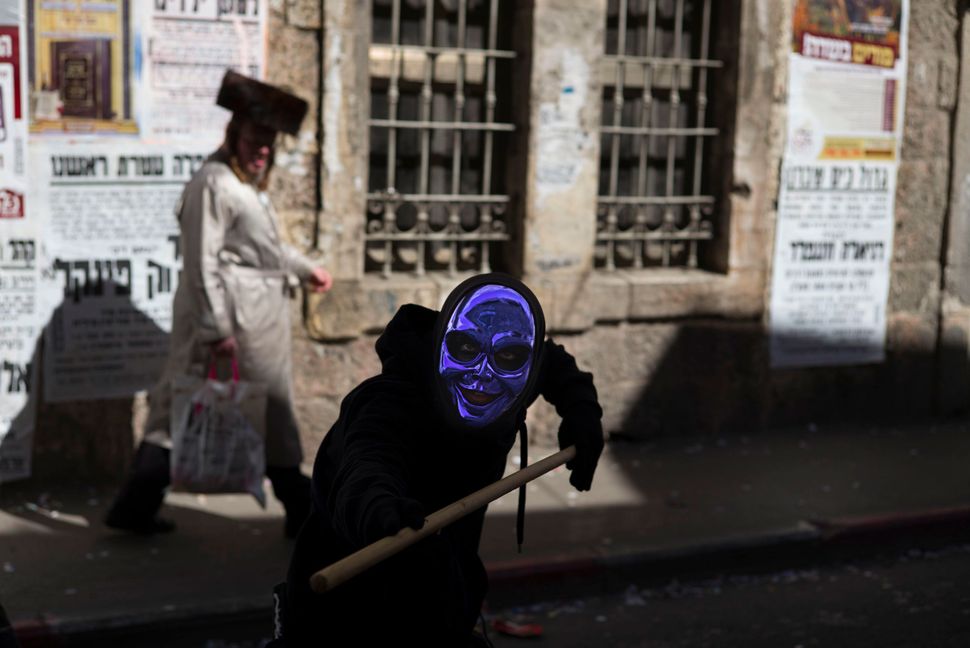
Image by Getty Images

By Naomi Zeveloff March 9, 2017
Purim is the Israeli Halloween. Pop-up costume shops appear in the weeks ahead, children dress up for school and hamantaschen are as ubiquitous as mini Snickers bars.
But there’s a darker side to the holiday, too. The Purim story is a tale of revenge. After Esther and Mordechai foil Haman’s plot to kill the Jews, they exact a painful revenge on their Persian enemies.
On Purim, some extremist Jews take the story literally, linking the ancient Amalekites, the anti-Semitic tribe to which Haman belonged, to modern-day Palestinians.
Over the years, there have been reports of violent attacks against Arabs on Purim perpetrated by Jews, and attacks on Jews by Palestinians. The most notorious event was in 1994, when Baruch Goldstein massacred 29 Palestinians in the Cave of the Patriarchs in Hebron.
For this year’s Purim, some Israeli kids are dressing as Elor Azaria, the Israeli soldier who killed a prone Palestinian suspect. Many Israelis view him as a hero, wrongfully punished for protecting the nation.
But Israeli President Reuven Rivlin sang a Purim song at an event this week to honor Jehan Jaber, an Arab Hebrew teacher in Taibe.
Contact Naomi Zeveloff at [email protected]
This is a moment of great uncertainty. Here’s what you can do about it.
We hope you appreciated this article. Before you go, we’d like to ask you to please support the Forward’s independent Jewish news this Passover. All donations are being matched by the Forward Board - up to $100,000.
This is a moment of great uncertainty for the news media, for the Jewish people, and for our sacred democracy. It is a time of confusion and declining trust in public institutions. An era in which we need humans to report facts, conduct investigations that hold power to account, tell stories that matter and share honest discourse on all that divides us.
With no paywall or subscriptions, the Forward is entirely supported by readers like you. Every dollar you give this Passover is invested in the future of the Forward — and telling the American Jewish story fully and fairly.
The Forward doesn’t rely on funding from institutions like governments or your local Jewish federation. There are thousands of readers like you who give us $18 or $36 or $100 each month or year.
Support our mission to tell the Jewish story fully and fairly.