German scholars make their best-selling annotated version of Hitler’s ‘Mein Kampf’ available online for free
The internet is rife with versions of the text “from very dubious sources,” said the head of the Institute of Contemporary History
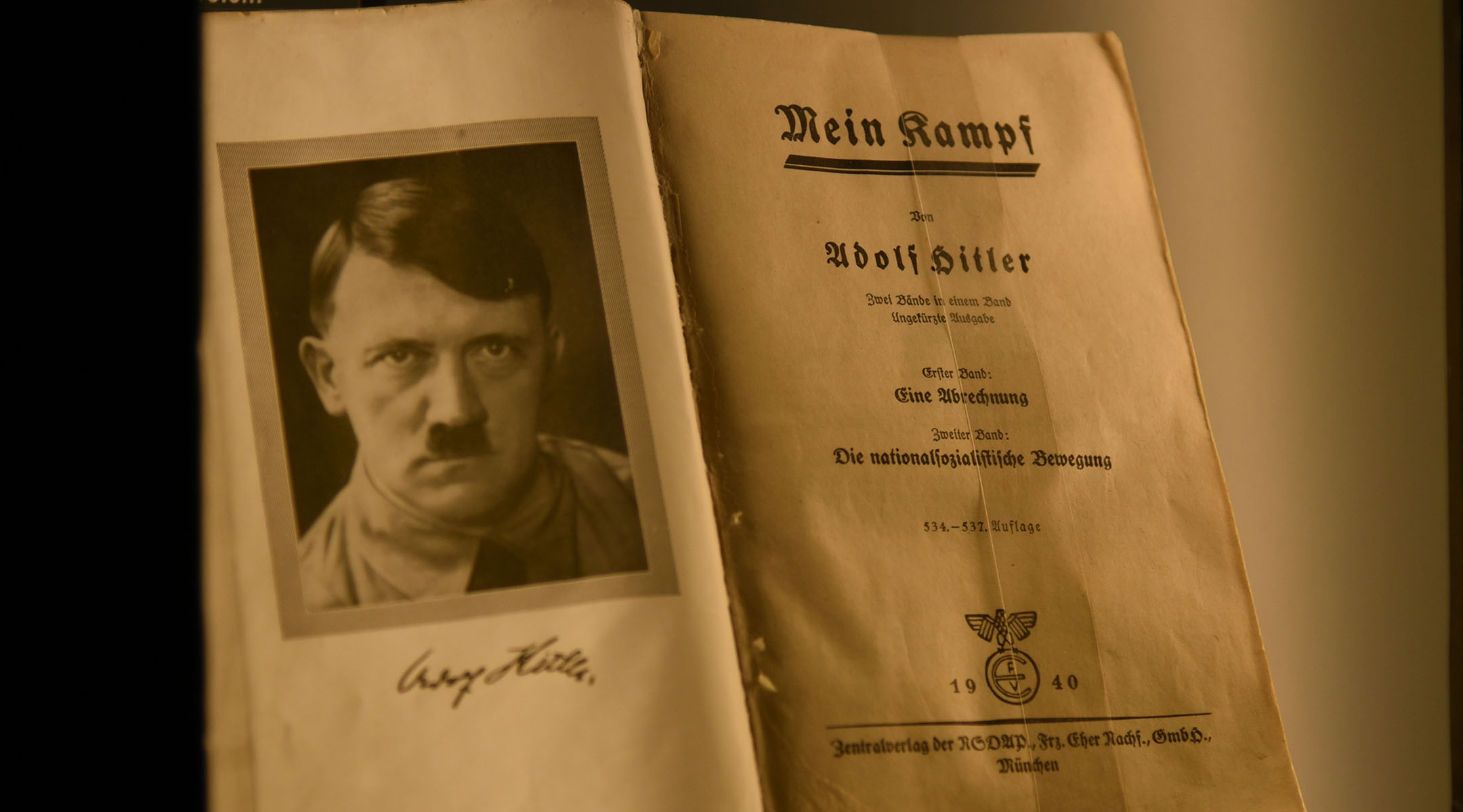
An annotated version of “Mein Kampf” is available online. (Wassilios Aswestopoulos/NurPhoto via Getty Images)
BERLIN (JTA) — The German research institute that published an annotated scholarly version of “Mein Kampf,” which sold tens of thousands of copies and drew criticism from Jewish leaders on its release in 2016, has put a free and searchable version of Adolf Hitler’s notorious screed online.
In a news release on Thursday, the director of the Munich-based Institute of Contemporary History (IfZ), Andreas Wirsching, said he wanted to fight fire with fire: since the internet is rife with versions of the text “from very dubious sources,” his institute’s “serious, scientifically sound” text would “provide political-historical education in the best sense of the word.”
The intention is to facilitate “scholarly research into the history of Hitler, the German nationalist movement and National Socialism,” Wirsching said. The edition now online includes explications of every chapter and of historical terms, providing context throughout.
Hitler wrote the book, a rant against Jews and communists, while in prison in 1923 following his attempted coup in Munich. After he came to power in 1933, many editions came out, including one given free to newlywed couples and another to mark Hitler’s 50th birthday in 1939.
After World War II, the Bavarian Finance Ministry inherited the copyright and barred publication in Germany until the copyright expired, in an effort to limit the spread of Hitler’s ideology. But it was published elsewhere, and is reportedly one of the most purchased books in the world. Contemporary neo-Nazis and others still cite “Mein Kampf” as inspiration.
The copyright expired in 2016, and the IfZ’s version sold out on its first day of release, going on to become one of the best-selling books in Germany that year. Amazon removed all versions of the book from its site in 2020.
Jewish leaders in Germany and beyond were split on the Institute’s project and whether it should be taught in schools or “left in the poison cabinet of history,” as World Jewish Congress President Ronald Lauder argued. Germany’s Central Council of Jews said that it would “demystify” the text, while former Central Council head and Holocaust survivor Charlotte Knobloch said it “does not belong in the classroom.”
This article originally appeared on JTA.org.
This is a moment of great uncertainty. Here’s what you can do about it.
We hope you appreciated this article. Before you go, we’d like to ask you to please support the Forward’s independent Jewish news. All donations are still being matched by the Forward Board - up to $100,000 until April 24.
This is a moment of great uncertainty for the news media, for the Jewish people, and for our sacred democracy. It is a time of confusion and declining trust in public institutions. An era in which we need humans to report facts, conduct investigations that hold power to account, tell stories that matter and share honest discourse on all that divides us.
With no paywall or subscriptions, the Forward is entirely supported by readers like you. Every dollar you give is invested in the future of the Forward — and telling the American Jewish story fully and fairly.
The Forward doesn’t rely on funding from institutions like governments or your local Jewish federation. There are thousands of readers like you who give us $18 or $36 or $100 each month or year.

Support our mission to tell the Jewish story fully and fairly.